Transition Networks SGPAT10xx-x05 PoE+ Converter User Guide
33719 Rev. C https://www.transition.com Page 18 of 49
3. Product Features
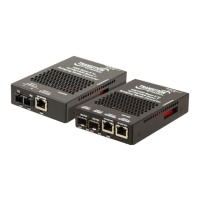
The 3-Port model (SGPAT1040-205) provides redundancy / revertive mode operation.
The 4-Port model (SGPAT1040-305) acts like two different converters: a) 4-port switch mode, or b) acts like two
media converters in one device.
Applications include a) SGPAT Connected to IP Camera (PD); b) SGPAT Connected to PoE Splitter; and c) Link Pass
Through.
Auto-Negotiation
The Auto-Negotiation feature allows the SGPAT10xx to automatically configure itself to achieve the best
possible mode of operation over a link. The media converter broadcasts its speed (100 Mb/s, or 1000 Mb/s) and
duplex capabilities (full or half) to the other devices and negotiates the best mode of operation. Auto-
Negotiation allows quick and easy installation because the optimal link is established automatically. No user
intervention is required to determine the best mode of operation.
A scenario where the media converter is linked to a non-negotiating device is a case where you may want to
disable Auto-Negotiation. In this instance, the mode of operation will drop to the lowest common denominator
between the two devices (e.g. 100 Mb/s, half-duplex). Disabling this feature lets you to force the connection to
the best mode of operation.
Note: The SGPAT10xx-13x supports 1000 Mbps fiber Auto-Negotiation.
Full-Duplex Network
In a full-duplex network, maximum cable lengths are determined by the type of cables that are used.
See the cable specifications for the different SGPAT models. The 512-Bit Rule does not apply in a full-duplex
network.
Half-Duplex Network (512-Bit Rule)
In a half-duplex network, the maximum cable lengths are determined by the round trip delay limitations of each
Fast Ethernet collision domain. (A collision domain is the longest path between any two terminal devices, e.g. a
terminal, switch, or router.) The 512-Bit Rule determines the maximum length of cable permitted by calculating
the round-trip delay in bit-times (BT) of a particular collision domain. If the result is less than or equal to 512 BT,
the path is good. For more information on the 512-Bit Rule, see the white paper titled “Collision Domains” on
the Transition Networks website at: https://www.transition.com.
AutoCross™
The AutoCross feature allows either straight-through (MDI) or crossover (MDI-X) cables to be used when
connecting to devices such as hubs, transceivers, or network interface cards (NICs). AutoCross determines the
characteristics of the cable connection and automatically configures the unit to link up, regardless of the cable
configuration.
Automatic Link Restoration
The SGPAT will automatically restore the link between networked devices after a fault condition has been
corrected. In contrast, products from competitors generally require the user to power down, then power up the
converters after a fault condition has been corrected.


 To Next Page
 Loading...