Transition Networks SGPAT10xx-x05 PoE+ Converter User Guide
33719 Rev. C https://www.transition.com Page 22 of 49
On the 3-port SGPAT1040-205, Redundancy must be disabled for Port Isolation to work. Port isolation can only
be enabled via the CLI; see section 4. CLI Commands on page 29. Traffic ingress on Port 1 will pass data on Port 2
or Port 3. Port 1 will pass data on Port 2 and Port 3, but data cannot be passed between Ports 2 and 3. Port
Isolation on 3-port converters is as shown below.
Port Traffic Forwarded To Port(s)
4-Port Model (SGPAT1040-305)
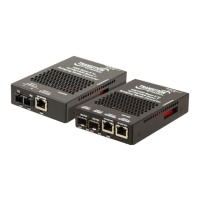
The 4-port model (SGPAT1040-305) can be configured as a 4-port switch, as a 3-port switch with Redundant
fiber, or as two independent PoE+ media converters (Dual Converter mode).
4-Port Switch Mode
In 4-Port Switch mode, the SGPAT1040-305 functions as a 4-port switch with two copper RJ45 ports and two
fiber ports.
4-Port Redundant Fiber Mode
With Redundant Fiber mode enabled, the SGPAT1040-305 Redundant mode can be set to:
Enabled-Revertive, without Port Isolation
Enabled-Revertive, with Port Isolation
Enabled-non-Revertive, without Port Isolation
Enabled-non-Revertive, with Port Isolation
When Redundant Mode is enabled:
The links for all 4 ports can come up. Both TP ports are always active, but only one of the two SFP ports
can be active at any given time. Port 3 is the Primary SFP port, and Port 4 is the Secondary SFP port.
Upon power-up, if Port 3’s link is up, data will be directed to Port 3 and restricted from Port 4. If Port 3's
link goes down, data will be directed from Port 3 to Port 4 with a sub-50ms failover time. At this point, if
Port 3's failed link is restored:
o With Revertive mode enabled, Port 3 will become active again, causing a sub-50ms failover
period for the switchover from Port 4 to Port 3.
o With Revertive mode disabled, Port 4 will remain active until its link goes down, at which point
the switch will failover to Port 3 with a sub-50ms failover.
If Port Isolation is enabled, Ports 1 and 2 will be isolated from each other, but individually able to
communicate with the Active SFP port. Port Isolation can only be enabled via the Command Line
Interface (CLI); see page 29 for CLI information.
You can tell whether Port 3 or Port 4 is active by looking at the Activity LEDs (flashing indicates data
transfer, and that only occurs on the Active port).


 To Next Page
 Loading...