-3-
router. Ensure there are no obstacles
beneath workpiece when cutting full
thickness, and that a sacrificial work
surface is used.
10.Hold power tool by insulated gripping
surfaces, because the cutter may
contact its own cord. Cutting the “live”
wire may make exposed metal parts
of the powertool “live” and shock the
operator.
11.Use clamps or another practical way
to secure and support the workpiece
to a stable platform. Holding the work
by your hand or against the body
leaves it unstable and may lead to loss
of control.
Router Cutter Safety
1. Cutting tools are sharp. Care should
be taken when handling them. Do not
drop cutters or knock them against
hard objects. Handle very small diam-
eter cutters with extra care. Always
return cutter to its packaging after use.
2. Always use cutters with a shank
diameter corresponding to the size of
the collet installed in your tool.
3. The maximum speed (n.max) marked
on the tool, or in instructions or on
packaging shall not be exceeded.
Where stated the speed range shall
be adhered to. Recommended speeds
are shown in the Trend Routing Cata-
logue and/or website.
4. Always use router cutters in a router.
Drill and boring bits must not be used
in a router. Router cutters must only
be used for the material cutting ap-
plication for which they are designed.
Do not use on metal or masonry.
5. Never use cutters with a diameter
exceeding the maximum diameter
indicated in the technical data of the
powertool or attachment used.
6. Before each use check that the cutting
tool is sharp and free from damage. Do
not use the cutting tool if it is dull, broken
or cracked or if in any other damage is
noticeable or suspected.
7. Cutters should be kept clean. Resin build
up should be removed at regular
intervals with Resin Cleaner. The use
of a PTFE dry lubricant will reduce
resin build up. Do not use PTFE spray
on plastic parts.
8. When using stacked tooling (multi-
blade, block and groover etc.) on a
spindle arbor, ensure that the cutting
edges are staggered to each other to
reduce the cutting impact.
9. Cutter shanks should be inserted into
the collet all the way to the line indi-
cated on the shank. This ensures that
at least
3
⁄
4
of the shank length is held
in the collet. Ensure clamping surfaces
are cleaned to remove dirt, grease, oil
and water.
10. Observe the correct assembly and
fitting instructions in the router instruc-
tion manual for fitting the collet, nut
and cutter.
11. Tool and tool bodies shall be clamped
in such a way that they will not
become loose during operation. Care
shall be taken when mounting cutting
tools to ensure that the clamping is by
the shank of the cutting tool and that
the cutting edges are not in contact
with each other or with the clamping
elements.
12. It is advisable to periodically check the
collet and collet nut. A damaged, worn
or distorted collet and nut can cause
vibration and shank damage. Do not
over-tighten the collet nut
13. Do not take deep cuts in one pass;
take several shallow or light passes
to reduce the side load applied to the
cutter and router. Too deep a cut in
one pass can stall the router.
14. In case of excessive vibrations whilst
using the router stop immediately and
have the eccentricity of the router,
router cutter and clamping system
checked by competent personnel
15. All fastening screws and nuts should
be tightened using the appropriate
spanner or key and to the torque value
provided by the manufacturer.
16. Extension of the spanner or tightening
using hammer blows shall not be
permitted.
17. Clamping screws shall be tightened
according to instructions provided by
the manufacture. Where instructions
are not provided, clamping screws
shall be tightened in sequence from
the centre outwards.
18. Do not touch the cutter immediately
after operation; it may be extremely
hot and could burn your skin.
Using Routers In A Fixed Position
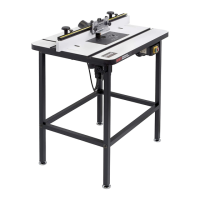
1. Attention should be made to the
HSE’s Safe Use of Vertical Spindle
Moulding Machines Information Sheet
No.18 and any revisions.
2. After work, release the router plunge
to protect the cutter.
3. Always use a push-stick or push-
block when making any cut less than
300mm in length or when feeding the
last 300mm of the cut.
4. The opening around the cutter should
be reduced to a minimum using
suitably sized insert rings in the table
and closing the back fence cheeks or
fitting a false fence on the back fence.
5. Whenever possible use a work holding
device or jig to secure component be-
ing machined. Ensure any attachment
is securely fitted to the workbench,
with table surface at approximately hip
height.
6. Use a No-Volt Release Switch. Ensure
it is fixed securely, easily accessible
and used correctly.
7. In router table (inverted) mode, stand
to the front right of the table. The
cutter will rotate anti-clockwise when
viewed from top so the feed direction
is from the right (against the rotation of
the cutter). In overhead mode, stand to
the front left of the machine table and
the feed direction is from the left.
8. Do not reach underneath table or put
your hands or fingers at any time in the
cutting path while tool is connected to
a power supply.
9. Never thickness timber between the
back of the cutter and the backfence.
Useful Advice When Routing
1. Judge your feed rate by the sound of
the motor. Feed the router at a con-
stant feed rate. Too slow a feed rate
will result in burning.
2. Trial cuts should be made on waste
material before starting any project.
3. When using some attachments e.g. a
router table or dovetail jig, a fine height
adjuster is recommended.
4. When using a template guide bush,
ensure there is sufficient clearance
between cutter tip and inside edge
of bush and that it cannot come into
contact with collet and nut. Ensure
cutter and guide bush are concentric.
Router Cutter Repair/Maintenance
1. Repair of tools is only allowed in accor-
dance with the manufacturers instructions.
2. The design of composite (tipped) tools
shall not be changed in process of re-
pair. Composite tools shall be repaired
by a competent person i.e. a person
of training and experience, who has
knowledge of the design requirements
and understands the levels of safety to
be achieved.
3. Repair shall therefore include, e.g. the
use of spare parts which are in accord-
ance with the specification of the origi-
nal parts provided by the manufacturer.
4. Tolerances which ensure correct
clamping shall be maintained.
5. Care shall be taken that regrinding of
the cutting edge will not cause weak-
ening of the body and the connection
of the cutting edge to the body.
Version 8.0 08/2017


 To Next Page