© Copyright 2013 TRENDnet. All Rights Reserved.
TRENDnet User’s Guide
TEW-810DR
36
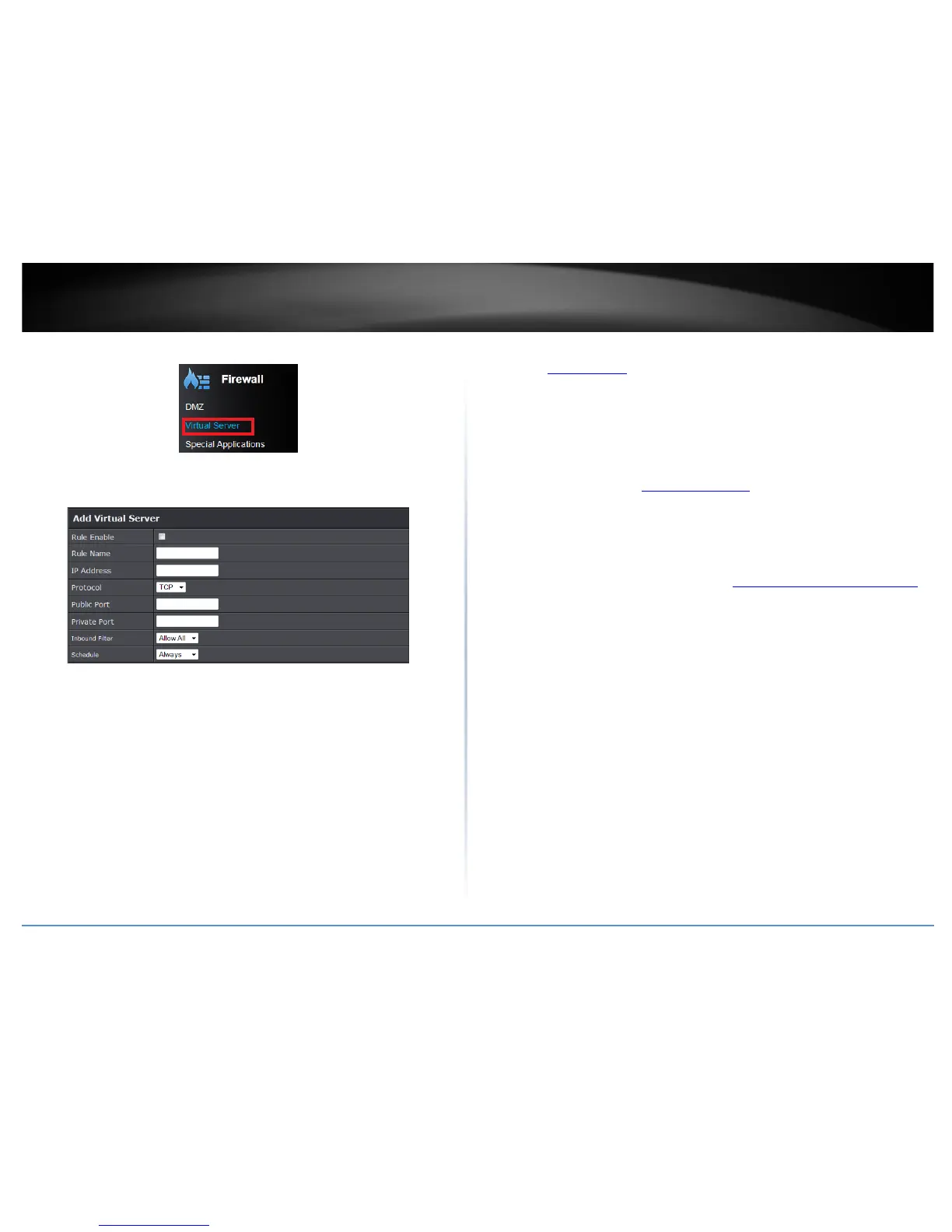
3. Click on the Firewall section and click on Virtual Server Rule.
4. Select Enable in the Virtual Server Function section. Review the virtual server settings.
Click Add to save settings.
• Rule Enable: Check to enable virtual server rule
• Rule Name: Enter the name you would like to assign to the virtual server rule.
• IP Address: Enter the IP address of the device to forward the port (e.g.
192.168.10.101).
• Protocol: Select the protocol required for your device. TCP or UDP.
Note: Please refer to the device documentation to determine which ports and
protocols are required. You should assign a static IP address to the device or use
DHCP reservation to ensure the IP address of the device does not change.
• Public/Private Public Port: Enter the port number used to access the device from
the Internet.
• Inbound Filter: Select the defined inbound filter you would like to apply or select
Allow All.
• Schedule: Select the defined schedule you would like to have the rule to be applied
(see “Create Schedule
” section on page 34).
Note: The Public Port can be assigned a different port number than the Private Port
(also known as port redirection), however it is recommended to use the same port
number for both settings. Please refer to the device documentation to determine
which ports and protocols are required.
Example: To forward TCP port 80 to your IP camera
1. Setup DynDNS service (see Identify Your Network
section page 41).
2. Access TRENDnet IP Camera management page and forward Port 80 (see product
documentation)
3. Make sure to configure your network/IP camera to use a static IP address.
Note: You may need to reference your camera documentation on configuring a
static IP address.
4. Log into your router management page (see “Access your router management page
”
on page 15).
5. Click on Advanced then Firewall, click on Virtual Server.
6. Click Enabled to turn on this virtual server.
7. Next to Rule Name, you can enter another name for the virtual server, otherwise,
leave the default name.
8. Next to IP Address, enter the IP address assigned to the camera. (e.g. 192.168.10.101)
9. Next to Protocol, make sure TCP is selected in the drop-down list.
10. The Private Port and Public Port, make sure port number 80 is configured for both
settings.
11. Select Allow All on Inbound Filter section.
12. Select Always for Schedule section.
13. To save the changes, click Add.
Special Applications
Advanced > Firewall > Special Applications
Special applications (also called port triggering) is typically used for online gaming
applications or communication applications that require a range of ports or several
ports to be dynamically opened on request to a device on your network. The router will
wait for a request on a specific port or range of ports (or trigger port/port range) from a
device on your network and once a request is detected by your router, the router will
forward a single port or multiple ports (or incoming port/port range) to the device on



 To Next Page