UHP SCPC MODEM
USER MANUAL, v3.2
© ROMANTIS 2015 28 www.uhp.net
5. POINTING TO SATELLITE
Before pointing an antenna system to a satellite follow the procedure below:
1. Choose the antenna installation place:
To install the antenna choose a flat horizontal surface or vertical surface perpendicular to the ground;
the size of the site depends on antenna dimensions;
Make sure there are no obstacles in the line of sight from the antenna in the direction of the satellite,
including the elevation and azimuth required for the satellite;
Make sure that the cable connecting the antenna and the satellite router is sufficient. (RG-6 cable can
be used for distances up to 75 m, RG-11 cable for distances up to 150 m);
Make sure that there are no damages along the whole cable.
2. The antenna must be assembled in accordance with the antenna system documentation. After it is
assembled make sure that:
The antenna is mounted on a solid surface that will ensure its stability under wind loads;
The base of the antenna is securely fixed to the surface;
If the antenna is fixed on a vertical surface make sure the fixture is reliable and the pole is fixed
strictly vertical.
3. Antenna pointing to the satellite.
Set the polarization angle in accordance with calculated values;
CAVEAT: METAL STRUCTURES NEAR THE INSTALLATION LOCATION MAY INFLUENCE COMPASS READINGS.
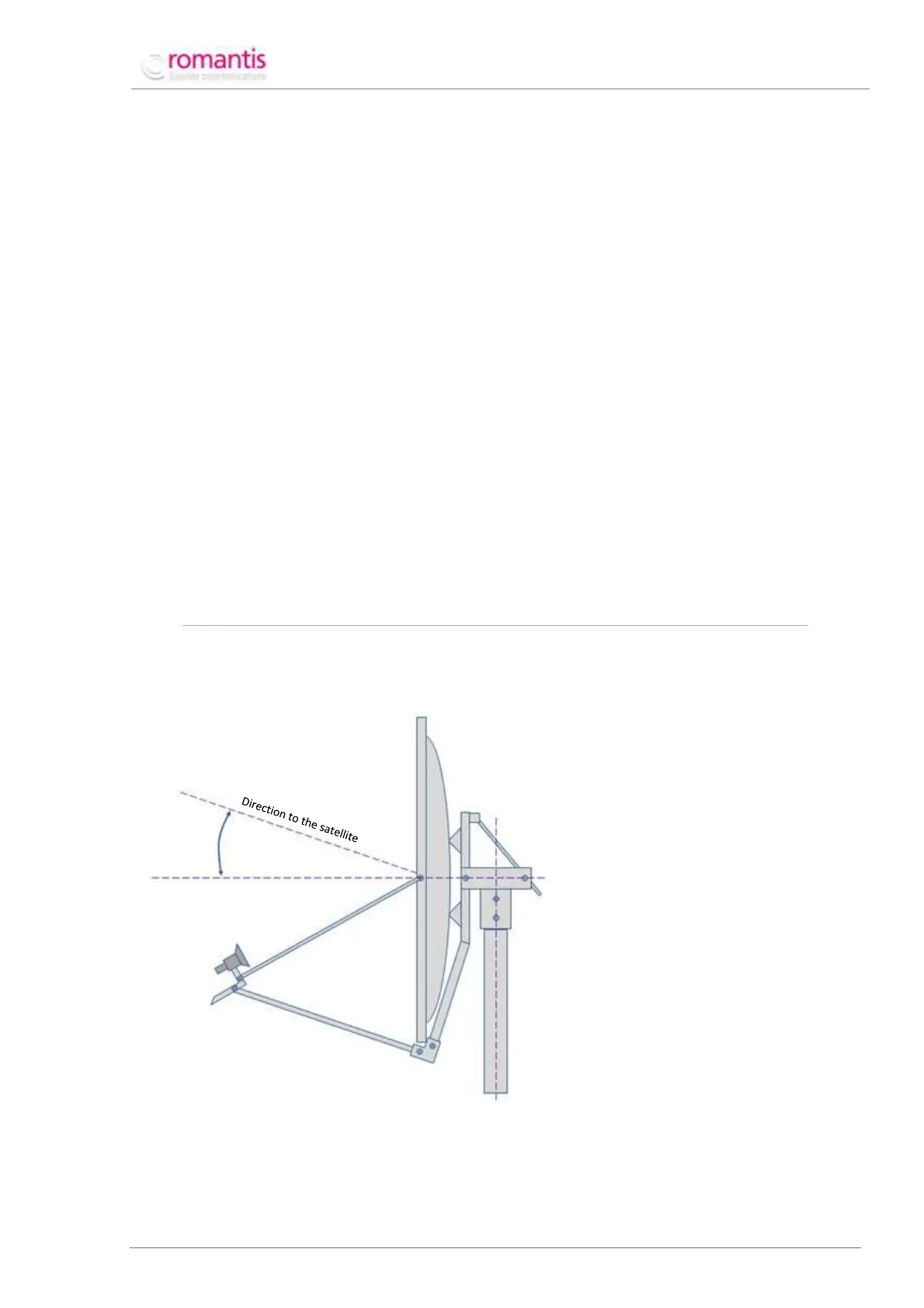
Set the tilt angle in accordance with the calculated values. It should be taken in mind that the offset
antenna mechanical axis direction does not coincide with the direction to the satellite. It should be
considered when setting the tilt angle (see Figure 30).
Figure 30 Pointing of parabolic offset antenna
For instance a typical 1.2 m antenna has the offset angle of 26.5
o
(to be indicated in the antenna
documentation). If the pointing angle to the satellite at a given location is 34.1
o
then the mechanical axis
angle to the satellite will be:
Mechanical axis direction



 To Next Page