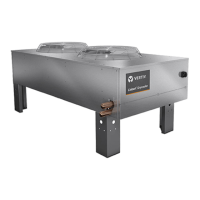
Calculate the internal volume of the system as closely as possible. The drycooler volumes are shown in 5.2 on the previous
page, and 5.2 on the previous page. Use Table 5.5 below, for field-installed piping volumes. Indoor unit volumes are found
in their respective user manuals.
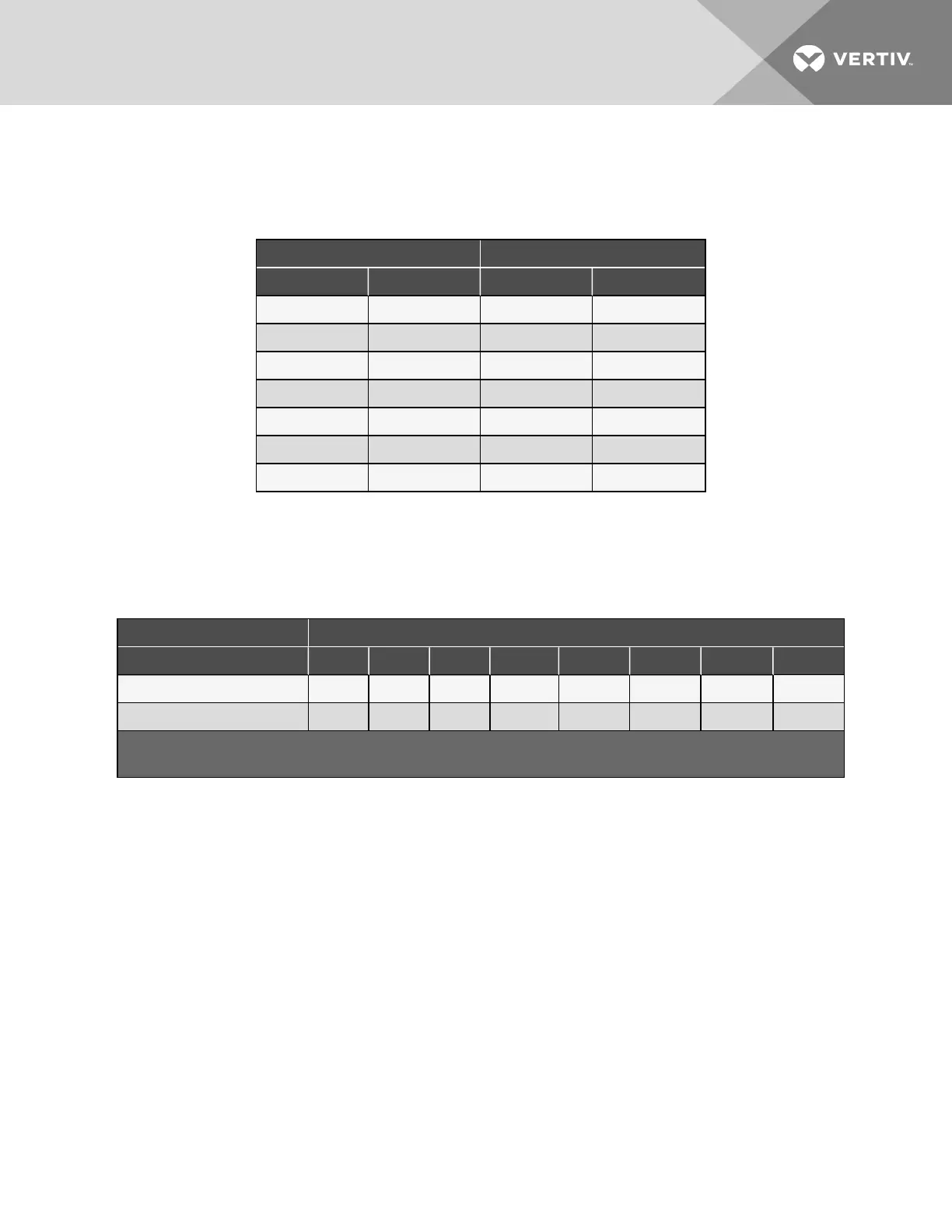
Diameter, in. Volume
Outside Inside gal/ft l/m
1-3/8 1.265 0.065 0.81
1-5/8 1.505 0.092 1.15
2-1/8 1.985 0.161 2.00
2-5/8 2.465 0.248 3.08
3-1/8 2.945 0.354 4.40
3-5/8 3.425 0.479 5.95
4-1/8 3.905 0.622 7.73
Table 5.5 Glycol volume in standard type "L" copper piping
When considering the use of any glycol products in a particular application, review the latest Material Safety Data Sheets
and ensure that the intended use can be accomplished safely. For Material Safety Data Sheets and other product safety
information, contact the supplier nearest you. Before handling any other products mentioned in the text, you should obtain
available product safety information and take necessary steps to ensure safety of use.
Minimum Outdoor Ambient Temperature, °F(°C)
Coolant 20 (–7) 10 (–12) 0 (–18) –10 (–23) –20 (–29) –30 (–34) –40 (–40) –50 (–46)
Propylene Glycol, % by volume 18* 29* 36 42 46 50 54 57
Ethylene Glycol, % by volume 17* 26* 35 41 46 50 55 59
Based on Dowfrost™ (PG) and Dowtherm™ (EG) product literature.
*Inhibitor levels should be adjusted to properly protect the system if solution concentrates are less than 30%.
Table 5.6 Glycol Concentrations for Freeze Protection by Ambient Temperature
There are two basic types of additives:
• Corrosion inhibitors
• Environmental stabilizers
The corrosion inhibitors function by forming a surface barrier that protects the metals from attack. Environmental stabilizers,
while not corrosion inhibitors in the strictest sense, decrease corrosion by stabilizing or favorably altering the overall
environment. An alkaline buffer, such as borax, is a simple example of an environmental stabilizer, because its prime
purpose is to maintain an alkaline condition (pH above 7).
The percentage of glycol to water must be determined by using the lowest design outdoor temperature in which the system
is operating. Table 5.6 above, indicates the solution volume of inhibited glycol required to provide freeze protection at
various ambient temperatures.
5 Piping
37



 To Next Page