VIDEONICS DIGITAL VIDEO MIXER PAGE 7
IN 1. The yellow highlight above preview A tells you A is currently the
active input.
• Press CUT→B. The B light will come on and the OUTPUT monitor will
show whatever is plugged into IN 2. B should be highlighted in yellow.
• If you have anything plugged into IN 3 or IN 4, the sources can be seen
by pressing CUT→C or CUT→D.
Borders and Solid Color Backgrounds
• Press CUT→COLOR. The word COLOR above the color sample will
highlight and the light above the button will come on. The OUTPUT
monitor will show a solid color screen.
To change the color, press BACK COLOR. Each time you press it, the
color will change in the background color sample (H) and at the
output. Continue to press the button until you see a color you like.
• You can also define a border to be used at the edge of most wipes.
Press BORDER COLOR and the color around the background color
sample (J) will show you the new choice.
• You can define your own colors as well. See Chapter 10, “Borders and
Backgrounds.”
Setting up a Transition
• Now, let’s switch from one video source to another using a transition
in between. We will go from A to B using a horizontally-moving curtain
wipe.
• Switch to A by pressing CUT→A.
• Pick the NEXT source (the one you want to see after the transition is
complete). In this case, we want to go to B, so press the B button at the
bottom of the control panel (not the CUT→B button).
ABCD
COLOR
A green highlight appears below preview image B and the light above
the CUT→B button flashes to tell you B is the NEXT source. Nothing
else happens on the screen because right now, you are only setting up
the transition.
• Next, choose the wipe effect by highlighting the appropriate symbol in
the effect palette. The fastest way to do this is to press WIPE. This
highlights the symbol for effect 30, the most common wipe, a horizon-
tally-moving wipe. In this case, however, we want a different wipe. Use
the down-arrow key to highlight transition effect number 40. The
screen should look like this (although the direction and speed indica-
tors may be different):
COLOR
CUT ➔
CD
CUT ➔ CUT ➔

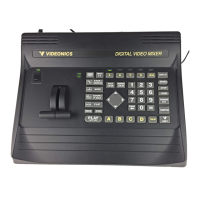

 To Next Page