PAGE 68 VIDEONICS DIGITAL VIDEO MIXER
Chapter 19 •Chapter 19 •
Editing and Other Applications
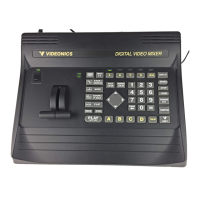
With its four inputs, frame synchronizer, time base corrector, and
audio capabilities, the MX-1 Digital Video Mixer is adept at mixing
multiple video sources in a wide variety of applications, including
both single- and dual-source editing.
The Video Mixer can mix video sources but it does not control them. This
chapter describes how to control your video sources so the correct material is
playing at the correct times. It starts with the simplest cases and progresses to
complex video editing setups that require the synchronization of as many as
four videotape players.
Chapter 4, “Connecting Editing Equipment,” explains how to connect
editing equipment such as titlers and video processors.The Digital Video
Primer contains additional information on editing.
Live Mixing
A simple application that does not depend on controlling sources at all is
live mixing, in which several cameras, or other sources, are fed through the
Mixer and displayed live or recorded as the event happens. The Mixer’s four
inputs make live productions particularly easy, as cameras and running
sources can be switched and transitioned at will.
Editing with Untimed Sources
Another application that does not require tight control of VCRs is the
combination of footage that is not time dependent or is only loosely timed.
For instance, you might wish to mix totally unrelated background footage,
such as computer-generated graphics or scenery footage from a laser disc.
Another example: You might be taping a performance or speech and
dissolve over to some audience footage from time to time. It wouldn’t matter
whether the audience shots were precisely synchronized with the perfor-
mance.
You might have untimed footage that amplifies what’s going on. An
example: In an industrial video, you have a manager explaining an inspec-
tion procedure. As the manager’s voice continues, you wipe to some footage
of the inspectors doing the procedure that is being described, then back to the
manager.


 To Next Page