Calculating the heat demand for DHW heating in commercial enterprises
1. Calculating the demand
Allow for a suitable number of washing facilities (washbasins/shower
cubicles) for the type of business concerned (see the earlier
DIN 18228, sheet 3, page 4).
Per 100 users (numbers in the most numerous shift), the washing
facilities listed in table 7 are required.
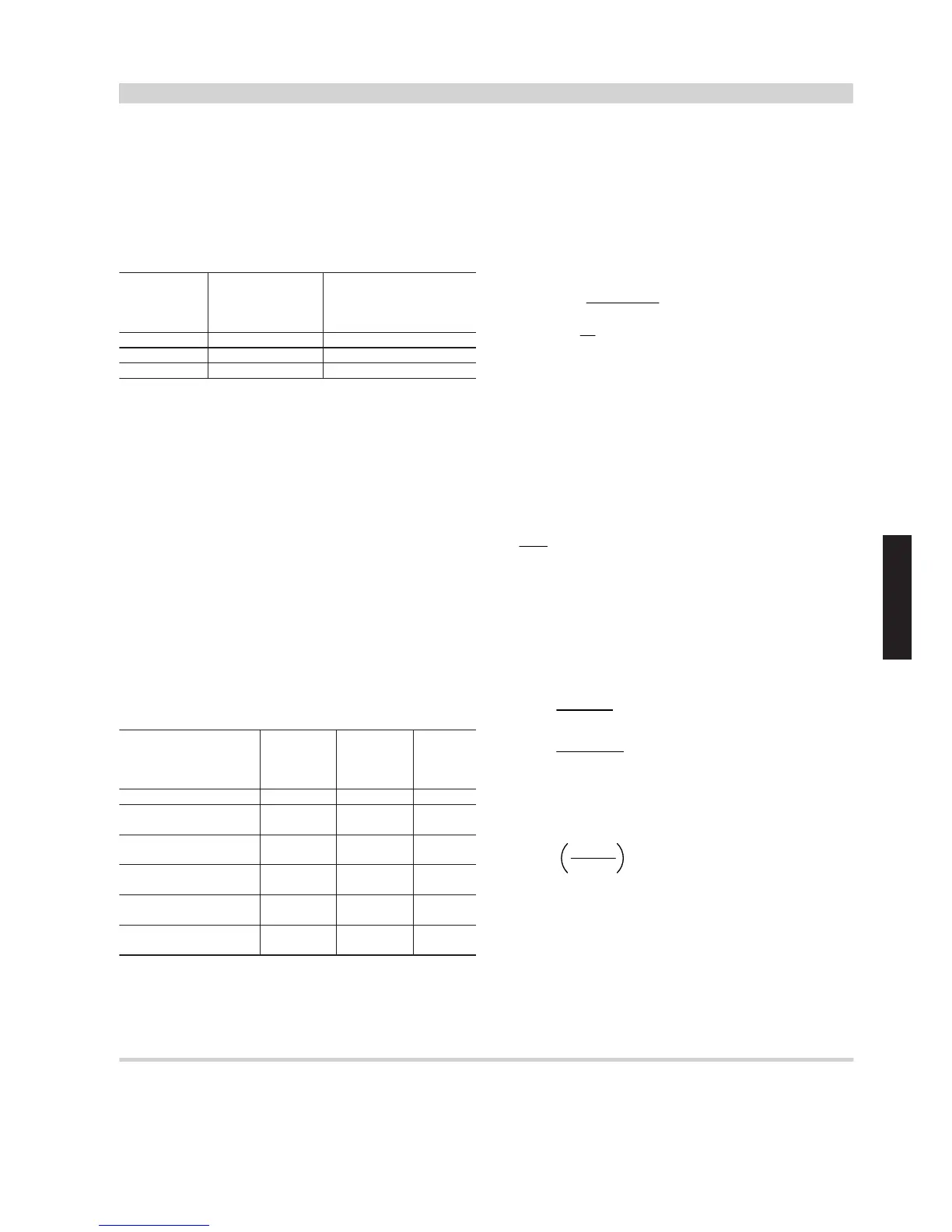
Table 7 – Standard working conditions
*11
Activity Number of wash-
ing facilities per
100 users
Splitting the washing fa-
cilities
Washing facilities/shower
cubicles
Slightly dirty 15 –/–
Moderately dirty 20 2/1
Very dirty 25 1/1
2. Sizing the DHW heating system
The following example is used to illustrate how to size the DHW heat-
ing system.
Example:
Number of employees during the most numerous
shift:
150 employees
Working pattern: 2-shift operation
Type of activity: Moderately dirty
Required DHW outlet temperature: 35 to 37 ºC
Cylinder storage temperature: 60 ºC
Cold water inlet temperature: 10 ºC
Heating water flow temperature: 90 ºC
Calculating the DHW demand
Table 7 shows that for moderately dirty work, 20 washing facilities are
required per 100 employees. The ratio of washbasins to shower cubi-
cles is 2:1.
Therefore, 20 washbasins and 10 shower cubicles are required for 150
employees.
Table 8 – Consumption figures for washing facilities and shower
cubicles with a DHW outlet temperature of 35 to 37 –C
Consumption point DHW vol-
ume in l/
min
Utilisation
time in min
DHW con-
sumption
per use in
l
Washbasins with tap 5 to 12 3 to 5 30
Washbasins with spray
head
3 to 6 3 to 5 15
Circular communal wash-
basin for 6 people
approx. 20 3 to 5 75
Circular communal wash-
basin for 10 people
approx. 25 3 to 5 75
Shower cubicle without
changing cubicle
7 to 12
5 to 6
*12
50
Shower cubicle with
changing cubicle
7 to 12
10 to 15
*13
80
Assuming:
The washing facilities (washbasin with spray head) are used by 120
employees (6 times in sequence) and the shower cubicles (showers
without changing cubicles) are used by 30 employees (3 times in
sequence).
Using table 8, we arrive at the following DHW volume required:
a) DHW demand of the washing facilities: 120 × 3.5 l/min × 3.5 min =
1470 l
b) DHW demand of the showers: 30 × 10 l/min × 5 min = 1500 l
Together, a) and b) result in a total DHW demand of 2970 l at approx.
36 ºC water temperature for a utilisation period of approx. 25
minutes.
Conversion to an outlet temperature of 45 ºC, results in:
As 8 hours are available between the shifts for reheating the DHW
cylinder, the cylinder capacity should be sized for storage purposes.
For this, the details for the peak output (10-minute peak output) in the
tables in the relevant datasheets for the DHW cylinders are used.
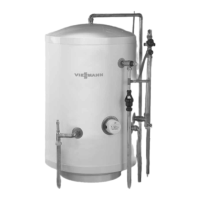
The relevant table in the Vitocell 300-V datasheet, line "Heating water
flow temperature = 90 ºC" for the Vitocell 300-V with 500 l capacity
shows the peak output at 10/45 ºC as 627 l/10 min.
Number of DHW cylinders n = calculated total volume/selected peak
output (10 min output) of the individual cylinder
ΔT
A
= Temperature differential between the cylinder storage
temperature and the cold water inlet temperature
(60 ºC – 10 ºC) = 50 K
Z
A
= Heat-up time in h
As an empirical value, a heat-up time of approx. 2 hours is selected.
In the above example, this means that the boiler and the circulation
pump for cylinder heating (required heating water volume) should be
sized for a heat-up rating of approx. 60 kW.
Calculating the heat demand for DHW heating in hotels, guest houses and residential homes
To calculate the DHW demand, it is necessary to establish the points
of use in every room.
For this, only consider the largest point of use per single/double
room.
*11
In businesses with exceptionally dirty working conditions, 25 washing facilities are required per 100 users.
*12
Showering time excluding changing.
*13
Showering time 5 to 8 min; rest of time for changing.
Sizing
(cont.)
DHW heating
VIESMANN
17
5414 646 GB
4






 To Next Page