6.5
6.5
6.5
6.513
19.5
19.5
6.5 13
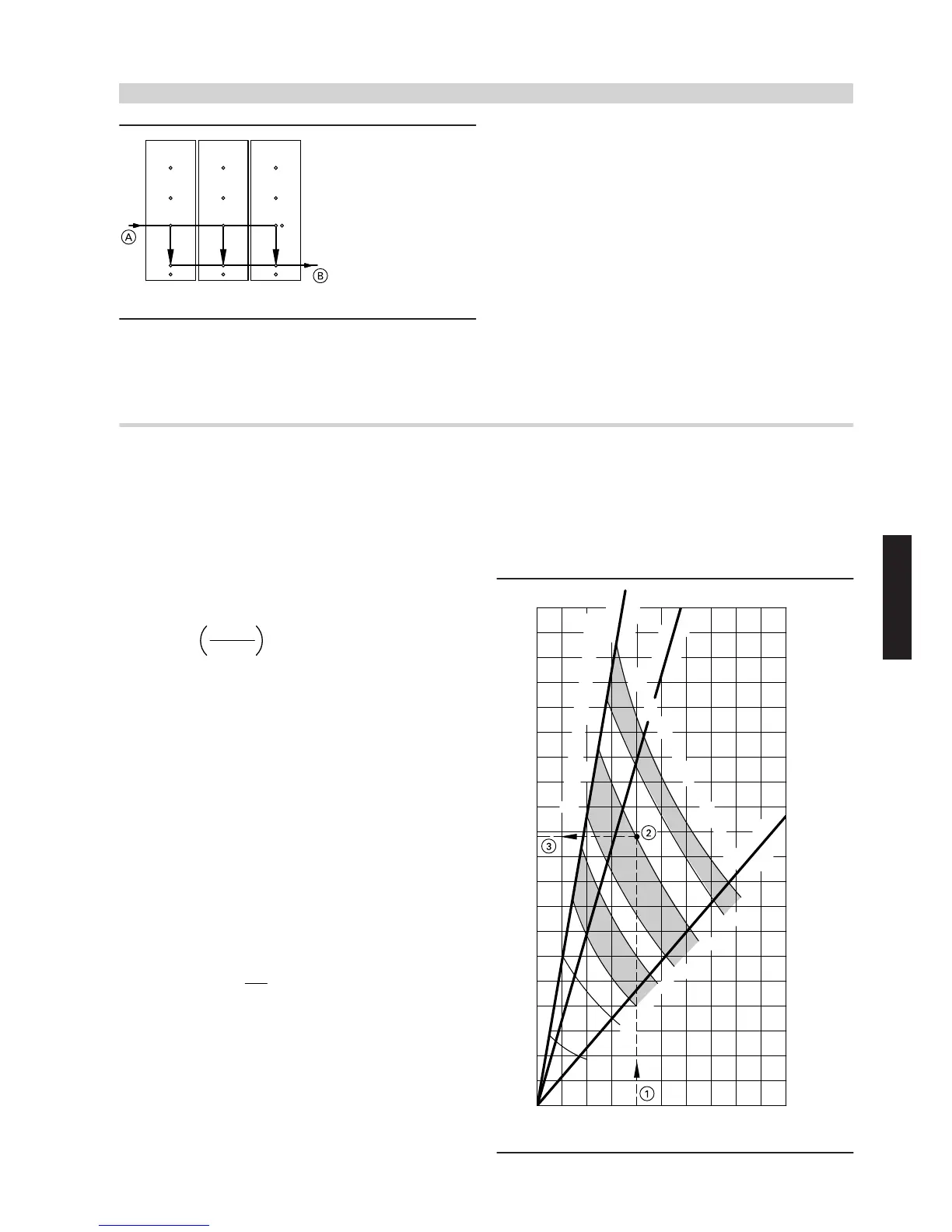
A
Heating water flow
B
Heating water return
Result:
Total heating water flow rate = 19.5 m
3
/h
Heating water flow rate per cylinder = 6.5 m
3
/h
Pressure drop on the heating water side of the DHW cylinder =
400 mbar (40 kPa)
Sizing the circulation pump for cylinder heating
The circulation pump for cylinder heating must therefore deliver a
heating water flow rate of 19.5 m
3
/h and overcome the pressure drop
on the heating water side of 400 mbar (40 kPa) for the 3 cylinders, plus
the pressure drop of the boiler, the pipework between the cylinders
and the boiler, and the individual pressure drop values of fittings and
valves.
The following rule of thumb applies: If the available boiler heating out-
put
²
K
(to DIN 4701) or Φ
K
(to EN 12831) is lower than the continuous
heating output
²
Sp.
or Φ
cyl
, it is sufficient to size the circulation pump
for cylinder heating to suit the transfer of the boiler heating output. If,
on the other hand, the boiler heating output is greater than the contin-
uous output
²
cyl.
or Φ
cyl
, the circulation pump for cylinder heating can
be sized to suit the continuous output as a maximum rating.
Determining the required DHW cylinder, example 2 (with a fixed heat source temperature differential)
Preconditions:
■ Required continuous output in kW or in l/h (conversion required)
■ DHW outlet temperature in ºC
■ Cold water inlet temperature in ºC
■ Heating water flow temperature in ºC
■ Heating water return temperature in ºC
Conversion of continuous output from l/h to kW
²
req.
or Φ
req.
=
Continuous output in kW
µ
WW
= Continuous output in l/h
c = Spec. thermal capacity
ΔT
WW
= Temperature differential between DHW outlet temper-
ature and cold water inlet temperature in K
²
req.
or Φ
req.
= µ
WW
· c · ΔT
WW
The size and number of DHW cylinders required can be calculated
using the diagrams for the continuous output of the DHW cylinders
concerned.
Example:
Required continuous output = 3000 l/h
Heating water flow temperature = 80 ºC
Heating water return temperature = 60 ºC
Heating water temperature differential = 80 ºC – 60 ºC = 20 K
Cold water inlet temperature = 10 ºC
DHW outlet temperature = 45 ºC
A vertical DHW cylinder has to be used on account of the structural
characteristics of the building.
Conversion of continuous output from l/h to kW
²
req.
or Φ
req.
= µ
WW
· c · ΔT
WW
1
860
= 122 kW
= 3000 · · (45 – 10)
Calculating the continuous output of the various cylinder sizes
As the method of calculation is the same for all cylinder sizes, the
process for calculating the continuous output of the Vitocell 300-V with
300 l capacity is used here as a representative example for all cylinder
sizes (see also the datasheet for the Vitocell 300-V with 300 l
capacity).
Starting from the horizontal axis at 20 K (point 1), draw a vertical line
upwards. The intersection with the curve for the required DHW heating
(from 10
1
C to 45
1
C) at the given heating water flow temperature
of 80
1
C results in point
2
.
From point
2
, draw a horizontal line.
The intersection with the vertical axis results in point
3
. You can read
off the continuous output of the DHW cylinder at point
3
as 54 kW.
DHW heating from 10 to ...°C
70
Heating water flow temperature ...°C
5.0 m³/h
280 mbar
80
50
60
90
110 mbar
3.0 m³/h
15 mbar
1.0 m³/h
500 5 40 453025201510 35
Heating water volume ... m³/h
Pressure drop on the heating water side ... mbar
Heating water temperature differential (ΔT) in K
40
45
0
5
10
15
20
25
30
35
50
55
60
65
70
75
0
80
85
90
95
100
Continuous output in kW
45
45
45
45
45
60
60
60
Sizing
(cont.)
DHW heating
VIESMANN
23
5414 646 GB
4






 To Next Page