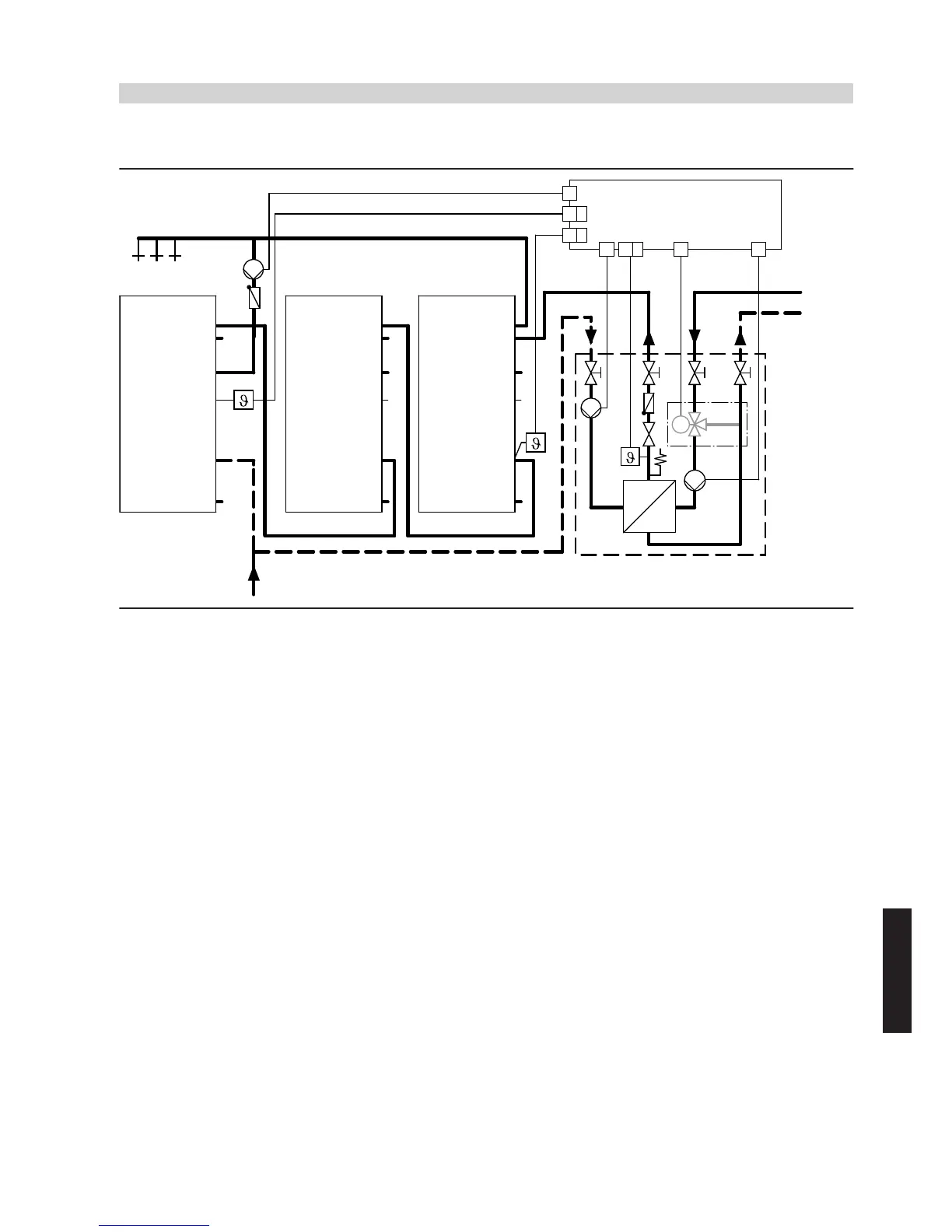
A
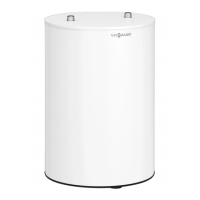
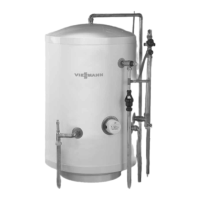
Vitocell 100-L (here: 500 l capacity)
B
DHW circulation pipe
C
DHW circulation pump
D
Draw-off points (DHW)
E
Vitotrans 222 heat exchanger set with mixer assembly
F
Vitotronic 200-H (type HK1B, type HK3B),
Vitotronic 100 (type GC1B, type GC4B),
Vitotronic 200 (type GW1B),
Vitotronic 300 (type GW2B, type GW4B) or
Vitotronic 300-K (type MW1B, type MW2B)
G
Plate heat exchanger
H
Heating water flow
K
Heating water return
L
Cylinder loading pump (secondary), highly efficient
N
Common cold water connection with safety assembly to
DIN 1988
O
Spring-loaded check valve
P
Cylinder temperature sensor, top
(ON, terminals
%
A)
Q
Cylinder temperature sensor, bottom
(OFF, terminals
%
B)
Note
■
Establish cold water connection N with a tee with straight flow to
the cold water connection of the Vitocell-L. Always make the cold
water connection to the Vitotrans 222 as a tee branch.
■ In order to ensure a fault-free heating operation, make sure that the
residual head of cylinder loading pump
L
is greater than that of
DHW circulation pump
C
, giving due consideration to the pipework
pressure drop.
Connect in series if relatively continuous DHW demand can be expec-
ted, e.g. in large apartment buildings.
Note the max. draw-off rate when sizing for DHW heating. The max.
flow velocity to DIN 1988 should not be higher than 2 m/s (affects
stratification inside the DHW cylinder).
The benefits of connection in series are particularly evident when heat
exchangers with low output ratings are combined with large cylinder
capacities, as a large cylinder capacity makes it possible to use smaller
boilers or the input of district heating.
Due to the necessary high flow temperatures of the heat source, never
use a directly connected heating circuit without mixer.
For optimum operation, disable the DHW cylinder priority control at the
control unit.
Installation — cylinder loading system
(cont.)
DHW heating
VIESMANN
43
5414 646 GB
7






 To Next Page