EasyManua.ls Logo

Westerbeke 12.5 BTDA - Generator Break-In Procedure; Break-In Description and Importance; Break-In Checks and Load Management; Generator Adjustments During Break-In

Westerbeke 12.5 BTDA
70 pages
Print Icon
To Next Page IconTo Next Page
To Previous Page IconTo Previous Page
Loading...
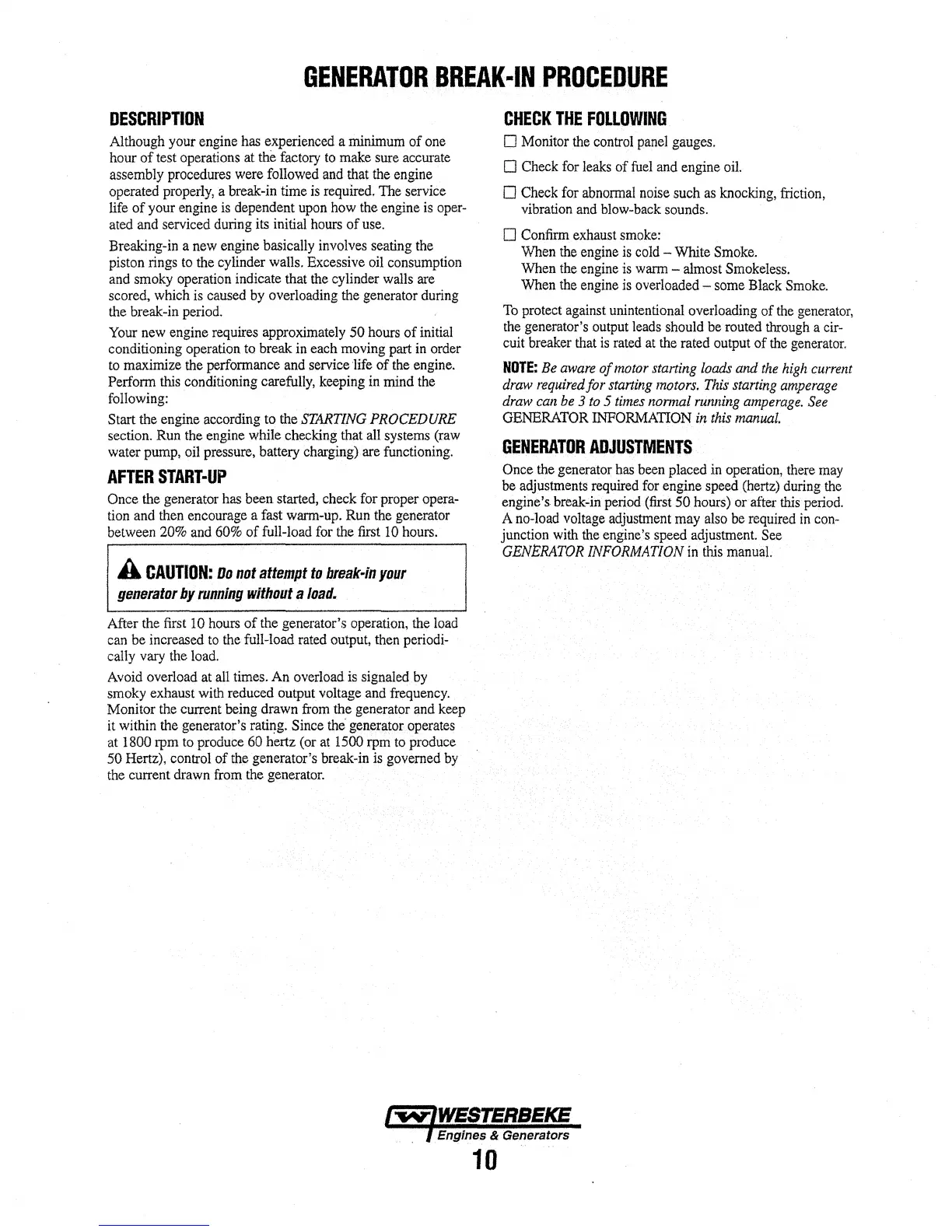
GENERATOR
BREAK·IN
PROCEDURE
DESCRIPTION
Although
your
engine
has
experienced
a
minbnum
of
one
hour
of test
operations
at
the
factory
to
make
sure
accurate
assembly
procedures
were
followed
and
that
the
engine
operated
properly,
a
break-in
time
is
required.
The
service
life
of
your
engine
is
dependent
upon
how
the
engine
is
oper-
ated
and
serviced
during
its
initial
hours
of
use.
Breaking-in
a
new
engine
basically
involves
seating
the
piston
rings
to
the
cylinder
walls.
Excessive
oil
consumption
and
smoky
operation
indicate
that
the
cylinder
walls
are
scored,
which
is
caused
by
overloading
the
generator
during
the
break-in
period.
Your
new
engine
requires
approximately
50
hours
of
initial
conditioning
operation
to
break
in
each
moving
part
in
order
to
maximize
the
performance
and
service
life
of
the
engine.
Perform
this
conditioning
carefully,
keeping
in
mind
the
following:
Start
the
engine
according
to
the
STARTING
PROCEDURE
section.
Run
the
engine
while
checking
that
all
systems
(raw
water
pump,
oil
pressure,
battery
charging)
are
functioning.
AFTER
START-UP
Once
the
generator
has
been
started,
check
for
proper
opera-
tion
and
then
encourage
a fast
warm-up.
Run
the
generator
between
20%
and
60%
of
full-load
for
the
first
10
hours.
A
CAUTION:
Do
not
attempt
to
break-in
your
generator
by
running
without
a
load.
After
the
first
10
hours
of
the
generator's
operation,
the
load
can
be
increased
to
the
full-load
rated
output,
then
periodi-
cally
vary
the
load.
Avoid
overload
at
all
times.
An
overload
is
signaled
by
smoky
exhaust
with
reduced
output
voltage
and
frequency.
Monitor
the
current
being
drawn
from
the
generator
and
keep
it
within
the
generator's
ratif!.g
•.
Since
the·
gen~rator
operates
at
1800
rpm
to
produce
60
hertz
(or
at
1500
ipm
to
produce
50
Hertz),
control
of
the
generator's
break-in
is
governed
by
the
current
drawn
from
the
generator.
CHECK
THE
FOLLOWING
0
Monitor
the
control
panel
gauges.
0
Check
for
leaks
of
fuel
and
engine
oil.
0
Check
for
abnonnal
noise
such
as
knocking,
friction,
vibration
and
blow-back
sounds.
0
Confirm
exhaust
smoke:
When
the
engine
is
cold
-White
Smoke.
When
the
engine
is
warm
-
almost
Smokeless.
When
the
engine
is
overloaded~
some
Black
Smoke.
To
protect
against
unintentional
overloading
.of
the
generator,
the
generator's
output
leads
should
be
routed
through
a
cir-
cuit
breaker
that
is
rated
at
the
rated
output
of
the
generator.
NOTE:
8e
aware
of
motor
starting
loads
and
the
high
current
draw
required
for
starting
motors.
This
starting
amperage
draw
can
be
3
to
5
times
nonnal
running
amperage.
See
GENERATOR
INFORMATION
in
this
manual.
GENERATOR
ADJUSTMENTS
Once
the
generator
has
been
placed
in
operation,
there
may
be
adjustments
required
for
engine
speed.
(hertz)
during
the
engine's
break-in
period
(first
50
hours)
or
after
this
period.
A
no-load
voltage
adjustment
may
also
be
required
in
con-
junction
with
the
engine's
speed
adjustment.
See
GENERATOR
INFORMATION
in
this
manuaL
Engines & Generators
10

Other manuals for Westerbeke 12.5 BTDA

Related product manuals