EasyManua.ls Logo

Westerbeke 12.5 BTDA - Cooling System Details; Cooling System Description; Fresh Water Cooling Circuit Operation; Coolant Recovery Tank Function and Placement

Westerbeke 12.5 BTDA
70 pages
Print Icon
To Next Page IconTo Next Page
To Previous Page IconTo Previous Page
Loading...
COOLING
SYSTEM
DESCRIPTION
Westerbeke
marine
diesel
engines are
designed
and
equipped
for
fresh
water
cooling.
Heat
produced
in
the
engine
by
com-
bustion
and
friction
is
transferred
to
fresh
water
coolant
which
circulates
throughout the engine. This circulating
fresh
water
coolant
cools
the
engine
block,
its
internal
moving
parts,
and
the engine
oil.
The
heat
is
transferred externally
from
the
fresh
water
coolant
to
raw
water
by
means
of
a heat
exchanger,
similar
in
function
to
an
automotive
radiator.
Raw
water
flows
through
the
tubes
of
the
heat exchanger
while
fresh
water
coolant
flows
around
the
tubes;
engine heat
trans-
ferred
to
the
fresh
water coolant is conducted
through
the
tube
walls
to
the
raw
water
which
is
then
pumped
into the
exhaust
system
where
finally
it is discharged
overboard.
In
other
words,
the engine
is
cooled
by
fresh
water
coolant,
this
coolant is cooled
by
raw
water,
and the
raw
water
carries the
transferred
heat
overboard
through the exhaust
syste~.
The
fresh
water
coolant
and
raw
water circuits
are
independent of
·
each
other.
Using
only
fresh
water coolant
within
the engine
allows
the
cooling
water
passages
to
stay
clean
and
free
from
harmful
deposits.
FRESH
WATER
COOLING
CIRCUIT
NOTE:
Refer
to
the
ENGINE
COOLANT
section
for
the
rec-
ommended
antifreeze
and water
mixture
to
be
used
as
the
fresh
water
coolant.
Fresh
water
coolant
is
pumped
through
the
engine
by
a circu-
lating
pump,
absorbing
heat
from
the engine.
The
coolant
then
passes
through
the
thermostat into the
manifold,
to
the
heat
exchanger whete it
is
cooled,
and
returned
to
the
engine
block
via
the
suction
side
of the circulating
pump.
~
ENGINE
BLOCK
COOLANT
DRAIN
When
the
engine
is
started cold, external coolant
flow
is
pre-
vented
by
the
closed thermostat (although
some
coolant
flow
is
bypassed
around
the
thermostat
to
prevent the
exhaust
manifold
from
overheating).
As the engine
warms
up,
the
thermostat
gradually
opens,
allowing
full
flow
of
the
engine's
coolant
to
flow
unrestricted
to
the
external
portion
of
the
cooling
system.
Coolant
Recovery
Tank
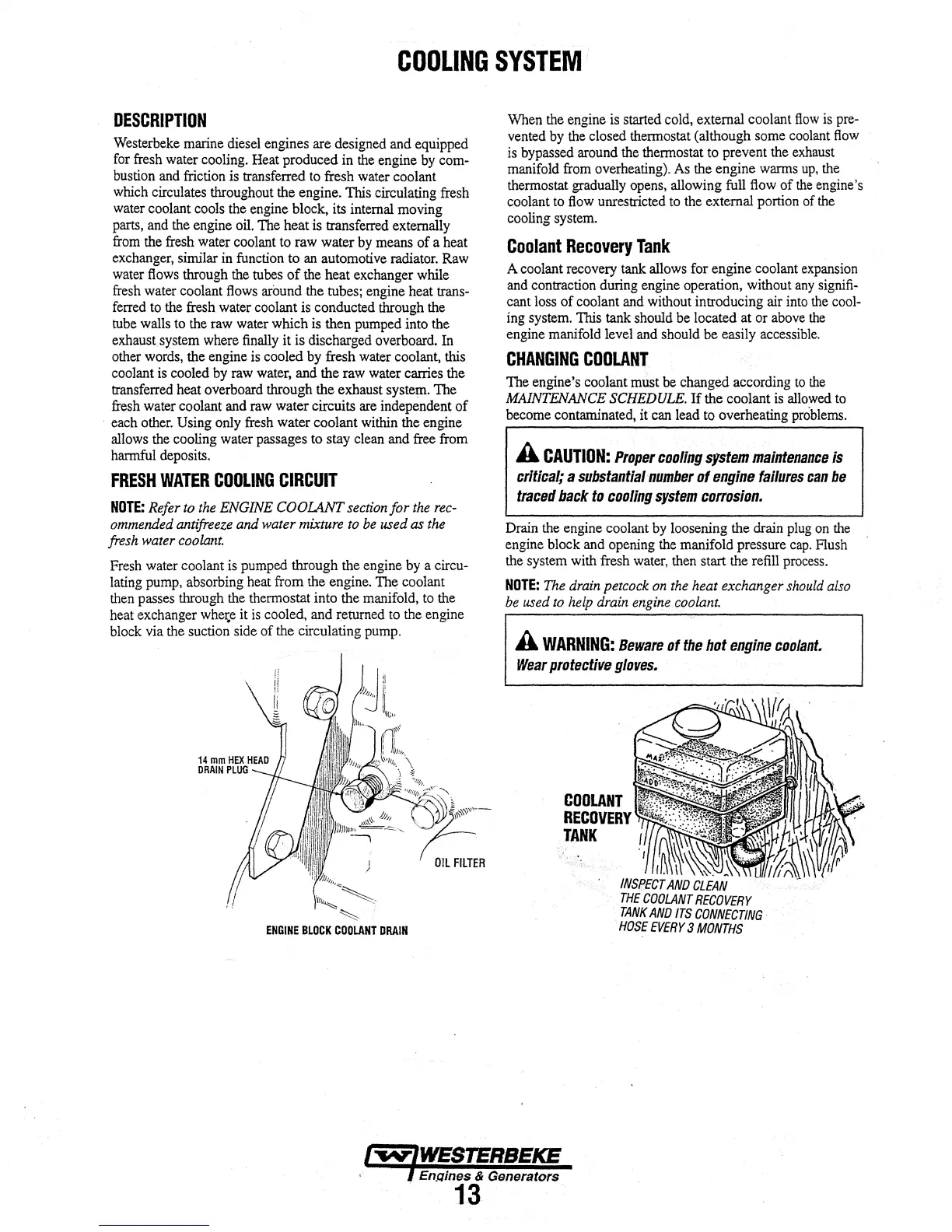
A coolant
recovery
tank
allows
for
engine coolant
expansion
and
contraction
during
engine operation, without
any
signifi-
cant
loss
of coolant
and
without
introducing air
into
the
cool-
ing
system.
This
tank
should
be
located at or
above
the
engine
manifold
level
and
should
be
easily
accessible.
CHANGING
COOLANT
The engine's coolant
must
be
changed according
to
the
MAINTENANCE
SCHEDULE.
If
the coolant
is
allowed
to
become
contaminated, it
can
lead
to
overheating
problems.
A
CAUTION:
Proper
cooling
system
malllfenance
is
critical;
a
substantlal11umber
of
engine
failures
can
be
traced
back
to
cooling
system
corrosion.
D~n
the
engine coolant
by
loosening the
drain
plug
on
the
engme
block
and
opening
the
manifold pressure
cap.
Flush
the
system with fresh
water,
then
start the
refill
process.
NOTE:
The
drain
petcock
on
the
heat exchanger
should
also
be
used
to
help
drain
engine
coolant.
A
WARNING:
Beware
of
the
bot
engine
coolant.
Wear
protective
gloves.
COOLANT
RECOVERY
TANK
t
INSF}ECT
AND
CLEAN
THE
COOLANT
RECOVERY
TANK
AND
ITS
CONNECTING.
HOSE
EVERY
3
MONTHS
IW'/WESJERBEKE
· f
En_Qines
& Generators
.
13

Other manuals for Westerbeke 12.5 BTDA

Related product manuals