DC
ELECTRICAL·
SYSTEM
ALTERNATOR
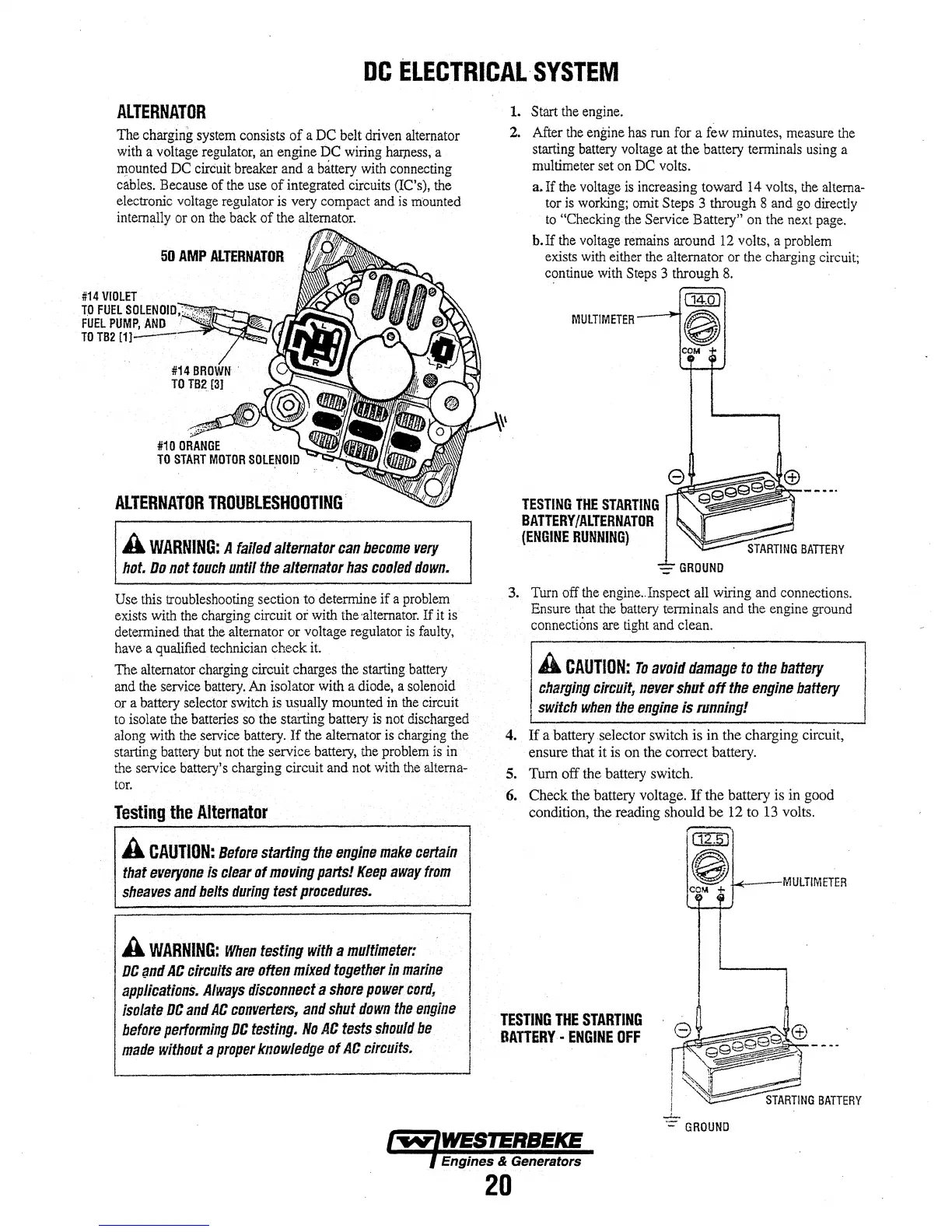
The charging
system
consists
of
a
DC
belt driven alternator
with
a voltage regulator, an engine
DC
wiring
harpess,
a
Il),OUnted
DC
circuit breaker and a
battery
with
connecting
cables. Because of
the
use
of integrated circuits (IC's),
the
electronic
voltage
regulator
is
very
compact
and
is
mounted
internally or
on
the
back
of the alternator.
50
AMP
ALTERNATOR
ALTERNATOR
TROUBLESHOOTING.
A
WARNING:
A
failed
alternator
can
become
very
hot.
Do
not
touch
until
the
alternator
has
cooled
down.
Use
this
troubleshooting
section
to
determine if a
problem
exists
with
the
charging
circuit or
with
the·alternator. If it is
determined that
the
alternator or voltage regulator
is
faulty,
have
a qualified
technician
check
il
The alternator charging circuit charges
the
starting
battery
and
the
service
battery.
An isolator
with
a diode, a solenoid
or a battery selector switch
is
usually mounted
in
the
circuit
to
isolate the
batteries
so the starting battery
is
not
discharged
along
with
the
service
battery
..
If
the
alternator is
charging
the
starting
battery
but
not
the service
battery,
the
problem is in
the
service battery's charging circuit and not
with
the
alterna-
tor.
Testing
the
Alternator
A
CAUTION:
Before
starting
the
engine
make
certain
that
everyone
Is
clear
of
moving
parts!
Keep
away
from
sheaves
and
belts
during
test
procedures.
A
WARNING:
When
testlqg
with
a
multlmeter:
DC
Bnd
AC
circuits
are
often
mixed
together
in
marine
applicationS.
Always
disconnects
shore
power
cord,
isolate
DC
and
AC
converters,
and
shut
down
the
engine
before
performing
DC
testing.
No
AC
tests
should
be
made
without
a
proper
knowledge
of
AC
circuits.
1.
Start
the
engine.
2.
After
the
engine
has
run
for
a few minutes,
measure
the
starting
battery
voltage
at the battery terminals
using
a
multimeter
set
on
DC
volts.
a. If
the
voltage
is
increasing toward 14 volts,
the
alterna-
tor
is
workingi
omit
Steps 3 through 8 and
go
directly
to
"Checking
the
Service Battery"
on
the
next
page.
b.If
the
voltage
remains around 12 volts, a problem
exists
with
either the alternator or the charging
circuit;
continue
with
Steps
3 through
8.
MUlTIMETER
TESTING
THE
STARTING
BATTERY/ALTERNATOR
(ENGINE
RUNNING)
3.
Turn
off
the
engine
..
Inspect all wiring
and
connections.
Ensure
that
the
battery
terminals
and
the
engine
ground
connections
are
tight
and clean.
A
CAUTION:
To
avoid
damage
to
the
battery
charging
circuit,
never
shut
off
the
engine
battery
switch
when
the
engine
is
running/
4.
If
a battery selector switch is in the charging circuit,
ensure that it is on the correct battery.
5.
Tum
off the battery switch.
6. Check the battery voltage.
If
the battery
is
in good
condition, the reading should be
12
to
13
volts.
TESTING
THE
STARTING
BATIERY
•
ENGINE
OFF
Engines & Generators
20



 To Next Page