ENGINE
LUBRICATING
OIL
ENGINE
OIL
CHANGE
SUMP
DRAIN
HOSE......,_,___..._
FOR
EXTENSION
1/4"
NPT
6"0.D.
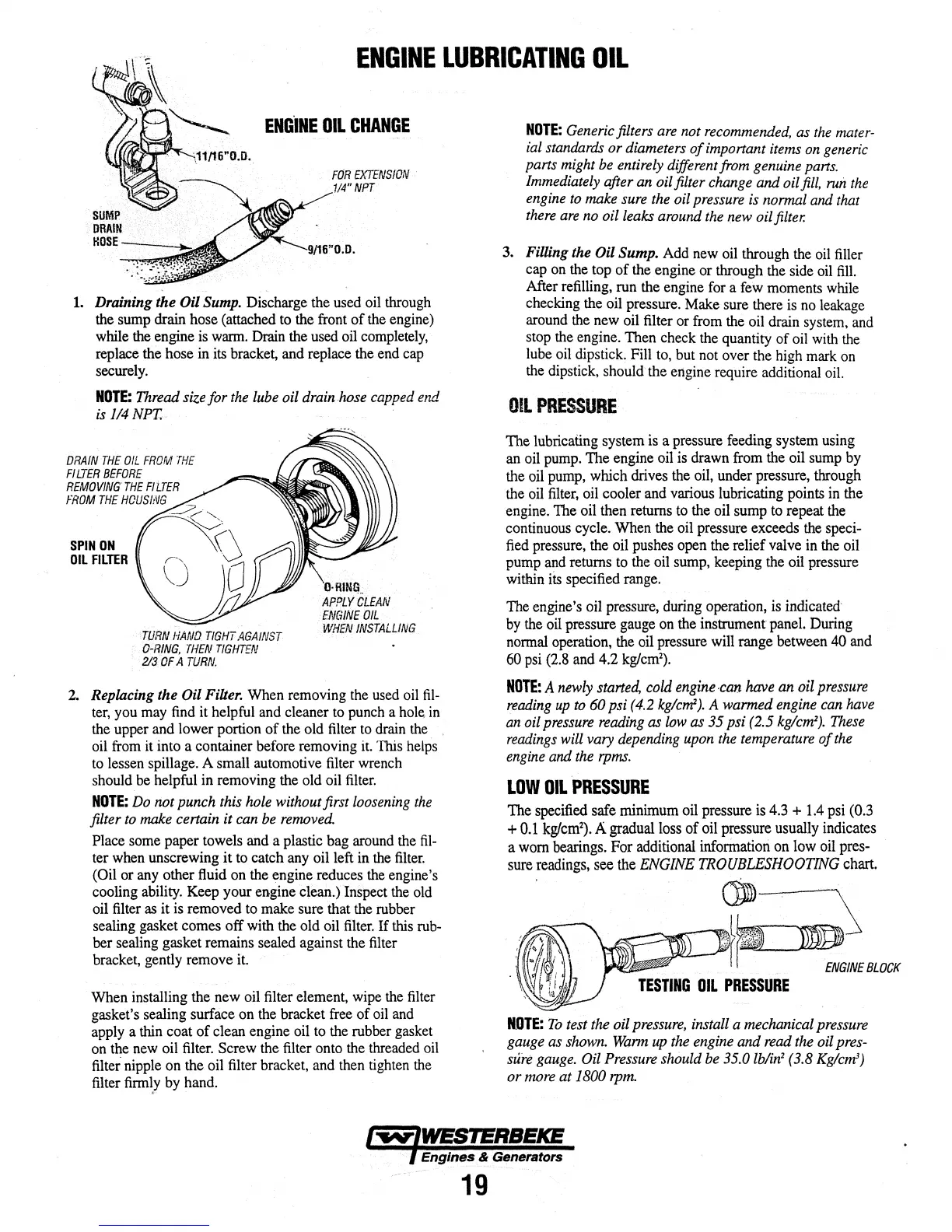
1. Draining the Oil Sump. Discharge the used oil through
the sump drain hose (attached to the front
of
the engine)
while the engine is wann. Drain the used oil completely,
replace the hose in its bracket, and replace the end cap
securely.
NOTE:
Thread
size for
the
lube
oil drain
hose
capped
end
is
114
NPT.
DRAIN
THE
OIL
FROM
THE
FI
U"ER
BEFORE
REMOVING
THE
FILTER
FROM
THE
HOUSING
SPIN
ON
OIL
FILTER
TWiN
!·/AND
TIGHT
AGAINST
O·RING,
THEN
TIGHTEN
213
OF
A
TURN.
AP.I'LY
CLEAN
ENCi/NE
OIL
WHEN
JNSTALL/tvG
2. Replacing the Oil Filter. When removing the used oil fil.
ter, you may find it helpful and cleaner to punch a
hole.
in
the upper and lower portion
of
the old filter to drain the
oil from it into a container before removing
it.
'Ibis helps
to lessen spillage. A small automotive filter wrench
should be helpful in removing the old oil filter.
NOTE:
Do
not punch this hole without first
loosening
the
filter
to
make
certain it
can
be
removed.
Place some paper towels and a plastic bag around the
fil-
ter when unscrewing
it
to catch any oil left in the filter.
(Oil or any other fluid on the engine reduces the engine's
cooling ability. Keep your engine clean.) Inspect the old
oil filter
as
it
is removed to make sure that the fllbber
sealing gasket comes off with the old oil filter.
If
this rub-
ber sealing gasket remains sealed against the filter
bracket, gently remove it.
When installing the new oil filter element, wipe the filter
gasket's sealing surface on the bracket free
of
oil and
apply a thin coat
of
clean engine oil to the rubber gasket
on the new oil filter. Screw the filter onto the threaded oil
filter nipple on the oil filter bracket, and then tighten the
filter firmly by hand.
19
NOTE:
Generic filters
are
not
recommended,
as
the
mater-
ial
standards
or diameters
of
important items
on
generic
parts might
be
entirely different
from
genuine
parts.
Immediately after
an
oil filter change and oil
fill,
run
the
engine
to
make
sure
the
oil
pressure
is
normal
and
that
there
are
no
oil leaks around
the
new oil
filter.
3. Filling the Oil Sump. Add new oil through the oil filler
cap on the top
of
the engine or through the side oil
fill.
After refilling, run the engine for a few moments while
checking the oil pressure. Make sure there is
no
leakage
around the new oil filter or from the oil drain system, and
stop the engine. Then check the quantity
of
oil with the
lube oil dipstick. Fill to, but not over the high mark on
the dipstick, should the engine require additional oil.
OIL
PRESSURE
The lubricating system is a pressure feeding system using
an oil pump.
The
engine oil is drawn from the oil sump by
the oil pump, which drives the oil, under pressure, through
the oil filter, oil cooler and various lubricating points in the
engine. The oil then returns to the oil sump to repeat the
continuous cycle. When the oil pressure exceeds the
speci-
fied pressure, the oil pushes open the relief valve in the oil
pump and returns to the oil sump, keeping the oil pressure
withln its specified range.
The engine's oil pressure, during operation, is indicated
by
the oil pressure gauge on the instrument panel. During
normal operation, the oil pressure will range between
40 and
60 psi (2.8 and 4.2 kg/cm
2
).
NOTE:
A
newly
started,
cold
engine
·can
have
an
oil
pressure
reading
up
to
60 psi
(4.2
kg!crrf).
A warmed engine
can
have
an
oil
pressure
reading
as
low
as 35 psi (2.5 kg/cm
2
).
These
readings
will vary
depending
upon
the
temperature
of
the
engine
and
the
rpms.
LOW
OIL
PRESSURE
The specified safe minimum oil pressure is 4.3 + 1.4 psi (0.3
+ 0.1 kg/cm
2
).
A gradual loss
of
oil pressure usually indicates
a worn bearings.
For
additional information on low oil pres-
sure readings, see the
ENGINE
TROUBLESHOOTING
chart.
Q)l~
·--~~hl
N.OTE:
To
test the oil
pressure,
install a mechanical pressure
gauge
as
shown.
Warm
up
the
engine and
read
the
oil pres-
sure
gauge.
Oil
Pressure should
be
35.0 lb/in
2
(3.8 Kg!cnt)
or
more
at 1800
rpm.



 To Next Page