EasyManua.ls Logo

Westerbeke 12.5 BTDA - Generator Voltage Adjustment; No-Load Voltage Adjustment; Full-Load Voltage Adjustment

Westerbeke 12.5 BTDA
70 pages
Print Icon
To Next Page IconTo Next Page
To Previous Page IconTo Previous Page
Loading...
GENERATOR
VOLTAGE
ADJUSTMENT
NOTE:
WESTERBEKE
recommends
that
the
following
generator
tests
and
adjustments
be
performed
by
a
quailified
technician.
NO-LOAD
VOLTAGE
ADJUSTMENT
Voltage
adjustment
is
made
with
the
generator
regulation
being
governed
by
the
compound
transformer.
1.
The
selector
switch,
if
installed, must
be
in
the
COMP
position.
2.
To
confirm
no-load
voltage,
start
the
generator
and
apply
a
momentary
(moderate)
load
to
excite
the·transformer.
The
voltage
produced
by
the
generator
after
the
momen-
tary
load
is
removed
is
no-load
voltage.
Note
the
voltage·
output
from
the
generators
120
volt
leg(s)
(230
volt
50
hertz)..
The
no-load
voltage
should be
between
121·124
volts
at
61.5-62
hertz
(232- 236
volts
at
51.5-52
hertz).
NOTE:
The
no-load
voltage
should
be
adjusted to the
voltage
produced
by
the
generator
once
staned
and
a
momentary
load
should
be
applied
to
excite
the
transformer
and
then
remqved.
The
voltage produced
~Y
the
generator
after
this
momentary
load
is
removed
is
no•
load
voltage.
3.
To
raise
or
lower
the
voltage, shims of
varying
thickness
(non-conductive
material)
are
placed
or
removed
from
under
the
steel
laminated
bar
on
top
of
the
compound
.
transformer.
The
material
used
for
shimming
should
not
soften
at
temperatures
in
the
176°
F
(80°
C) range. A
small
reduction
in
no-load
voltage
(1
.to
3
volts)
can
·some
times
be
accomplished
by
gently
tapping
the
top
of
the
·
laminated
steel
bar
to
reduce
the
gap
between
the
existing
shims
and
the
transformer
core.
NOTE:
No-load
voltage
may
be
effected needing
readjustment
with
the
compound
transfonner.
Do
notuse
.these
·
adjustments
to
compensate
for overload
corulitions
being
placed
on
the
generator/engine
(inductive-motor
type
loads}.
Less
of
generator
herk/speed, the
result
of
overload,
will
cause
a
drop
in
voltage
output.
Shim
thickness
ofO.OOl
inch
will
change
the
no-load
voltage
by
approximately
4
~
6
volts.
Adding
shim
material
raises
the
no-load
voltage.
Removing
shim
material
lowers
no-load
voltage.
FULL·LOAD
VOLTAGE
ADJUSTMENT
The
voltage
hertz
connection
bar
that
is
used
when
changing
from
60Hz
to
50Hz
can
also
be
used
to
increase
or
decrease
the
generators·
full~load
output.
Fine
voltage
adjustments
can
be performed
by
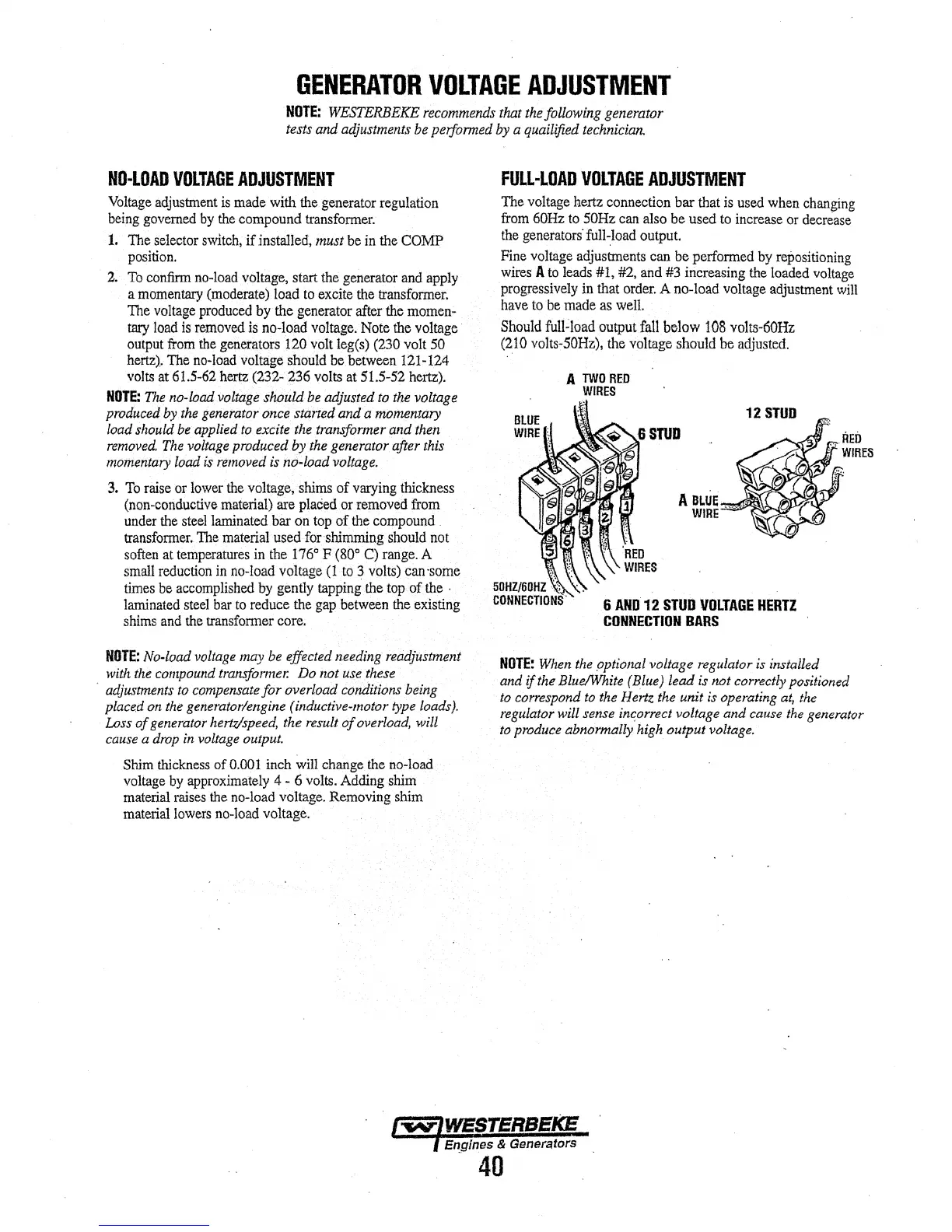
repositioning
wires
A to
leads
#1, #2,
and
#3
increasing
the
loaded
voltage
progressively
in
that
order.
A no-load
voltage
adjustment
will
have
to
be
made
as
well.
Should
full~load
output
fall
below
108
volts-60Hz
(210
volts-50Hz),
the
voltage
should
be
adjusted.
A
TWORED
WIRES
12
STUD
6
AND
12
STUD
VOLTAGE
HERTZ
CONNECTION
BARS
NOTE:
When
the
.optional
voltage
regulator
is
installed
and
if the
Blue/White
(Blue)
lead
is
not
correctly
positioned
to
correspond
to
the
Hertz
the
unit
is
operating
at,
the
regulator
will
sense
inc_orrect
voltage and
cause
the
generatQr
to
produce
abnormally
high
output
voltage.
En_gines
& Generators
40

Other manuals for Westerbeke 12.5 BTDA

Related product manuals