INSTALLATION AND MAINTENANCE MANUAL
LYNX E1 FAMILY
LICENSED & SPREAD SPECTRUM RADIOS
JUNE 2001
PAGE 3-76 SECTION 3: INSTALLATION & ADJUSTMENTS
4. If the Lynx radios are connected in a repeater configuration, Orderwire services can be
established to all Lynx terminals in the network by implementing a connection of their rear-panel
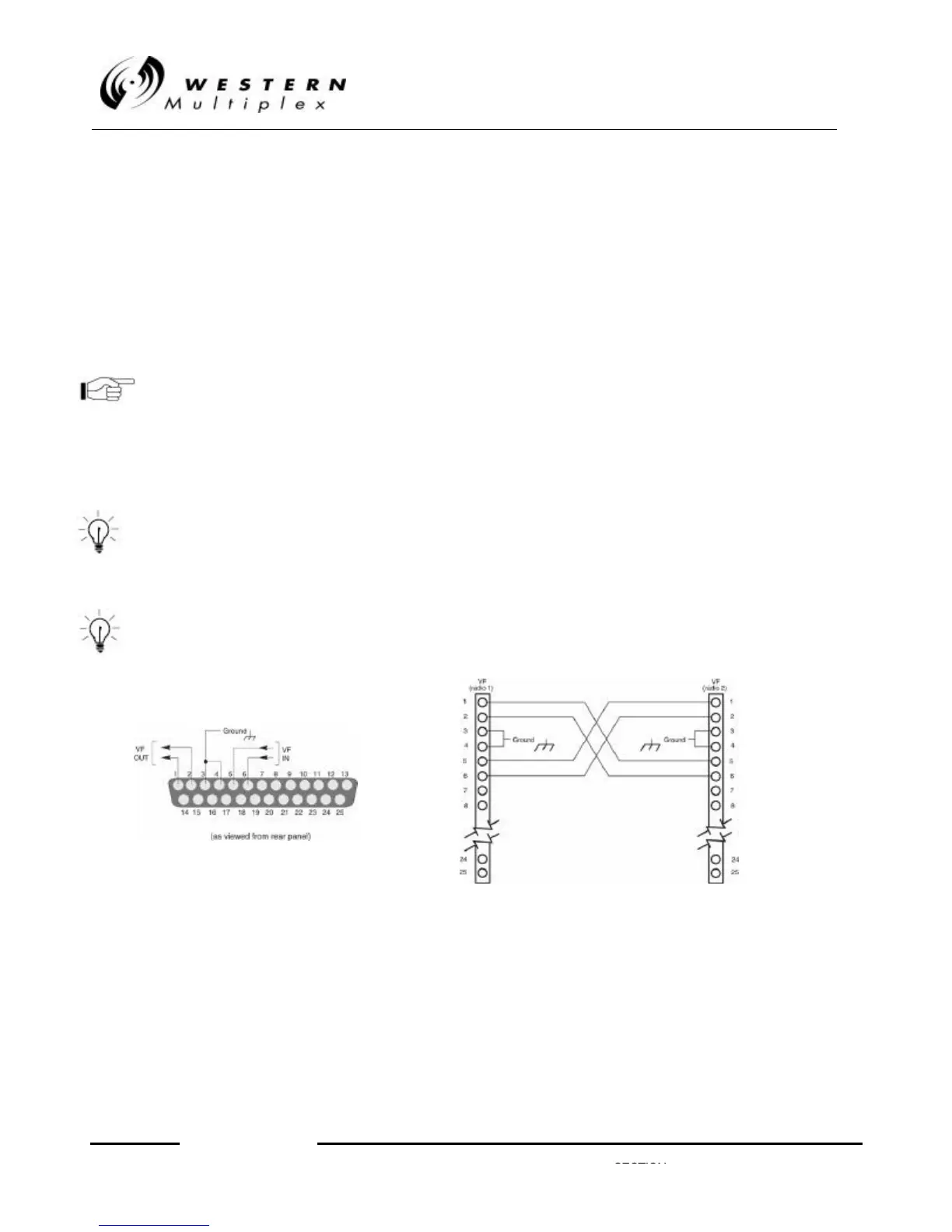
connectors between repeater terminals. At the repeater site, a cable can be connected to the
two Lynx terminals between their rear panel VF 25-pin connectors as shown in Figure 3-20.
With this cable in place, the Orderwire function will operate at terminals at each end of the
repeater and at the repeater site. This function can be continued through several repeater sites
if desired. For hub connections of 3 or more Lynx radios at the same site, an external 4-wire
bridge is required to connect all radios to the orderwire.
The orderwire system can be integrated with orderwire equipment
supported by many other vendors. If your existing orderwire network uses
2 digit addressing, and 0 dBm VF interface, it can be connected to a
Lynx as shown in Figure 3-20.
Dialing a V (star key) on the orderwire telephone implements an “all call”
feature which rings all connected radios. Also, if a phone anywhere in the
connected network has accidentally been left off-hook, the # (pound key)
key can be used to mute all off-hook handsets until they are placed on
and off hook again.
The orderwire operates like a “party line”. All telephones provide
communication to all other telephones in the connected network. Even if a
particular telephone does not ring, it can still be used to talk and listen to
any ongoing orderwire activity if the orderwire is in use at other terminal
locations.
Figure 3Figure 3-- 20: VF Port Connection20: VF Port Connection
VF Connector
OrderWire



 To Next Page