Xtralis Pty Ltd XCC Product Guide
www.xtralis.com 5
2 Pipe Networks
Note: To achieve EN 54-20 Class C compliance you must use the pre-engineered pipe networks
described in this section.
These pre-engineered pipe networks provide installations which have a sensitivity better than 8%
obscuration/m and transport time better than 90 sec. This ensures that they have a good margin of
performance as a Class C detector and allow hole positions along the pipe to be varied from exact equal
spacing while still achieving an acceptable system balance.
Wherever possible the hole sizes have been restricted to increments of 0.5mm and a maximum of two hole
sizes on any one detector (e.g. 3mm holes with last hole 3.5mm). However, this is not always possible,
particularly on the designs using capillary sampling. For these, more than two drills sizes are often needed on
a particular design to accommodate the flexibility given for the length of capillary pipes – being from 0.25m to
4m long (Note: capillaries should be equal lengths for a particular detector).
Fire-Alarm Threshold Settings:
There are 4 sensitivity thresholds provided on the XCC detector to accommodate different numbers of holes,
pipe lengths and pipe arrangements. These are denoted I, II, III and IV (with I being the most sensitive).
Pre-Alarm Threshold Settings:
The Pre-alarm condition on the XCC detector is signaled at 70% of Fire-Alarm Threshold Settings.
The tables in the following sections define the pre-engineered systems allowed.
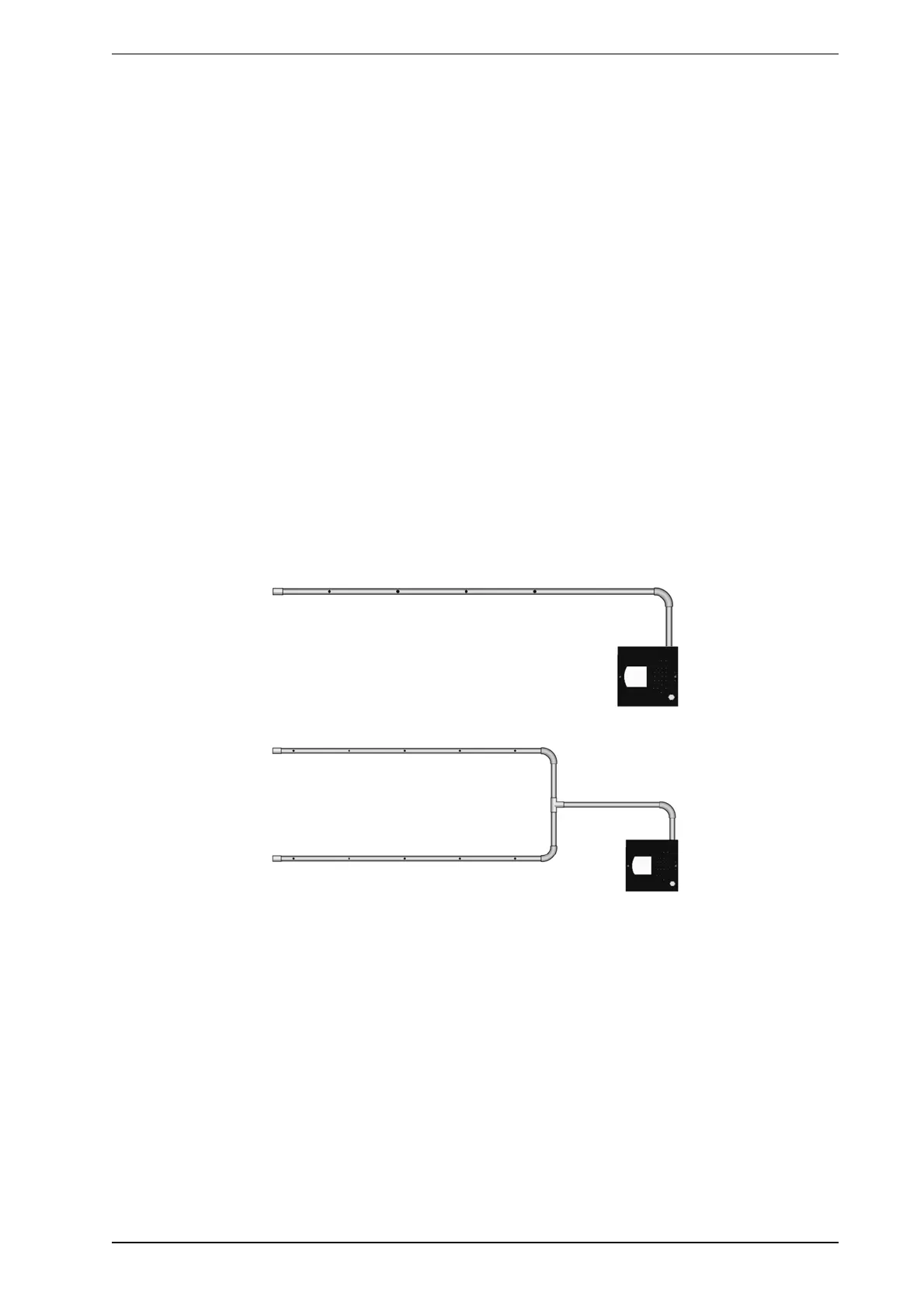
Refer to Figure 2-1 and Figure 2-2 below for examples of single pipe and single branch (U-style) pipe
networks.
Figure 2-1: Single pipe network
Figure 2-2: Branch Pipe network





 To Next Page