CHARTS OF DEFAULT EXPOSURE
VALUES
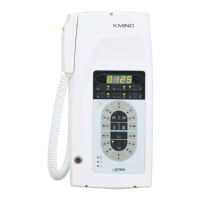
The charts below indicate the predened exposure values stored in the “X-MIND unity” x-ray system.
PLEASE NOTE
The following exposure values are only indicative and the manufacturer cannot warranty the universal applicability of them for any kind of
circumstances or type of x-ray sensor used, since variations and inaccuracies may arise from sensor to sensor and may require adjustments to
accommodate local congurations (software, lm processing, digital processing, CCD or CMOS types, etc.)
Therefore you must establish for each support used and for each type of patient the correct technique factors (kV, mA, s) settings needed.
The operator has the full responsibility to determine and implement the correct technique factors required in accordance the type of x-ray
examination being performed.
Before performing an intraoral radiograph by any Digital X-ray sensor (CMOS or CCD) or Phosphor Plates (PSP), the operator must imperati-
vely verify and eventually adjust the preprogrammed exposure time setting of the X-MIND Unity along with the instructions in the accompa-
nying document of the sensor
PLEASE NOTE
When selecting the kV you can follow this general rule:
Lower kV – high contrast images useful for endodontic diagnosis, apex and bone structures.
Higher kV – wider gray scale. Useful for diagnosis of periodontal pathologies.
CAUTION
In radiologic physics the x-ray beam intensity is measured in terms of air kerma (mGy), the unit that indicates the amount of radiation in an
x-ray beam.
The x-ray beam intensity is proportional to the x-ray tube current (mA): doubling the tube current will double the x-ray beam intensity.
The x-ray beam intensity is proportional to the exposure time (s): doubling the exposure time will double the x-ray beam intensity.
PLEASE NOTE
To modify the default exposure times refer to Chapter 7.


 To Next Page