ADOBE PREMIERE PRO 2.0
User Guide
286
Color Balance effect
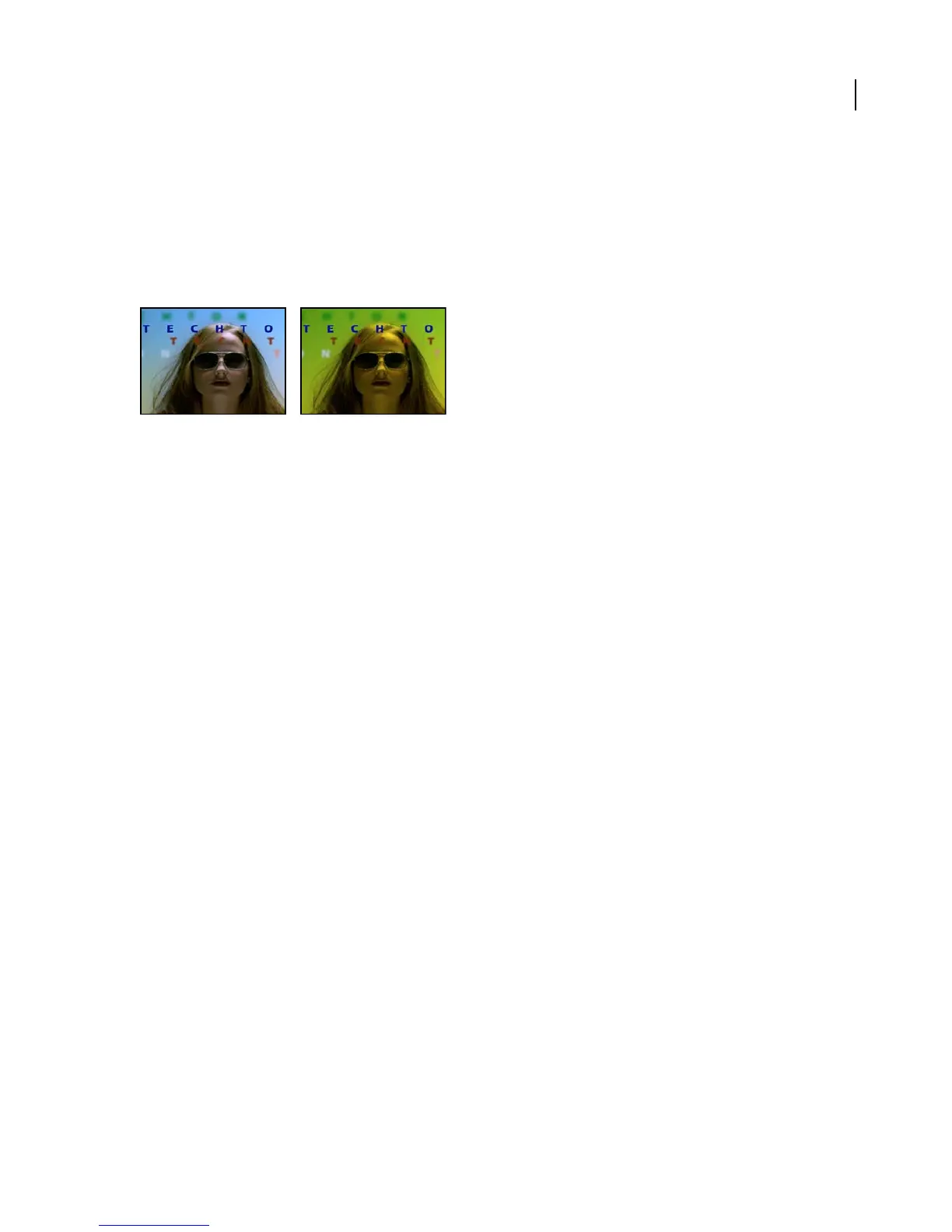
The Color Balance effect changes the amount of red, green, and blue color in a clip. The center point of each slider
is neutral and indicates no change. A setting of –100 removes all of the color; a setting of +100 intensifies the color.
The clip’s quality setting does not affect Color Balance. The Shadow/Midtone/Hilight channel Balance controls
specify the amount of a channel’s color in the darker, middle, and lighter color intensity ranges of a clip. Preserve
Luminosity preserves the average brightness of the image while changing the color. This control maintains the tonal
balance in the image.
Color Balance effect: Original (left) and with variations of Color Balance effect applied (right)
Convolution Kernel effect
The Convolution Kernel effect changes the brightness values of each pixel in the clip according to a predefined
mathematical operation known as a convolution. The Convolution Kernel Settings dialog box displays a grid that
representsapatternofpixelbrightnessmultipliers,withthepixelbeingevaluatedinthecenterofthegrid.Usethis
effect to create custom blurs and embosses.
See also
“To adjust brightness using convolution” on page 276
Extract effect
The Extract effect removes colors from a video clip, creating a textured grayscale appearance. Control the clip’s
appearance by specifying the range of gray levels to convert to white or black.
See also
“To remove color in a clip” on page 275
Levels effect
The Levels effect manipulates the brightness and contrast of a clip. It combines the functions of the Color Balance,
Gamma Correction, Brightness & Contrast, and Invert effects.
The Levels Settings dialog box displays a histogram of the current frame. The x-axis of the histogram represents
brightness values from darkest (0) at the far left to brightest (255) at the far right; the y-axis represents the total
number of pixels with that value.
See also
“To adjust luminance using levels” on page 268



 To Next Page