AUTOMATIC
16
5 Parts and accessories of the Saver One
5.1 Saver One Batteries
The Saver One defibrillator can work with two different types of batteries:
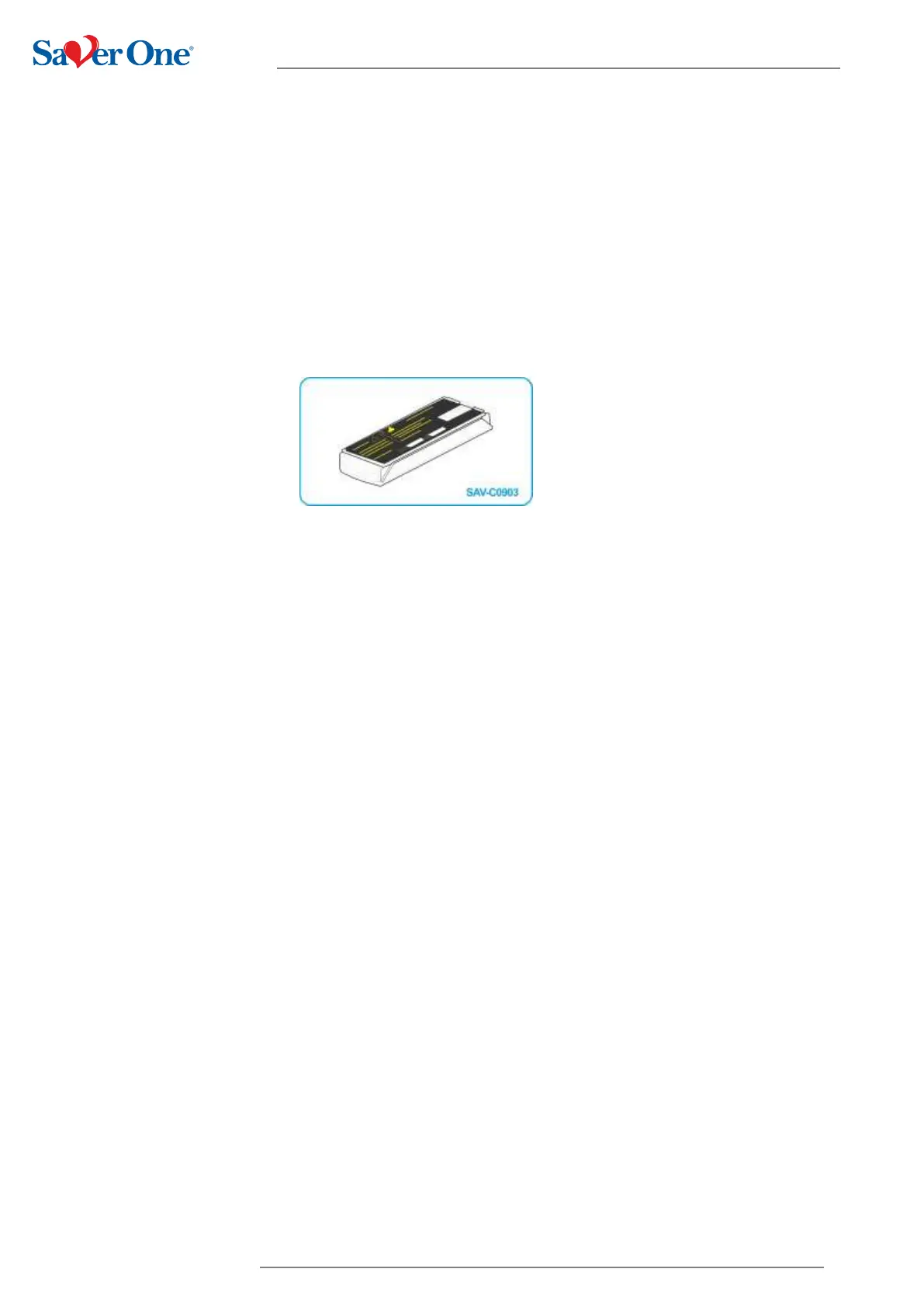
(SAV-C0903) Non-rechargeable Li-SOCl
2
battery
(SAV-C0011) Rechargeable Li ion battery
5.1.1 Non-rechargeable Li-SOCl
2
battery (SAV-C0903)
The non-rechargeable battery with Li-SOCl
2
technology (SAV-C0903) is supplied fully charged and ready for use. The
Li-SOCl
2
non-rechargeable battery has been designed to have a long battery life and no maintenance whatsoever.
The non-rechargeable battery of the Saver One in Standby mode is guaranteed for 4 (four) years*
1
assuming a battery
activation test, daily self-tests without turning on the AED. The Li-SOCl2 non-rechargeable battery (SAV-C0903) is
able to carry out a large number of shocks, which vary according to the version:
Saver One Standard 200J 300 complete rescue cycles (shocks at 200J. and CPR)*
1
Saver One Power 360J 200 complete rescue cycles (shocks at 360J. and CPR)*
1
*
1
New and fully charged battery, constant temperature at 20°C and relative humidity without condensation 45%
If the remaining battery level is low, the Saver One informs the user via audio and visual messages.
The Saver One will give a low battery warning when the level is ≤5% (WARNING) and a very low battery
warning when the level is ≤ 1% (ALARM)
WARNING: Remaining capacity level of Battery equal or less than 5%.
This notice will only be provided in Operating mode as indicated in paragraph 5.1.
With a 5% battery the Saver One allows to deliver about 14 shocks or 40 days of stand-by*
2
ALARM: Remaining capacity level of Battery at ≤ 1%
This warning will be provided both in Stand-by and in operating mode, as indicated in paragraph 5.1
With a battery at ≤ 1% the Saver One carries out about 7 shocks or 20 days of stand-by*
2
In this condition, the use of the device is not recommended.
*
2
, Constant temperature at 20°C and relative humidity without condensation 45%
!!ATTENTION!!
In order to protect the battery life (SAV-C0903) and guarantee automatic daily tests, after installing it, it is
advisable not to remove the battery (SAV-C0903) unless it is replaced. The removal of the battery and the
subsequent insertion involves a complete test of the AED, which considerably consumes its capacity.
Furthermore, if the battery is not properly attached it could be damaged.


 To Next Page