Chapter 1 Preparing for a WLAN Deployment
26 Aerohive
Designing a channel pattern is easier for the 5 GHz spectrum. Depending on the country and the device being used,
there are between 4 and 24 channels available for Wi-Fi use. However, in most countries there are at least 8
40-MHz-wide channels with which to work. To simplify the layout of more than 3 channels most use a 7-to-1 pattern,
as is shown on the right in Figure 6 on page 25. This channel layout is much more flexible than the 3-channel system
and allows for much better capacity over all channels.
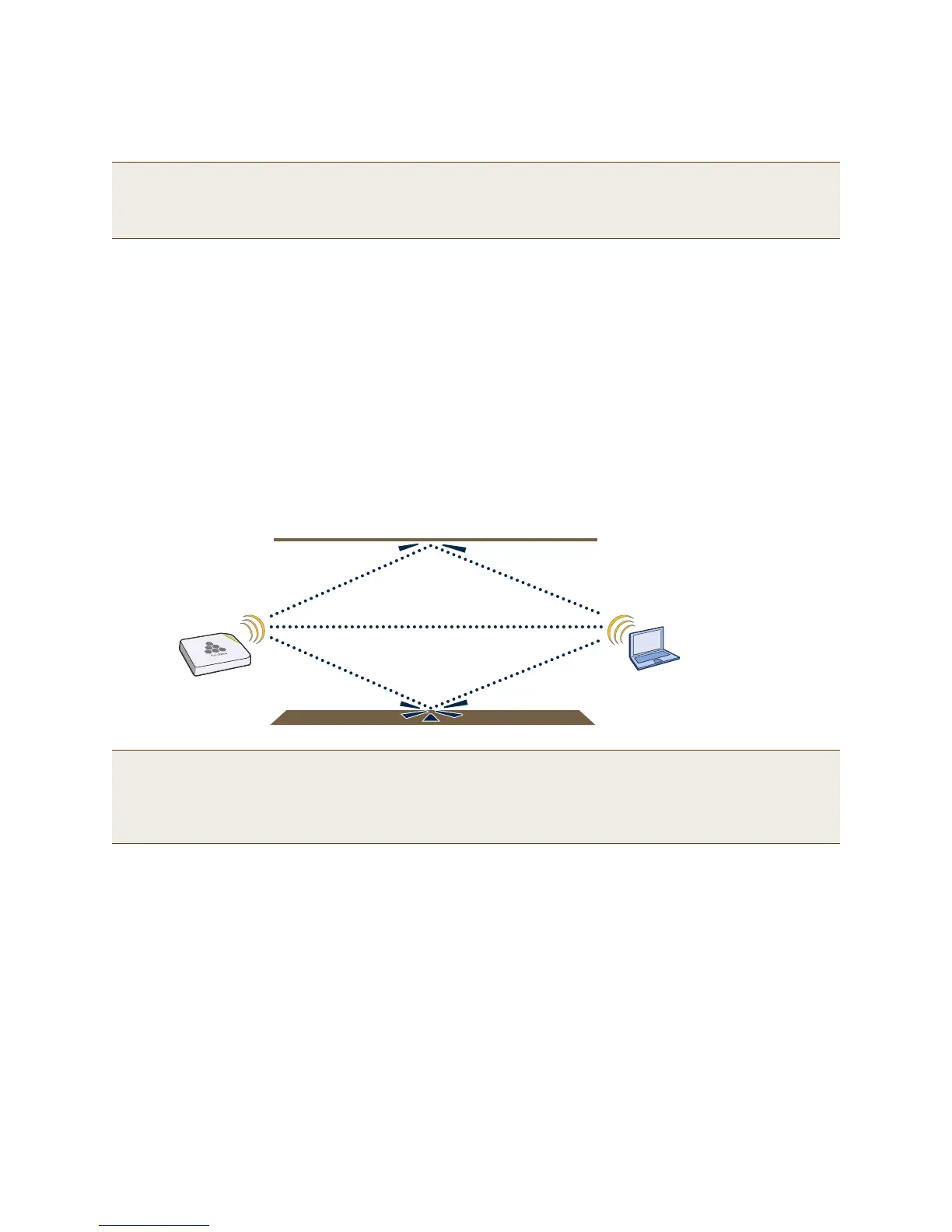
The last topic to cover is the concept of multipath. When a client receives a transmission from an access point (or
vice versa), the RF signal reaches the client first through a "direct path", but then shortly thereafter by the "indirect
paths" reflected off other objects. The direct path combined with the indirect paths make up multipaths
(see Figure 7). RF signals can bounce off of almost anything—walls, people, plants, and so on—but they bounce the
greatest off of metal. As the RF signals bounce about while propagating, one or more of the secondary paths can
interfere with the primary path, causing the signal strength of the direct path to diminish. In doing so, multipath
can greatly decrease signal to noise ratio with legacy 802.11a/g radios. With 802.11n, a certain amount of multipath
is desirable and increases performance.
Figure 7 Multipath radio waves
Note: There are alternative 2.4 GHz channel layouts, such as one for four channels using 1, 4, 8 and 11 and
another using channels 1, 5, 9 to counter interference from microwaves, which tend to cause interference
in the high end of the spectrum. Aerohive recommends alternative channel layouts only for the most
challenging radio environments.
Note: If you would like to learn more about how radio frequency propagation works or the details of 802.11,
Wikipedia provides excellent background information under the entries "IEEE 802.11", "radio propagation",
and "multipath". Additionally, spending a few hours with a site survey tool such as AirMagnet Surveyor or
Ekahau’s Site Survey (ESS) and a few test APs can increase both your familiarity with Wi-Fi propagation and
your confidence about how it behaves.
Primary Path
Secondary Path
Secondary Path


 To Next Page