1.3.1 Leaving at height
The work elevating platforms are not designed by taking into account the risks of the “leaving at height” because the only access
position considered is when the platform is completely lowered. For this reason this activity is formally forbidden.
However, there are exceptional conditions in which the operator needs to access or leave the work platform not in the access
position. This activity is normally defined as “leaving at height”.
The risks connected to the “leaving at height” do not depend exclusively on the PLE (work elevating platform) characteristics; a
specific risk analysis carried out by the employer can authorize this specific use by taking into account:
▪ The working environment characteristics;
▪ The absolute prohibition to consider the work platform as an anchoring point for people working outdoors;
▪ The use of the machine at xx% of its performances to avoid that additional forces created by a specific operation or
bending of the structure move away the access zone from the unloading zone. Provide for some tests in order to define
these limitations;
▪ Provide for a specific evacuation procedure in case of emergency (for example: an operator always on the platform, one at
the ground control panel while a third operator leaves the lifted platform);
▪ Provide for a specific training of the staff both as operator and transported staff;
▪ Equip the unloading zone with all the devices that are necessary to avoid the risk of fall of the staff that accesses/leaves
the platform.
What said above is not a formal authorization of the manufacturer for the “leaving at height”, but it wants to supply information to
the employer - who is fully responsible for that - which can be useful for the planning of this exceptional activity.
1.4 Description of the machine
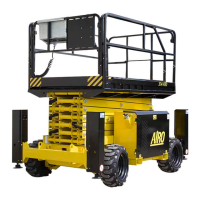
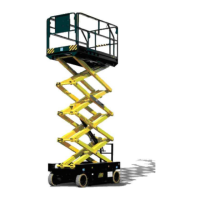
The machine described in this use and maintenance manual is a self-propelled elevating work platform equipped with:
▪ Motorized chassis equipped with wheels
▪ Vertical scissor lifting structure operated by one or more hydraulic cylinders (the number of cylinders varies according to
machine model)
▪ Operator platform with manual slide-out extension deck (the max. capacity varies according to the model - see chapter
"Technical features")
The chassis is motorised to allow the machine to move (see "Use instructions”) and has two rear idle wheels and two front driving
and steering wheels. The rear wheels are equipped with hydraulic parking brakes, positive logic type (when drive controls are
released brakes are automatically activated).
The hydraulic cylinders which move the articulated structure are provided with solenoid safety valves directly flanged on the same.
These devices allow the booms to remain in position even if one of the supply tubes accidentally breaks.
The platform, which can be manually extended from the front side, is equipped with rails and toe-boards of a prescribed height (the
height of the rails is 1100 mm; the height of the toe-boards is 150 mm, the entrance area has a toe-board of at least 100 mm).
When no motive power is available, the manual emergency lowering can be controlled enabling the knob manually from the ground
(see instructions plates).
The allowed capacity on the platform does not change depending on the position of the extension deck.


 To Next Page