malletKAT User Manual (ver.07-17-18)
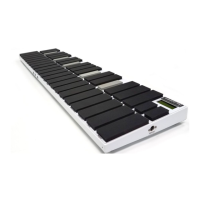
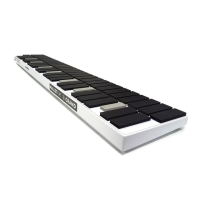
Looking down at the malletKAT, you will see that the “white” keys represent the most common programming
functions, and that ten of the “black” keys (accidentals) have been assigned individual numbers. These are
described in the section Editing Functions – Pad Shortcuts(https://alternatemode.com/online-
docs/malletkat/#editing-functions-pad-shortcuts)
Step on the Edit Footswitch and hold it down… Tap on the SETUP pad (second highest C natural) and then the
numbers corresponding to the User Setup you want.
Because of the size of the malletKAT Express, this shortcut is not available. Express users can get around this by
using Chains. This is described in the section How to Create a Chain(https://alternatemode.com/online-
docs/malletkat/#how-to-create-a-chain)
4.4. Training Your malletKAT To Your Playing Style
A Note of Caution: While the malletKAT can distinguish between 127 different velocity levels from your
mallets, playing excessively hard CAN and WILL damage your instrument. If you find you need to play
louder, first try using a more powerful amplifier!
Training the Pads
One of the most important design features of the malletKAT is its ability to have the pads be trained by the user
for personal dynamic response. Every player has their own idea of what a soft hit is and how hard they ultimately
want to play. By teaching the malletKAT your playing style, the instrument learns the way you play and provides
the widest dynamic response possible for you.
Training your malletKAT is NOT the same thing as adjusting sensor thresholds.
Threshold adjustments
are used to change the overall sensitivity of the sensors under the pad. If your instrument does not seem to
respond well to soft hits, or is falsely triggering (playing notes without you hitting the pad), then you should adjust
the sensor thresholds before you train the malletKAT.
There are three ways that the malletKAT can be trained.
GLOBAL TRAINING, where you hit one pad soft, then hard to give the overall dynamic response for the entire
instrument.
GROUP TRAINING, where each octave on the malletKAT is trained separately.
INDIVIDUAL PAD TRAINING, where individual pads can be trained separately from the rest of instrument.
These last two features can be invaluable if one note starts to behave differently or if an expander octave was
purchased at a different time from the original and its sensitivity characteristics are slightly different from the rest
of the unit.
25 / 109


 To Next Page