18 I
I – 2 Milling Specific Operations
Arc Milling
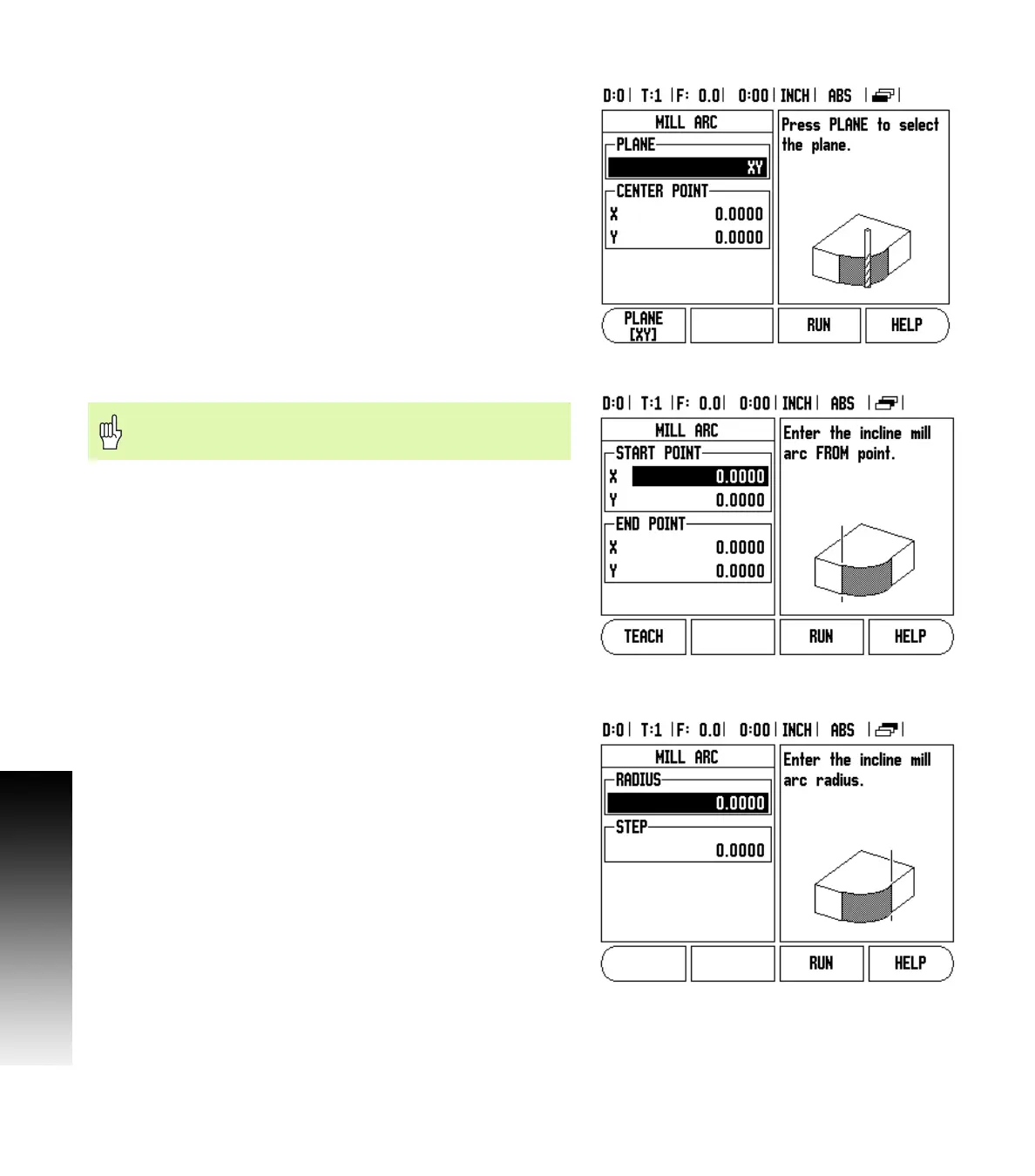
Entry Form: (See Fig. I.23 Entry Form: Center Point), (Fig. I.24 Entry
Form: Start Point) and (Fig. I.25 Entry Form: Radius)
The Arc Milling form is used to specify a curved surface to be milled.
Press the ARC MILLING hard key to open the form.
Plane Selection: Select the plane by pressing the PLANE soft key.
The current selection is shown on the soft key and in the plane field.
The graphic in the message box aids in selecting the correct plane.
Center Point: Enter the coordinates of the arc’s center point.
Start Point: Enter the coordinates of the start point.
End Point: Enter the coordinates of the end point
Radius: Enter the radius of the arc.
Step: Enter the step size. When milling, this is the distance along
the circumference of the arc between each pass or step along the
arc’s contour.
Press ENTER or RUN to execute the milling operation. Press C to exit the
form without executing. Settings are retained until power is turned
off.
Execution
Execute the milling operation by opening the entry form and
pressing the RUN soft key or ENTER key. The screen switches to the
incremental DRO view.
Initially, the DRO shows the current incremental distance from the
start point. Move to the start point and make a plunge cut or the first
pass across the surface. Press the NEXT PASS soft key to continue
with the next step along the contour.
After pressing NEXT PASS, the incremental display shows the
distance from the next step along the arc’s contour.
If no step size was specified, the incremental display always shows
the distance from the closest point on the arc. To follow the
contour, move the two axes in small steps, keeping the (X, Y)
positions as close to 0 as possible.
When executing a surface milling operation, three views are
available: incremental DRO, contour, and absolute DRO. Press the
VIEW soft key to toggle through the available screens.
Fig. I.23 Entry Form: Center Point
Fig. I.24 Entry Form: Start Point
Fig. I.25 Entry Form: Radius
The Step size is optional. If the value is zero, the operator
decides at run-time how far to move between each step.



 To Next Page