Update Documentation P44x/EN AD/E44
MiCOM P441, P442 & P444
Page 45/82
9.6 New Function Description: THERMAL OVERLOAD
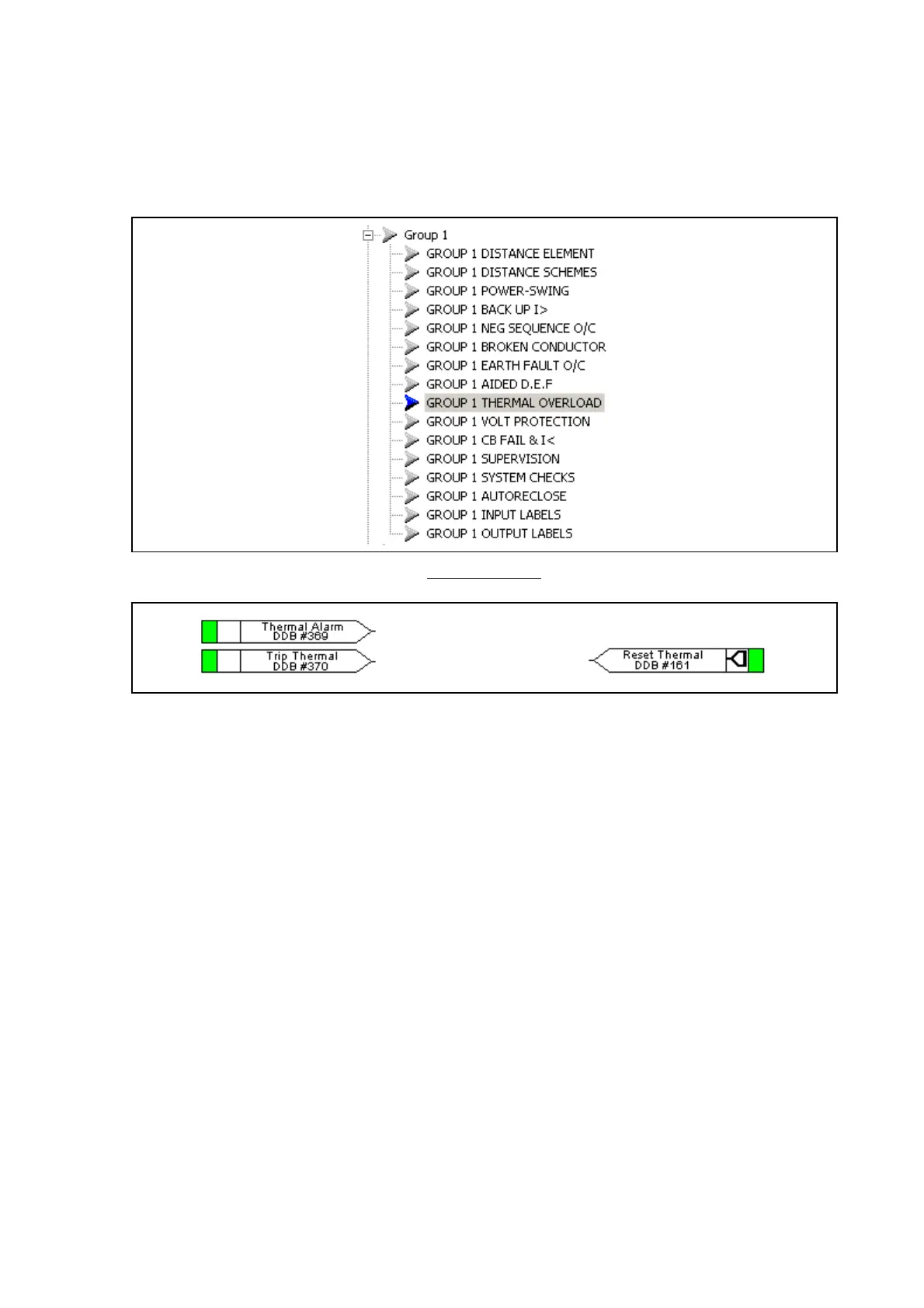
A NEW THERMAL OVERLOAD (with 2 time constant) function has been created as in the
other transmission protection of the MiCOM Range, which offer alarm & trip (see section
1.2.1)
New DDB cells:
Thermal overload protection can be used to prevent electrical plant from operating at
temperatures in excess of the designed maximum withstand. Prolonged overloading causes
excessive heating, which may result in premature ageing of the insulation, or in extreme
cases, insulation failure.
The relay incorporates a current based thermal replica, using load current to model heating
and cooling of the protected plant. The element can be set with both alarm and trip stages.
The heat generated within an item of plant, such as a cable or a transformer, is the resistive
loss (Ι
2
R x t). Thus, heating is directly proportional to current squared. The thermal time
characteristic used in the relay is therefore based on current squared, integrated over time.
The relay automatically uses the largest phase current for input to the thermal model.
Equipment is designed to operate continuously at a temperature corresponding to its full load
rating, where heat generated is balanced with heat dissipated by radiation etc. Over
temperature conditions therefore occur when currents in excess of rating are allowed to flow
for a period of time. It can be shown that temperatures during heating follow exponential
time constants and a similar exponential decrease of temperature occurs during cooling.


 To Next Page