37
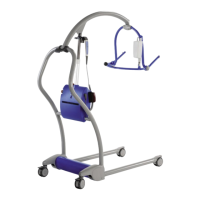
Care of your Maxi Move
The frequency of the following actions depends on how
often the equipment is used.
Unless otherwise stated, follow the cleaning, care and
inspection procedures described in this section before
each and every use.
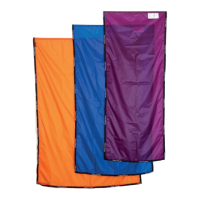
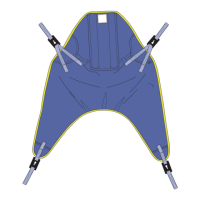
Sling Cleaning and Care
The slings should be checked before and after each
patient use and if necessary, washed in strict accordance
to the instructions on the sling. This is especially
important when using the same equipment for another
patient, as it can minimize the risk of cross-infection.
Also refer to sling instruction sheet MAX.01510.INT.
Slings should not be classified as linen, but as an
accessory to a patient transfer lift and, therefore, are
classified as a medical device accessory.
Mechanical pressure, such as rolling or pressing, should
be avoided during the washing and drying procedure, as
this can damage parts that are vital to the safe and
comfortable operation of the sling.
The strap stretcher cross straps and suspension straps
should be checked and washed if necessary. Washing
and drying temperatures must not exceed 80°C (176°F).
Wash using normal detergents. Do not iron. Also refer to
the Sling Instruction sheet MAX.01510.INT.
It is essential that the slings, sling loops, straps and
attachment clips are carefully inspected before each and
every use. If the slings, loops or straps are frayed or the
clips damaged, the sling must not be used and should be
replaced immediately.
Lift Cleaning and Care
It is recommended that the patient lifting equipment and
accessories be cleaned and/or disinfected between each
patient use. If the lift and/or equipment need cleaning, or
is suspected to be contaminated, follow the cleaning and/
or disinfection procedures recommended below before
reusing the equipment.
To clean the lift equipment and accessories (except
slings), wipe them down with a damp cloth using warm
water and “ARJO CLEAN” disinfectant/cleaner or
equivalent.
“ARJO CLEAN” disinfectant cleaner is available from
ARJO or its approved distributor.
To disinfect contaminated lifts, equipment and
accessories (except slings), use the preferred method of
wiping the product completely with “hard surface
disinfectant wipes” which are supplied impregnated with
a 70% v/v solution of Isopropyl Alcohol.
Rub the equipment vigorously when using the wipes, to
promote an effective disinfection of the lift’s surfaces.
Using 70% v/v Isopropyl Alcohol wipes has been proven
to be effective against MRSA and several other micro-
organisms under light soiling conditions.
Mandatory Daily Checks
The Following Checks Should Be Carried out Daily:
• Ensure that the battery pack is always fully charged.
• Ensure that the castors are firmly secured to the
chassis.
• Carefully inspect all parts, in particular where there
is close contact with the patient’s body. Ensure that
no cracks or sharp edges have developed which
could injure the patient’s skin or become unhygienic.
• Check that all external fittings are secure and that all
screws and nuts are tight.
• Ensure that all the instruction labels are firmly
attached and in a readable condition.
Periodic Testing
Some testing needs to be carried out at weekly intervals.
Periodic testing of the various functions is advisable to
ensure everything operates properly.
Test for full and efficient movement of the lift/lower
mechanism: Raise and lower the jib using the control
handset. Test the mechanism with the switches on the
control panel as well.
Automatic Stop Function: With the jib well above its
lowest position and the lift positioned over an empty
bed, use the handset control to lower the jib onto the bed.
When the jib lowering becomes restricted, the motor will
stop. Release the handset lower button after a second or
two. Use the control handset to raise the jib. Then repeat
this test using the control panel. This is to check for the
correct functioning of the automatic stop.
Immediate Stop: To test the immediate stop function,
operate the remote control handset to lift or lower the jib.
While operating, press the stop button (see Fig. 8).
Powered movement should stop immediately.
Press the power button to reset to the normal function
(see Fig. 8). Repeat this test using the control panel.
Reset to normal function. Repeat this check for the
chassis leg opening/closing function, and reset the power
button.
WARNING: Do not drench the product, as this
could damage electrical components and
cause internal corrosion.
If a hot air dryer is used to dry the lift, the
temperature must not exceed 80°C (176 °F).
Do not use petroleum-based solvents, as this
may damage plastic parts.
CAUTION: Cleaning and disinfection products
must be used in accordance with the
instructions. Wear the appropriate eye, hand
and clothing protection at all times when
handling disinfectants.


 To Next Page