24
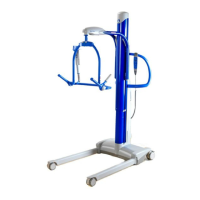
Using your Maxi Move
Once the sling has been positioned and attached securely
to the spreader bar, the patient can be lifted using the
control handset. For general patient manoeuvring and
transferring, see also the section entitled “Using DPS
Spreader Bar”.
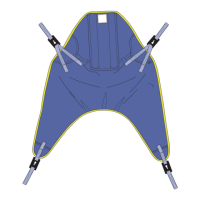
Apart from the methods listed above, the Loop spreader
bar with loop slings is also extremely useful for lifting
patients who have “contracted legs”, which prohibit the
use of the DPS spreader bar. Attach the sling as
described in the section entitled “To lift from the Bed”.
To Lift from the Bed
Place the sling under the patient as if it were a sheet. Flex
the patient’s legs and bring the sling leg sections under
the thighs. Attach the sling to the spreader bar using any
of Methods 1-3 above.
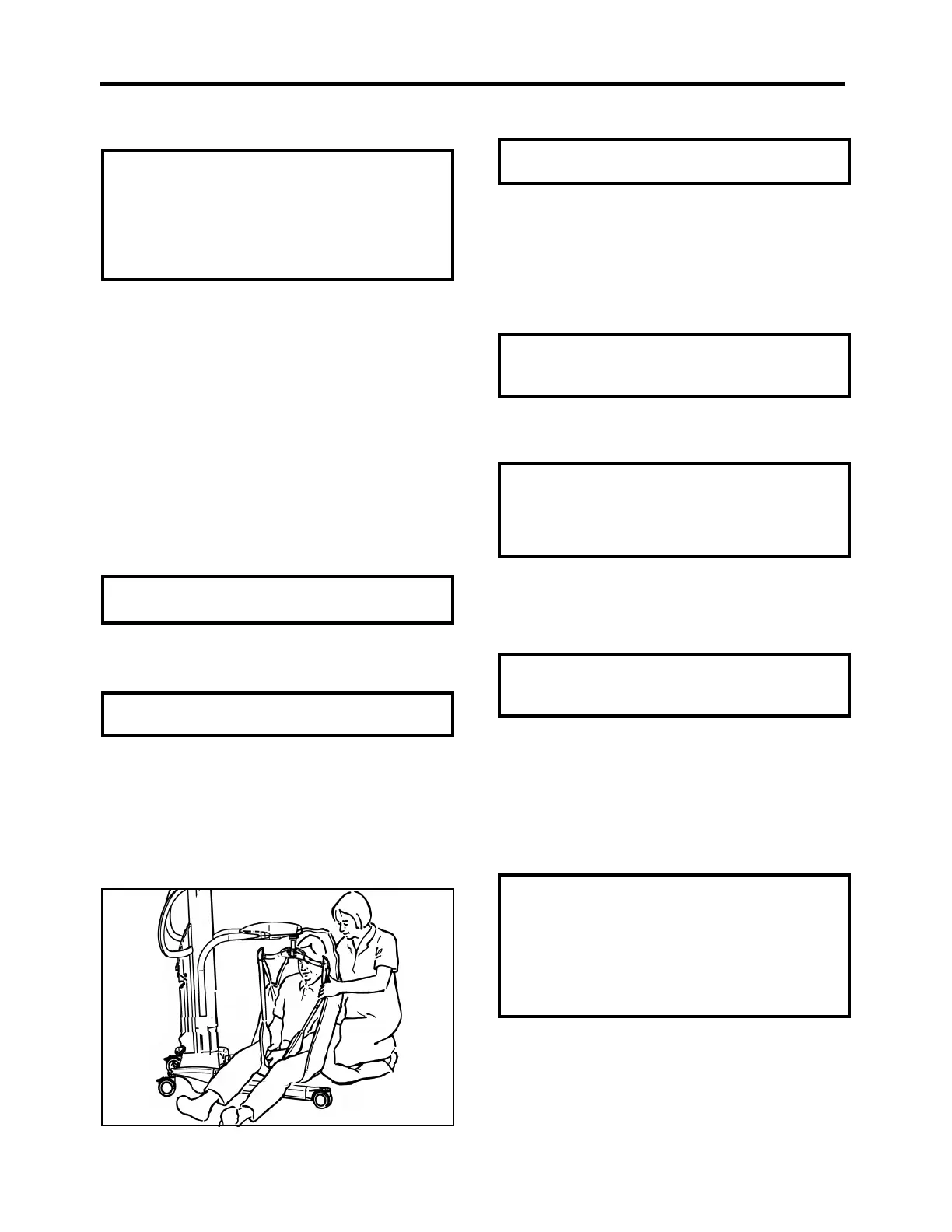
To lift from the Floor
Raise and support the patient into a sitting or half sitting
position. Feed the sling down along the patient’s back.
Bring the leg portions of the sling into position. Raise the
patient’s legs over the chassis, and bring the lift into
position (see Fig. 39). With the jib as low as possible,
attach the shoulder loops. Bend up the patient’s knees to
connect up the leg portions of the sling.
Fig. 39
When lifting or lowering a patient who is supported by a
sling, do not use the castor brakes. This allows the lift to
move to the correct position using the patient’s center of
gravity.
When the patient has been returned to the bed, the patient
may be laid down before the sling is detached.
Using the Stretcher Frame
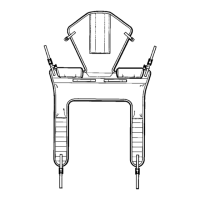
The stretcher frame has been designed to aid portability
without removing the stretcher frame from the lift, such
as for going through doorways.
Using the Soft Stretcher
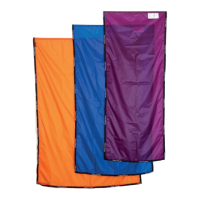
The soft stretcher is intended for use with the stretcher
frame and is available in two sizes: large and extra-large.
It is also supplied in both plain polyester or polyester
mesh for washing. Both types are available with or
without commode hole. Use the following procedure to
lift a patient using the stretcher frame and soft stretcher.
Identify the head section of the soft stretcher. Look for a
label sewn to the end of the head section.
Position the soft stretcher sling by rolling the patient
over as if inserting a sheet. Ensure that the top section of
the sling (as indicated by the label attached to the sling)
is under the patient’s head, with the top edge of the sling
WARNING: Always check that all the sling
attachment loops are fully in position before
and during the lifting cycle, and in tension as
the patient’s weight is gradually taken up.
When lowering, ensure that both the patient’s
and attendant’s legs and feet are well clear of
the moving mast.
CAUTION: Check that all four points of the
sling are securely connected before lifting.
NOTE: Some attendants prefer to use a larger
sling for this operation.
CAUTION: Check that all the loops are securely
attached before lifting.
WARNING: When lowering the spreader bar,
ensure that both the patient’s and attendant’s
legs and feet are well clear of the moving mast.
WARNING: To avoid tipping when using the
lifter with a stretcher, transfers must only be
performed on flat, non-sloping surfaces/
floors. Also, always make sure that the patient
is positioned in the middle of the stretcher.
WARNING: Do not raise or lower the patient
while the stretcher frame is being used to
transfer a patient.
CAUTION: Before the soft stretcher can be
used with the Maxi Move, ensure the ARJO
stretcher frame has been correctly installed on
the carrier (see Fig. 14). Once correctly
installed, the stretcher frame should be able to
rotate approximately 90° around its axis. Do
not install the stretcher frame in line with the
jib.


 To Next Page