
 Need help?
Do you have a question about the Avid Technology Digidesign USD and is the answer not in the manual?
Details hardware and OS requirements for Pro Tools and standalone USD use.
Information about the specific cables required for connecting the USD to various systems.
Guidance on ensuring compatibility with other hardware and software components.
Explains the symbols and formatting conventions used throughout the manual.
Lists the various sources the USD can use for positional synchronization.
Lists the various sources the USD can use for clock synchronization.
Guides on establishing a connection between the USD and a computer system.
Details about the specific serial cable included with the USD.
Instructions for connecting USD to a Mac for setup without Pro Tools.
Instructions for connecting USD to a PC for setup without Pro Tools.
Steps for connecting the USD to a power source.
How to connect video sources for sync and window burn.
Instructions for connecting devices using Linear Time Code (LTC).
How to connect devices for Word Clock synchronization.
Connecting to AES/EBU for clock reference.
Using USD to provide AES/EBU clock reference.
Details about the MTC Out port and its capabilities.
Connecting MTC devices to the USD.
Software installation for specific Pro Tools systems.
Software installation for Pro Tools III systems.
Steps to install the USD Setup application.
Configuration steps for USD within Pro Tools.
Configuration steps for the USD Setup application.
How to check the current firmware version.
Steps to update firmware using Pro Tools.
Steps to update firmware using USD Setup.
Explanation of the status LEDs on the USD front panel.
Using the TC field for reference and troubleshooting.
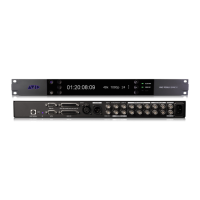
Overview of the controls and displays on the USD front panel.
Controls power to the USD unit.
Selects the USD's clock reference source.
Indicate the active clock reference selected.
Displays the current USD sample rate.
Multifunction display for time code and parameters.
Momentary switches for accessing USD functions.
Selects the USD's positional reference source.
Yellow LEDs indicating the active positional reference.
Selects the time code frame rate and format.
Displays the current USD frame rate.
Indicates the USD's state relative to clock references.
Accessory port for Bi-Phase, Tach, GPI, and Pilot signals.
Bidirectional serial port for PC-compatible computers.
Input for video source as clock reference or window burn.
Output for passing video reference signals to other devices.
Serial port for Macintosh computers and Pro Tools systems.
Input for video signal for clock reference or window burn.
Output for video signals, potentially with VITC or window burn.
Output for MIDI Time Code (MTC).
Input for Linear Time Code (LTC) signals.
Output for Linear Time Code (LTC) signals.
Input for AES/EBU digital audio signals for clock reference.
Output for AES/EBU digital audio signals.
Input for Word Clock signals.
Output for Word Clock signals.
Input for Super Clock signals.
Output for Super Clock signals.
Connector for AC mains power input.
Instructions for activating and deactivating help within USD Setup.
Details the three methods for controlling the USD.
Compares control availability across different methods.
Lists features only controllable via software, not the front panel.
Explains the function of the 'Set' switch.
Explains the function of the 'Down' and 'Up' switches.
How to set frame rate using front panel.
How to choose a clock source from Pro Tools.
Steps for configuring clock reference in Pro Tools.
Using front panel to select clock reference.
Using USD Setup to select clock reference.
Specific options for video clock reference.
Using serial time code with MachineControl.
Notes on limitations of the front panel switch for video.
How to resolve to digital clock sources.
Details on using Word Clock as a reference.
Details on using Super Clock as a reference.
Steps to resolve USD to LTC.
Additional details about LTC signals.
Steps to resolve USD to Pilot Tone.
Configuration for Bi-Phase/Tach clock reference.
How to select a positional reference from Pro Tools.
Relationship between positional reference and Bi-Phase/Tach.
Details on using LTC as a positional reference.
Setting the duration for time code freewheeling.
Using VITC with Pro Tools for positional reference.
Using front panel for VITC positional reference.
Using USD Setup for VITC positional reference.
Other settings related to VITC.
Ensuring correct signal routing for VITC.
Selecting Auto Switch in Pro Tools.
Selecting Auto Switch via front panel.
Selecting Auto Switch via USD Setup.
Prerequisites for using Auto Switch.
Calculating positional reference from Bi-Phase/Tach.
Setting the starting frame for Bi-Phase/Tach.
Defining signal direction on front panel.
Setting PPF value via front panel.
Conditions for regenerating time code.
Mode for internal time code generation.
Restrictions on frame rates during generation.
Setting start frame via Pro Tools.
Setting start frame via front panel.
Steps to regenerate LTC using various methods.
Steps to generate LTC using various methods.
Rule for applying VITC based on video inputs.
Regenerating VITC via front panel.
Regenerating VITC via USD Setup.
Generating VITC internally via front panel.
Controlling MTC output when LTC is idle.
Requirements for burning window dubs.
Burning dubs via Pro Tools.
Pro Tools configuration for window dub.
USD Setup configuration for window dub.
Disabling window dubbing.
Enabling window dub via front panel.
Customizing window dub appearance (size, position, color).
Details parameters and features of front panel controls.
Explains the USD's 7-segment LED abbreviations.
Steps to select parameters on the front panel.
Setting the generator's start time.
Available digital clock references.
Choosing the USD's sample rate.
Inserting VITC into outgoing video signals.
Setting which line pair to use for VITC source.
Setting line pair for VITC insertion.
Enabling/disabling window dub via front panel.
Setting freewheel duration via front panel.
Steps to set LTC output level.
Enabling/disabling pitch memory.
Setting PPF value via front panel.
Selecting NTSC or PAL format.
Muting idle MTC via front panel.
Using video inputs as clock reference.
Using video inputs for VITC and character generator.
Steps to implement fader start.
Configuring Pro Tools tracks for fader start.
Pre-calibration warm-up procedure.
Restoring factory calibration.
Steps to reset all parameters to defaults.
Information on video and VITC signals for sync.
Details on LTC signal characteristics and limitations.
Examples illustrating Auto-Switch functionality.
Details on using Word Clock.
Details on using AES/EBU.
Details on using Super Clock.
General specifications including sample rates, frame rates, and VSO.
Time taken to lock to various reference signals.
Stability and aging of frequency reference.
Specifications for burn-in window appearance.
Physical dimensions of the USD unit.
Physical weight of the USD unit.
Resistance to vibration.
Resistance to shock.
Recommended operating temperature range.
Recommended storage temperature range.
Humidity limits for operation.
Voltage, frequency, and wattage specifications.
Compliance with regulatory standards.
Specifications for the LTC input connector.
Specifications for the LTC output connector.
Specifications for the main video input.
Specifications for the main video output.
Specifications for the video reference input.
Specifications for the video reference output.
Specifications for the AES clock input.
Specifications for the AES clock output.
Specifications for the Word Clock input.
Specifications for the Word Clock output.
Specifications for the Super Clock input.
Specifications for the Super Clock output.
Specifications for the Bi-phase/Tach/GPI/Pilot connector.
Specifications for GPI inputs.
Specifications for TTL GPI outputs.
Specifications for Relay GPI outputs.
Specifications for MTC output.
Specifications for the Mac Serial port.
Specifications for the PC Serial port.
Specifications for VITC input.
Specifications for VITC output.
Pin assignments for the Mac Serial Port.
Pin assignments for the PC Serial Port.
Pin assignments for the accessory port.
Pin assignments for the USD serial cable.
Notes on interfacing with the accessory port.
Description of opto-isolated GPI inputs.
 General
| Brand | Avid Technology |
|---|---|
| Model | Digidesign USD |
| Category | Recording Equipment |
| Language | English |






 To Next Page