D9068 | Operation and Installation Guide | 4.0 System Operation
Bosch Security Systems, Inc. | 3/13 | F01U071094-07
3.2 System Quick Start
The D9068 starts in a trouble condition
until the installer completes the
following steps:
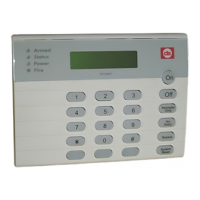
1. Connect the D7033/FMR-DACT-KEYPAD
Keypad Programmer. Refer to
Connecting the Keypad to the D9068 in
Section 2.2.4 Telephone Connections
on page 17.
2. Program the D9068 using the
D7033/FMR-DACT-KEYPAD. Refer to
Section 5.1 Using the Keypad on page
32.
3. Configure the five input points.
Refer to 1: CONFIGURE in Section
5.4.3 PROG INPUTS on page 39.
4. Assign the D9068 account numbers.
Refer to 1: ACCOUNT NUMS in Section
5.4.5 PROG ACC’NTS on page 42.
5. Assign the D9068 telephone numbers.
Refer to 2: PHONE NUMS in Section
5.4.5 PROG ACC’NTS on page 42.
When you complete Steps 1 through 5,
refer to Section 5.0 Programming on page
32 to finish the programming sequence.
If the D9068 is correctly
programmed and the input wiring
is properly connected and
supervised, only the Heartbeat
LED flashes. This indicates
normal system operation.
To verify correct
communications, perform a
manual Communications Test.
Refer to 1: TEST COMM in
Section 5.5.4 3- TEST on page
50 for manual communication
testing instructions.
Test the system according to
NFPA 72 Chapter 10.4.1.2 (2002)
after modifications, repairs,
upgrades, or adjustments.
Refer to Appendix A:
Troubleshooting on page 51 for
information on error messages
or messages indicating abnormal
operating conditions.
4.0 System Operation
4.1 Communicator Operation
The D9068 has an integrated communicator
that sends reports to a monitoring
station. The communicator operates
automatically.
When events occur, the communicator
sends corresponding reports to the
monitoring station by priority according
to NFPA requirements. Fire and water-
flow alarms are sent first, followed by
supervisory alarms and trouble reports,
and finally by all other reports.
4.1.1 Phone Line and Phone Number
Selection
To comply with UL and NFPA
standards, program a primary
and an alternate telephone
number. The numbers must be
different.
The D9068 can report to two telephone
numbers with full single, double, and
backup reporting. It communicates in
Modem IIIa
²
, Contact ID, SIA, and
4/2 formats.
To verify the delivery of critical
reports, the D9068 can report over two
phone lines. Reports can be directed to
one or both of the two phone numbers
using the report steering feature in the
D9068 programming. Account Number 1 is
used with Phone Number 1 and Account
Number 2 is used with Phone Number 2.
Except for Test Reports, the
D9068 automatically selects the
telephone line to use.
Report Routing
Reports are routed in two ways:
1. Report routing starts using Phone
Number 1 on Phone Line 1, unless the
line monitor shows Phone Number 1 to
be bad at the start of reporting. If
the report fails on Phone Number 1 on
Phone Line 1, the D9068 automatically
switches and uses Phone Number 2 on
Phone Line 1.
2. If the report still fails on either
phone number on Phone Line 1, the
D9068 tries to send the report on
Phone Line 2 using Phone Number 1. If
this fails, it tries Phone Number 2
on Phone Number 1.


 To Next Page