Service Manual 04/2010 Rev.B
73
: 1h
: Small standard and cross screwdrivers,
pliers, multimeter.
L : Defective cable or connector may cause the
following malfunction:
1. One or more hydraulic movements do not
work.
2. Fuse F7 blows up.
TO CONTROL THE CABLE:
Disconnect the machine from power supply.
Open the electric box (5.0).
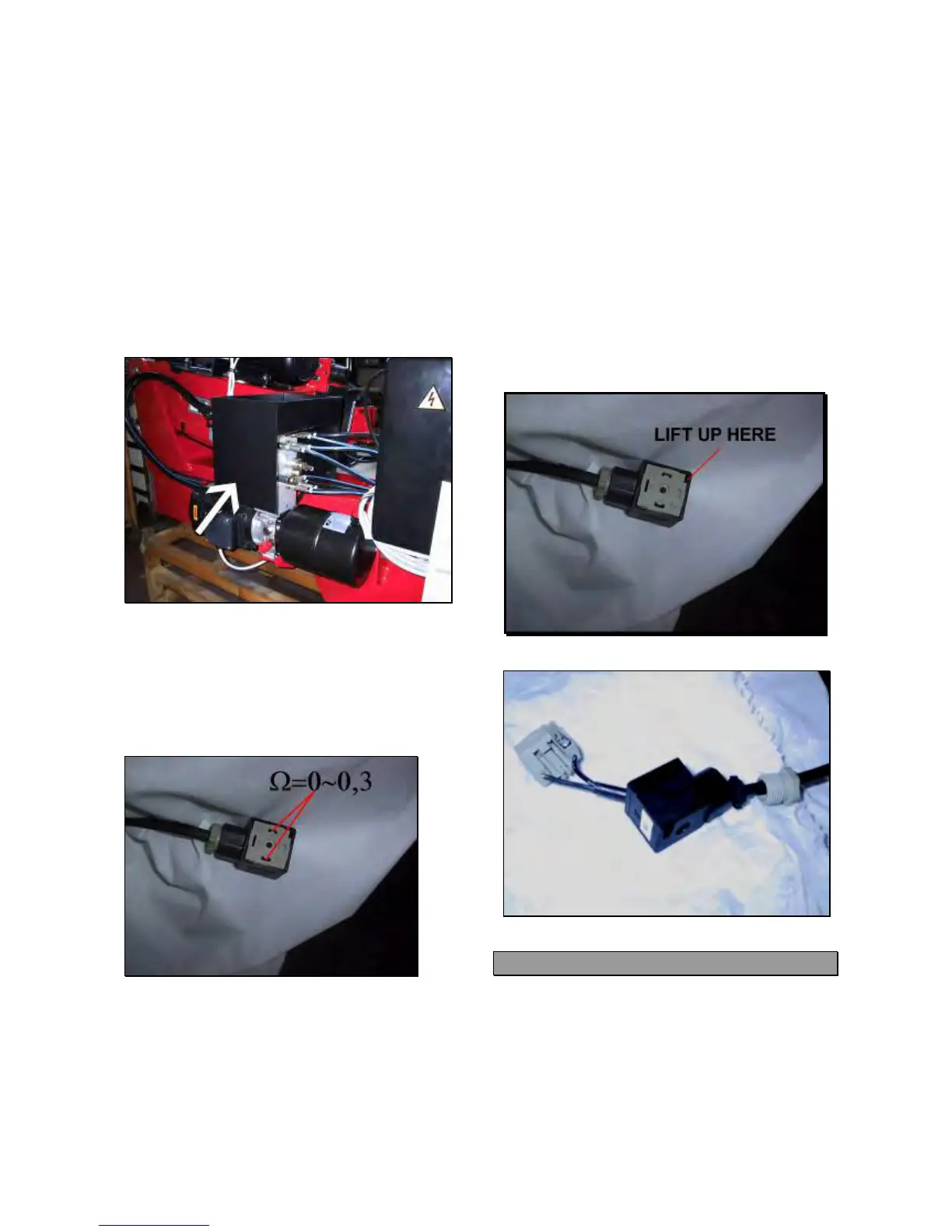
Remove the coil valve protection (Fig.122).
Fig.122
Remove all coil connector from coil valves.
Take a multimeter and select it in Ohm.
Position the multimeter probes on the ends of
the coil connector (Fig.123) and verify if there
is continuity between the terminals: If there is
not continuity the wires are defective.
Fig.123
TO REPLACE THE CABLE:
Disconnect all wires from the terminals block.
Disconnect all connectors from coil valves.
Release the cable strains relief.
Lift up the connectors by using a screwdriver
to have access to the wires (Fig.124).
IMPORTANT!
VERIFY IF THE WIRES ARE FITTED ON THEIR
TERMINALS. IF THEY AREN’T TIGHTEN THEM
FIRMLY TO THE TERMINALS, MOUNT THE
CONNECTOR AGAIN AND VERIFY IF THE
MACHINE WORKS FINE. IF THE PROBLEM IS
STILL NOT SOLVED PROCED FOLLOWING
THE BELOW INSTRUCTION.
Remove all wires from connectors (Fig.125).
Take away the defective cable.
Insert the new cable.
Tighten all wires FIRMLY on the terminals
block and on the coil connectors.
Tighten the cable strains relief.
Fix the connectors to the coil valve following
the correct order.
Fig.124
Fig.125
6.0 HYDRAULIC FUNCTION
The hydraulic working pressure at which each
machine is carefully regulated is 160 Bar (2300
P.S.I) and it is reported on the sticker label.
The hydraulic system is composed by two
different circuits:
High pressure circuit at 160 Bar (2300 psi).
Low pressure circuit at 60 Bar (860 psi).



 To Next Page