Service Manual 04/2010 Rev.B
92
Lock FIRMLY the support screw.
Lock FIRMLY the nut #1 (Fig.186).
Mount the cylinder protection 6.1 Fig.127.
Turn on the machine.
Open the saddle.
Mount the hose plastic separators (Fig.184).
Mount the oil hose protection 6.1 Fig.127.
Check the hydraulic oil level 6.2.
6.11 KING 5600 SADDLE CYLINDER
SEALS: CHECK AND REPLACEMENT
: 2h
: End wrench 13, 19mm, 8mm Allen wrench,
socket wrench of 27mm, medium standard
screwdriver, pliers, calliper wrench, steel and
rubber hammer, hydraulic oil container.
L Defective seals may cause the following
malfunction:
1. Oil leaking from the piston rod.
2. Oil leaking from ring screw.
3. Low bead breaker power.
TO CHECK THE RING NUT “O” RING AND THE
PISTON ROD LIP SEAL:
Switch the machine on.
Close the saddle cylinder.
When it is at the end of stroke, keep it under
pressure and verify if there is oil leaking from
the piston rod or from ring nut.
Open the cylinder ‘till end of stroke and verify
that the piston rod would not show marks or
other kind of damaging.
TO CHECK THE PISTON SEAL:
Defective seals may cause low bead breaker
power in one or both way.
Switch the machine on.
Close the saddle cylinder ‘till end of the
stroke.
Press the coil valve by screwdriver to unload
the remaining pressure (5.13 Fig.93).
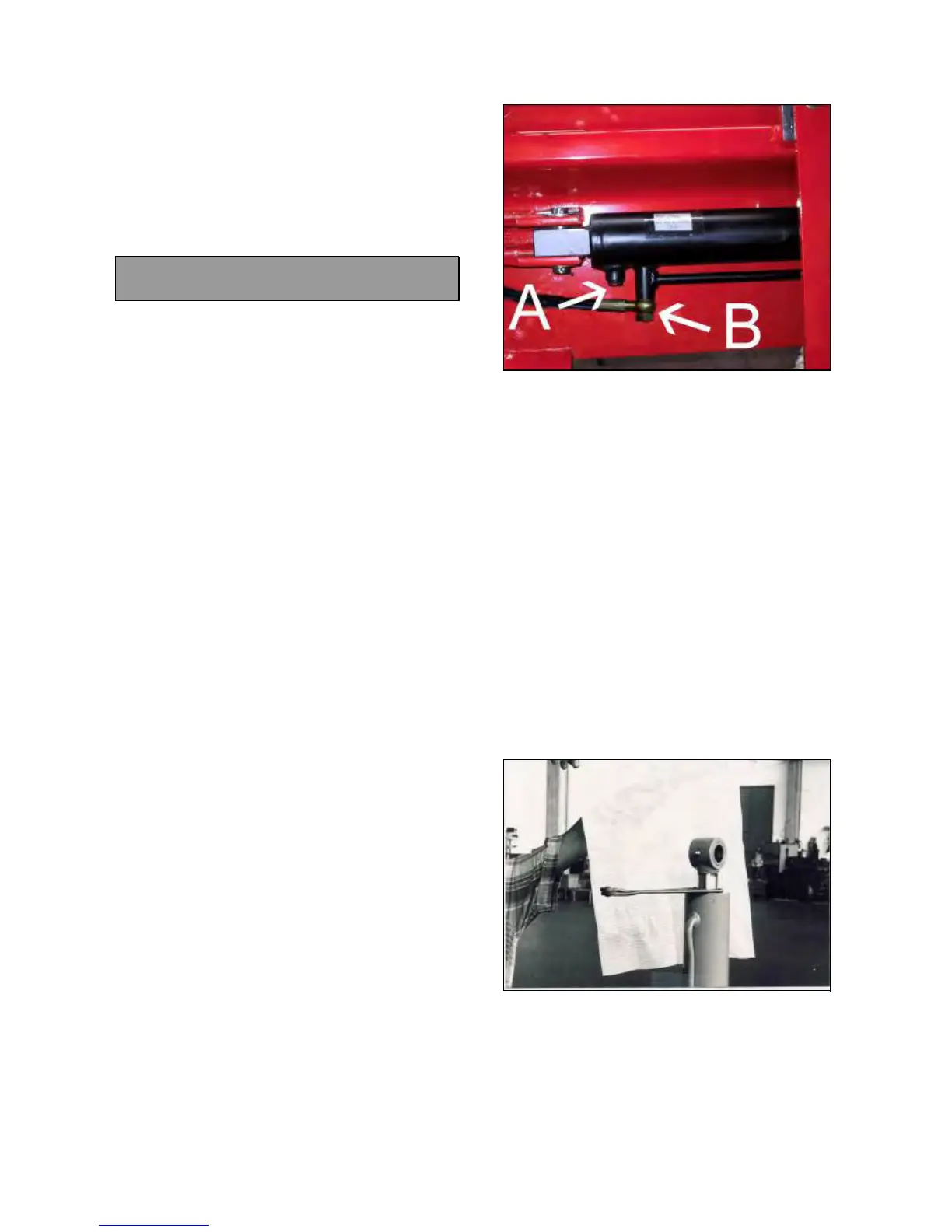
Take the oil container and remove the hose
“A” (Fig.191).
Fig.191
Take the portable control and press the
movements left of the saddle to have the hose
“B” (Fig.191) under pressure.
If the side “A” will leak considerably oil, the
piston seal is defective.
Some drops of oil leaking are considered
absolutely normal.
Perform the same operation on the side “B”.
TO REPLACE THE “O” RINGS AND THE
SEALS:
IMPORTANT!
WHEN THE CYLINDER NEEDS TO BE OPENED
THE REPLACEMENT OF WHOLE SET OF
SEALS IS HARDLY SUGGESTED.
Remove the cylinder from the machine 6.9.
Lock the cylinder on a vice.
Remove the ring nut (Fig.192).
Fig.192
When the ring screw is completely off, unload
the oil into the oil container.
Lock the piston head on the vice.
Remove the nut (Fig.193).



 To Next Page