Classic Cycles Technical Resources
27
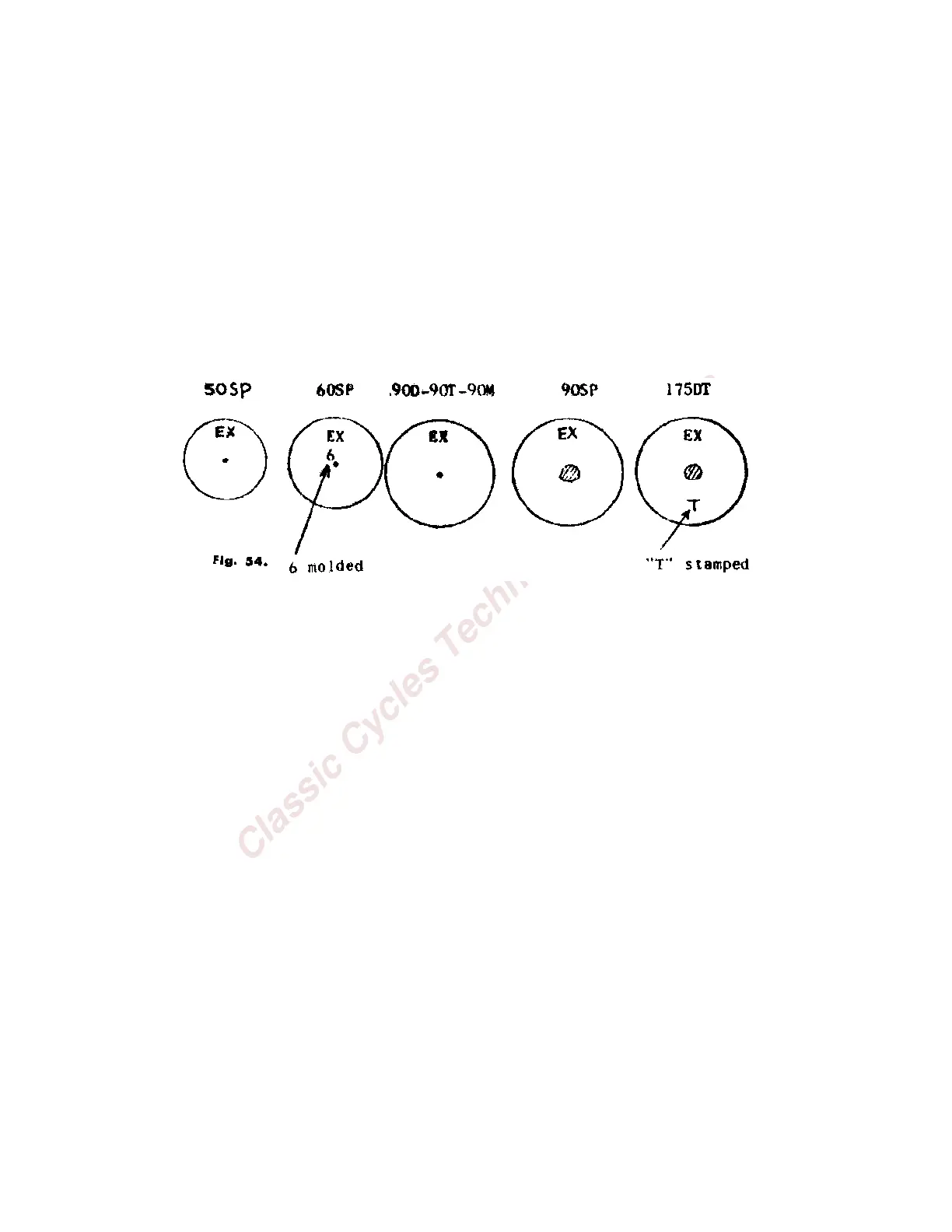
5. Pistons made only for chrome plated aluminum cylinders can be recognized by the small flat spot on the
top of the piston.
6. Pistons for the 90 Sport and 173 DT can be distinguished by the "T" stamped on the top of 173 pistons
and no mark on 90 Sport pistons.
7. When installing new pistons or cylinders, the piston clearance should be checked and adjusted for proper
operation. Check the piston clearance at the skirt of the piston and just above the ports in the cylinder.
• Correct piston clearance for cast iron cylinders: .002 – .003 (50, 60 Spt), .0025 – .004 (90STD, T, M.)
• Correct piston clearance for aluminum cylinders .0015 – .0025 (90SPT, 175DT)
On cast iron cylinders, the cylinder can be honed to adjust clearance.
On aluminum cylinders, the piston must be polished to adjust clearance. Pistons are identified on top of the
pistons as follows:
CRANKSHAFT AND ROTARY DISC VALVES
A. Construction and Operation
When the piston moves up and down in the cylinder from the force of the explosion of fuel/air mixture gas,
the crankshaft converts this reciprocating movement to rotary motion and supplies power to the rear wheel
through the clutch and transmission. The crankshaft must endure the impact of explosive force and the
high temperatures of combustion.
Crankshaft strength and precision are required to endure continuous high speed operation for long times.
Crankshaft materials must be selected carefully and machined exactly to prevent twisting, cracking,
offcentering, etc. The amount and direction, vertical or horizontal, of engine vibration has extreme affect on
riding comfort and fatigue of the rider. The crankshaft is one source of vibration. If the crankshaft is not
balanced properly, engine vibration will increase. Bridgestone crankshafts are designed to give smooth
rotation and balanced operation with a minimum of vibration.
Rotary disc valves are installed between the carburetors and the crankcase and control the supply of
fuel/air mixture from the carburetors to the crankcase. In conventional two-stroke engines, the fuel/air
mixture is controlled by the skirt of the piston and port timing, the opening and closing of inlet and exhaust
ports, is limited to before top dead center and after top dead center so that fuel mixture supply is not
efficient.
By using a rotary disc valve, the best timing for engine operation can be determined by altering the
cutaway of the valve disc, so that fuel supply and engine power are increased. Carburetor blow-back and
fuel loss can also be eliminated and engine performance increased tremendously.
Fig. 55. Cross section of rotary disc valve engine



 To Next Page