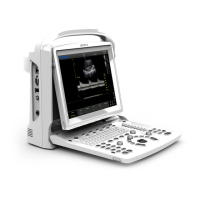
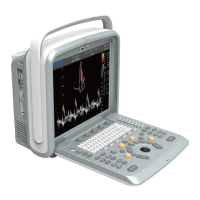
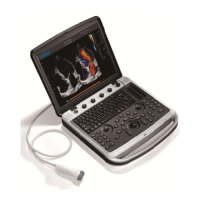
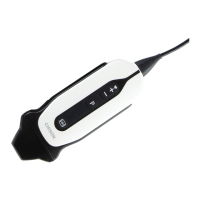
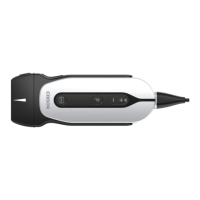
ECO 6 Digital Color Doppler Ultrasound System
123
should also review the Centers for Disease Control and Prevention document on sterilization and disinfection
of medical devices to be certain that their procedures conform to the CDC principles for disinfection of patient
care equipment.
1. CLEANING
After removal of the probe cover, use running water to remove any residual gel or debris from the probe. Use a
damp gauze pad or other soft cloth and a small amount of mild non-abrasive liquid soap (household
dishwashing liquid is ideal) to thoroughly cleanse the transducer. Consider the use of a small brush especially
for crevices and areas of angulation depending on the design of your particular transducer. Rinse the transducer
thoroughly with running water, and then dry the transducer with a soft cloth or paper towel.
Cleaning Compatibility
Epizyme-Rapid(Rapid Multi-Enzyme cleaner)
Quaternary ammonium chlorides
2. DISINFECTION
Cleaning with a detergent/water solution as described above is important as the first step in proper disinfection
since chemical disinfectants act more rapidly on clean surfaces. However, the additional use of a high level
liquid disinfectant will ensure further statistical reduction in microbial load. Because of the potential disruption
of the barrier sheath, additional high level disinfection with chemical agents is necessary. Examples of such
high level disinfectants include but are not limited to:
Disinfectants Compatibility
Aihujia Environmental Surface Wipes
Quaternary ammonium chlorides
Quaternary ammonium chlorides
Sani-Cloth Bleach Germicidal Wipes
CAUTION: Repeated disinfection will eventually damage the transducer, please check
WWW.CFS.IT - CFS PRODOTTI MEDICALI SRL


 To Next Page