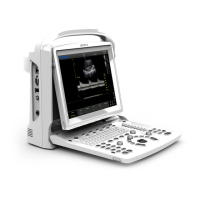
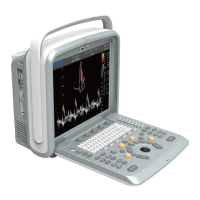
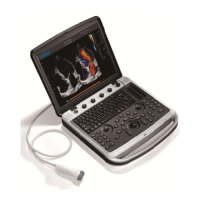
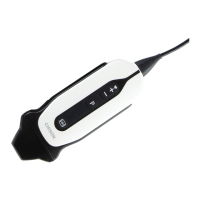
ECO 6 Digital Color Doppler Ultrasound System
124
the transducer’s performance periodically.
Other agents such as quaternary ammonium compounds are not considered high level disinfectants and should
not be used. Isopropanol is not a high level disinfectant when used as a wipe and probe manufacturers
generally do not recommend soaking probes in the liquid.
The FDA has published a list of approved sterilants and high level disinfectants for use in processing reusable
medical and dental devices. That list can be consulted to find agents that may be useful for probe disinfection.
Practitioners should consult the labels of proprietary products for specific instructions. They should also
consult instrument manufacturers regarding compatibility of these agents with probes. Many of the chemical
disinfectants are potentially toxic and many require adequate precautions such as proper ventilation, personal
protective devices (gloves, face/eye protection, etc.) and thorough rinsing before reuse of the probe.
3. PROBE COVERS
The transducer should be covered with a barrier. If the barriers used are condoms, these should be
nonlubricated and nonmedicated. Practitioners should be aware that condoms have been shown to be less
prone to leakage than commercial probe covers, and have a six-fold enhanced AQL (acceptable quality level)
when compared to standard examination gloves. They have an AQL equal to that of surgical gloves. Users
should be aware of latex-sensitivity issues and have available nonlatex-containing barriers.
4. ASEPTIC TECHNIQUE
For the protection of the patient and the health care worker, all endocavitary examinations should be performed
with the operator properly gloved throughout the procedure. Gloves should be used to remove the condom or
other barrier from the transducer and to wash the transducer as outlined above. As the barrier (condom) is
removed, care should be taken not to contaminate the probe with secretions from the patient. At the completion
of the procedure, hands should be thoroughly washed with soap and water.
Note: Obvious disruption in condom integrity does NOT require modification of this protocol. These
guidelines take into account possible probe contamination due to a disruption in the barrier sheath.
In summary, routine high-level disinfection of the endocavitary probe between patients, plus the use of a probe
cover or condom during each examination is required to properly protect patients from infection during
endocavitary examinations. For all chemical disinfectants, precautions must be taken to protect workers and
patients from the toxicity of the disinfectant.
Amis S, Ruddy M, Kibbler CC, Economides DL, MacLean AB. Assessment of condoms as probe covers for
transvaginal sonography. J Clin Ultrasound 2000;28:295-8.
Rooks VJ, Yancey MK, Elg SA, Brueske L. Comparison of probe sheaths for endovaginal sonography. Obstet.
Gynecol 1996;87:27-9.
Milki AA, Fisch JD. Vaginal ultrasound probe cover leakage: implications for patient care. Fertil Steril
WWW.CFS.IT - CFS PRODOTTI MEDICALI SRL


 To Next Page