Installation 2-9
5160 Service Aggregation Switch Hardware Installation and Start-up Manual
009-3207-001 Standard Revision A
Copyright
©
2013 Ciena
®
Corporation September 2013
See “Installing a DC Power Supply” on page 2-22 for a procedure.
Transceivers
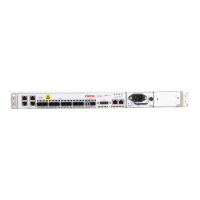
The faceplate of the 5160 has 24 NNI/UNI connections which use 1/10 Gigabit
Ethernet pluggable SFP/SFP+ optics. These are ports 1 to 24.
Note: Copper SGMII transceivers be installed in any of these ports except
ports 19 and 20. When copper transceivers are used the supported
speeds are 10/100/1000M.
Note: If the 5160 is configured to use RFC 2544, Y.1731 and/or TWAMP
then Port 20 becomes unavailable, thereby reducing the effective port
count of the 5160 system by one. These features are enabled through the
CLI and require the Advanced-OAM license of SAOS. If you subsequently
disable this functionality, a system reboot will be required before the
change will take effect and Port 20 will become available for use.
Figure 1-1 on page 1-1 shows the location of these different ports on the
faceplate of the 5160. For more information about the ports see 39XX/51XX
Product Fundamentals.
The SFP/SFP+ modules provide the media-specific portion of an interface,
allowing it to support Ethernet using different media types. One optic module
can be installed into each available port and can be hot swapped. Figure 2-3
shows a typical pluggable optic module and its parts.
Table 2-1
5160 DC Lug Summary
Wire Size Stud Maximum Lug Width Recommended Lug
14 AWG #6 0.31” Panduit PV14-6FF-C (16-14 AWG)
14 and 18 AWG #6 0.31” Panduit PV14-6LF-C (18-14 AWG)
Panduit PV14-6LFW-C (18-14 AWG)
Note: Use one of these recommended lugs or a close equivalent. If a ring lug is used, you will need to
remove and reinstall the screw. Take care not to lose the screw during this process.



 To Next Page