EXP
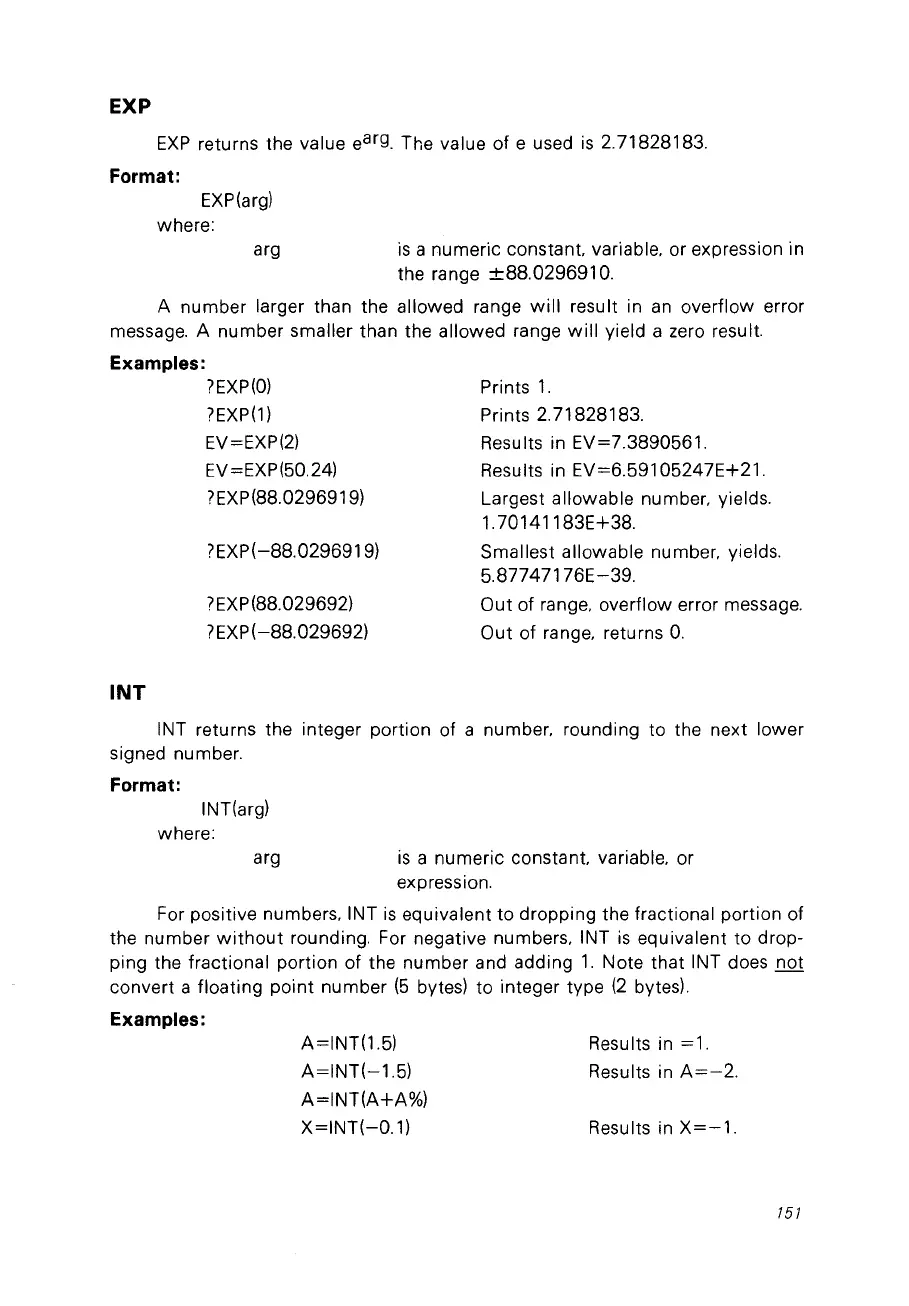
EXP
returns the value earg. The value of e used
is
2.71828183.
Format:
EXP(arg)
where:
arg
is
a numeric constant, variable. or expression in
the range
±88.0296910.
Prints
1.
Prints 2.71828183.
Results in EV=7.3890561.
Results in EV=6.59105247E+21.
Largest allowable number. yields.
1.70141183E+38.
A number larger than the allowed range
will
result in
an
overflow error
message. A number smaller than the allowed range
will
yield a zero result.
Examples:
?EXP(O)
?EXP(l)
EV=EXP(2)
EV
=EXP
(50.
24)
?EXP(88.0296919)
INT
?EXP(-88.0296919)
?EXP(88.029692)
?EXP(-88.029692)
Smallest allowable number. yields.
5.87747176E-39.
Out
of range. overflow error message.
Out
of range, returns
O.
arg
INT returns the integer portion of a number, rounding to the next lower
signed number.
Format:
INT(arg)
where:
is
a numeric constant, variable, or
expression.
For positive numbers. INT
is
equivalent to dropping the fractional portion of
the number
without
rounding. For negative numbers, INT
is
equivalent to drop-
ping the fractional portion of the number and adding
1.
Note that INT does not
convert a floating
point
number
(5
bytes) to integer type
(2
bytes).
Examples:
A=INT(1.5)
A=INT(-1.5)
A=INT(A+A%)
X=INT(-O.l)
Results in =1.
Results in
A=-2.
Results in
X=-l.
151



 To Next Page