Step 2: Align the minuend and subtrahend by right-justifying both
numeric strings.
This process
is
the same
as
was presented in step 2 of
the"
Ad-
dition via Numeric Strings" program (page 190).
30
I!LANK$="
40
X=LEN(A$):Y=LEN(B$)
50
IF
>1,
<
'T'
THEN
A$=LEFT$ŒLANK$
..
'T'-~O+A$
60
IF
Y<X
THEN
B$=LEFT$(BLANK$,X-Y)+I!$
Step 3: For subtraction. we must determine which numeric string has a
larger value.
Although
the
input
strings may
be
equal in length. their values can
be
quite different. For
simplicity
in our example. the minuend. A$.
is
assigned the
larger value. and the subtrahend.
B$.
is
a smaller value. Ideally. the minuend
is
al-
ways the larger value. but this cannot
be
guaranteed.
The values of A$ and B$
are
compared using the VAL function
in
state-
ments 65 and 70:
65
1F
"iAL
0::
A$)
='.,.'AL
(E:$)
THEN
C$="
0"
:
CiOTO
1151<:1
70
IF
VALO::A$»VAL(B$)
GOTO
1000
If
A$
is
larger than
B$.
we
have a simple subtraction problem. and the program
drops to line 1000. If B$
is
larger than A$. or
we
are subtracting a larger number
from a smaller number. the program prepares for a negative answer.
If
the subtrahend
is
larger than the minuend
(8$
is
larger than A$), the
answer
will
be negative. To subtract
two
numbers that yield a negative answer.
program a small routine to
switch
the contents of
A$
and B$ so that the value of
A$
,is
larger than
B$.
Subtract B$ from A$. and the difference
is
C$.
To make
C$
negative. a
negative
sign.
"-".
is
concatenated
onto
the
front
of
C$:
C$="-"+C$.
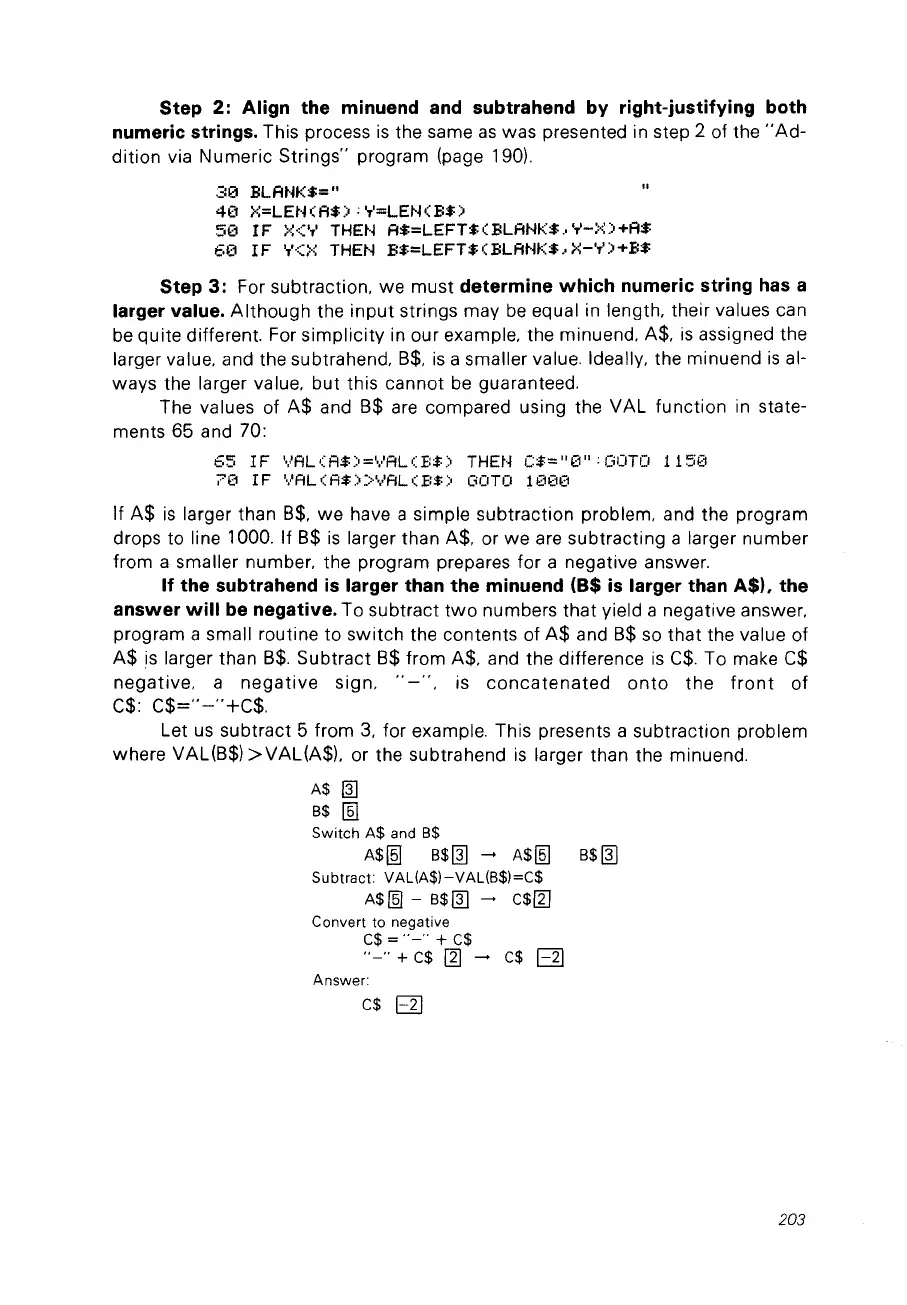
Let
us
subtract 5 from
3.
for example. This presents a subtraction problem
where VAL(B$)
>VAL(A$). or the subtrahend
is
larger than the minuend.
A$
lm
B$
[ID
Switch A$ and
B$
A$
[ID
B$
@]
-+
A$
[ID
B$
@]
Subtract: VAL(A$)-VAL(B$)=C$
A$ill]
- B$@]
-+
C$~
Convert to negative
C$
=
"-"
+
C$
"-"
+
C$
[1]
-+
C$
~
Answer:
C$
~
203



 To Next Page