Oength of
A$)+
Oength
of
B$)
~
16
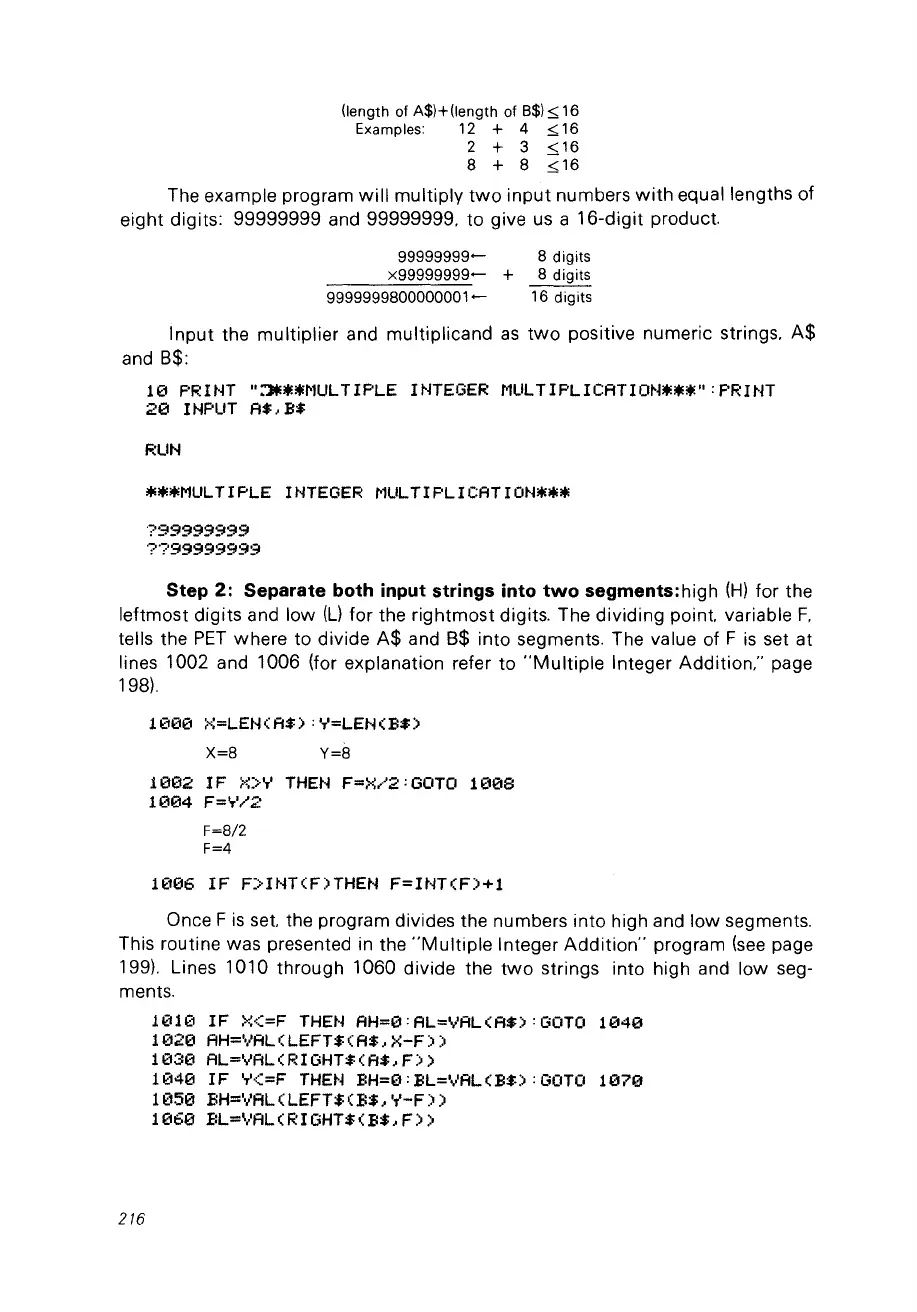
Examples: 12 + 4
~16
2 + 3
~16
8 + 8
~16
The example program
will
multiply
two
input
numbers
with
equallengths
of
eight digits: 99999999 and 99999999.
to
give
us
a
16-digit
product.
99999999-
x99999999-
+
9999999800000001-
8 digits
8 digits
16 digits
Input
the multiplier and multiplicand
as
two
positive numeric strings.
A$
and B$:
le
PR
l
NT
":'lte1lE1IE1'1UL
TI
PLE
l
NTEGER
MUL
TI
PL
l
CAT
l
OHlIElIElIE"
:
PR
l
NT
213
INPUT
A$,B$
RUN
1IE1IE1IEMULTIPLE
INTEGER
MULTIPLICATIONlIElIElIE
799999999
7?99999999
Step 2: Separate both input strings into
two
segments:high
(H)
for the
leftmost digits and low
(L)
for the rightmost digits. The dividing point. variable
F.
tells the
PET
where to divide
A$
and B$ into segments. The value of F
is
set at
lines 1002 and 1006 (for explanation refer to
"Multiple
Integer
Addition:'
page
198).
113130
X=LEN(A$):Y=LEN(B$)
X=8 Y=8
1002
IF
X>Y
THEN
F=X/2:GOTO
11308
10134
F='T'/2
F=8/2
F=4
113136
IF
F>INT(F)THEN
F=INT(F)+l
Once F
is
set. the program divides the numbers into high and low segments.
This routine was presented in the
"Multiple
Integer
Addition"
program
(see
page
199). Lines 1010 through 1060 divide the
two
strings into high and low seg-
ments.
11310
IF
X(=F
THEN
AH=0:AL=VAL(A$):GOTO
1040
1020
AH=VAL(LEFT$(A$,X-F»
1030
AL=VAL(RIGHT$(A$,F»
1040
IF
'T'(=F
THE~l
BH=0:BL=VAL<B$) :
GOTO
1070
1050 BH=VAL(LEFT$(B$,Y-F»
1060
BL=VAL<RIGHT$<B$,F»
216


 To Next Page