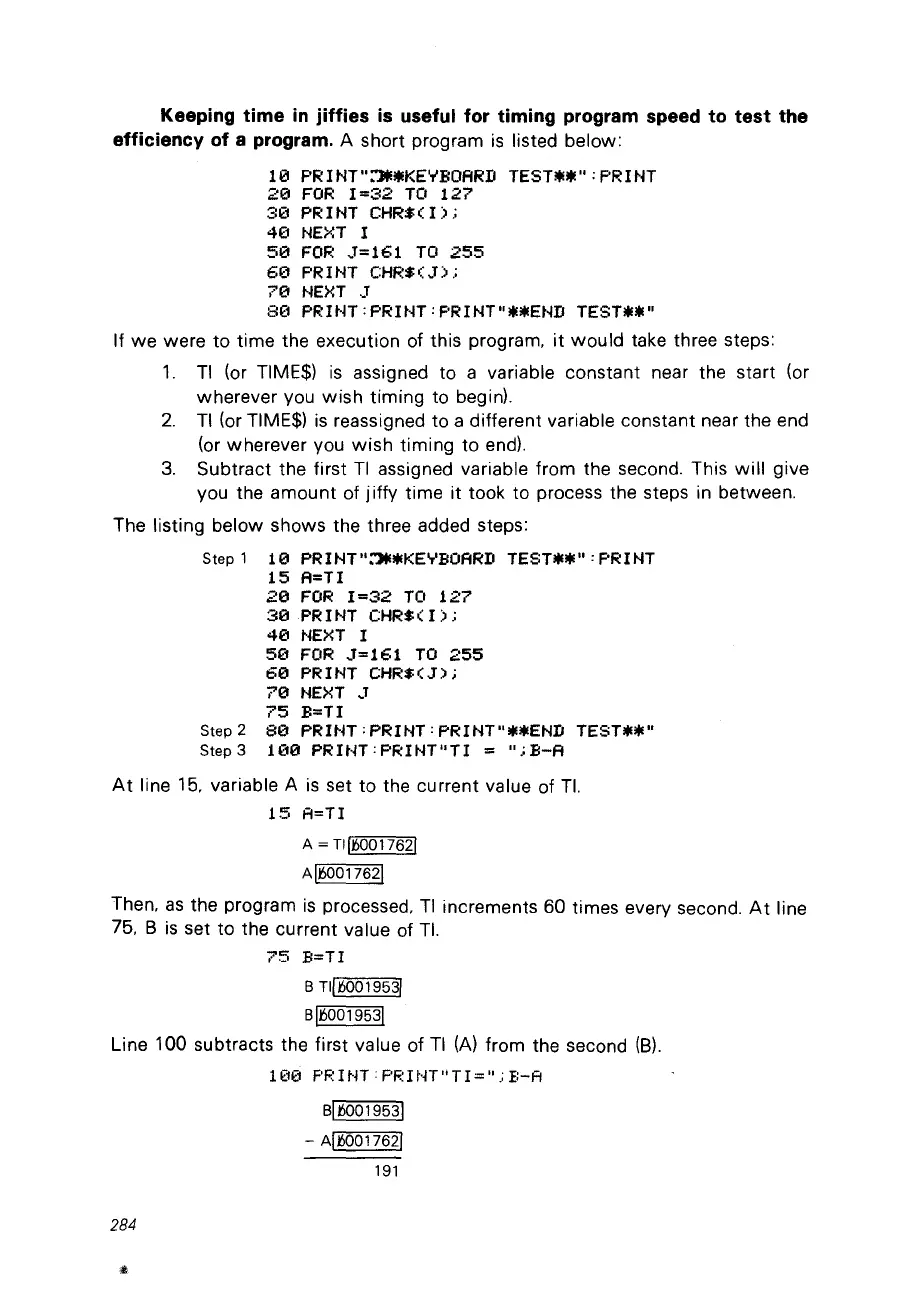
Keeping time
in
jiffies
is
useful for timing program speed to test the
efficiency of a program.
A short program
is
listed below:
10
PRINT"::')fElIiKEYBOARD
TESTlIilli":PRINT
20
FOR
1=32
TO
127
30
PRINT
CHR$(I);
40
NEXT
1
50
FOR
3=161
TO
255
60
PRINT CHR$(3);
70
NEXT
3
8(1
PRIt-.lT:
PRINT:
PRINT"iIIi11END
TESTiIIiII"
If
we
were
ta
time
the execution of this program,
it
would
take three steps:
1.
TI
(or TIME$)
is
assigned ta a variable constant near the start (or
wherever vou
wish
timing ta beginl.
2.
TI
(or TIME$)
is
reassigned ta a different variable constant near the end
(or wherever
Vou
wish
timing ta end).
3.
Subtract the first
TI
assigned variable from the second. This
will
give
Vou
the amount of
jiffv
time
it
took ta process the steps in between.
The listing below shows the three added steps:
Step
1 10
PRINT"::')fElIiKEYBOARD
TESTiIIiII":
PRINT
15
A=TI
20
FOR
1=32 Ta
127
30
PRINT
CHR$(I);
40
NEXT
1
50
FOR
3=161
TO
255
60
PRINT CHR$(3);
70
NEXT
~T
75
B=TI
Step 2
80
PRINT: PRINT:
PRINT"iIIi11END
TE8TiIIiII"
Step3
100
PRIt..jT:PRINT"TI =
";B-A
At
line 15. variable A
is
set ta the current value of
TI.
15
A=TI
A =
TQl'>0017621
A11'>001762\
Then,
as
the program
is
processed.
TI
increments 60 times everv second.
At
line
75, 8
is
set ta the current value of
TI.
75
B=TI
B
TIII'>0019531
BII'>0019531
Line 100 subtracts the first value
of
TI
(A)
from the second
(8).
100
PF~It-n·
PF~It-n"TI=".;
E:-A
BII'>0019531
-
A11'>001762/
191
284


 To Next Page