Special Symbols
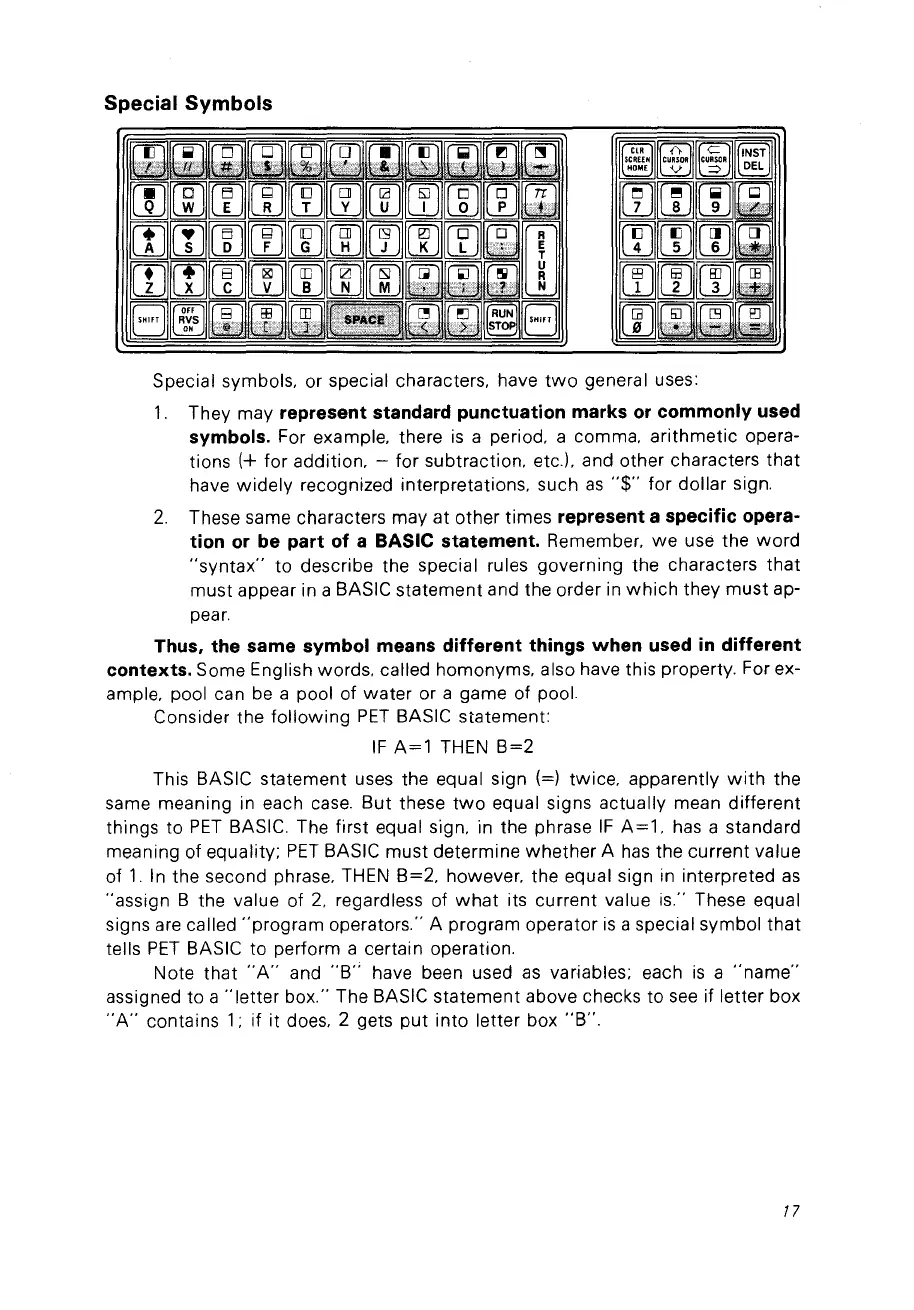
Special symbols, or special characters, have
two
general uses:
1.
They may represent standard punctuation marks
or
commonly used
symbols.
For example, there
is
a period, a comma,
arithmetic
opera-
tions
(+
for addition. - for subtraction. etc.). and other characters
that
have
widely
recognized interpretations, such
as
"$"
for dollar sign.
2.
These same characters may at other times represent a specifie opera-
tion
or
be part of a BASIC statement. Remember,
we
use the
word
"syntax"
to
describe the special rules governing the characters
that
must
appear in a BASIC statement and the order in
which
they
must
ap-
pear.
Thus, the same symbol means different things when used
in
different
contexts.
Some English words. called homonyms, also have this property. For ex-
ample. pool can
be
a pool of
water
or a game of pool.
Consider the
following
PET
BASIC statement:
IF
A=l
THEN
B=2
This BASIC statement uses the equal sign (=) twice, apparently
with
the
same meaning in each case.
But
these
two
equal signs actually mean different
things to
PET
BASIC. The first equal sign. in the phrase
IF
A=l.
has
a standard
meaning of equality;
PET
BASIC must determine
whether
A
has
the current value
of
1.
In the second phrase. THEN
B=2,
however, the equal sign in interpreted
as
"assign B the value of
2.
regardless of
what
its current value is." These equal
signs are called
"program
operators." A program operator
is
a special symbol
that
tells
PET
BASIC to perform a certain operation.
Note
that
"A"
and
"B"
have been used
as
var·iables; each
is
a
"name"
assigned
to
a ''1etter box." The BASIC statement above checks
to
see
if letter box
"A"
contains 1; if it does, 2 gets
put
into letter box
"B".
17



 To Next Page