The header
is
made up of the
word
RANDOM
as
blanks outlined by reverse
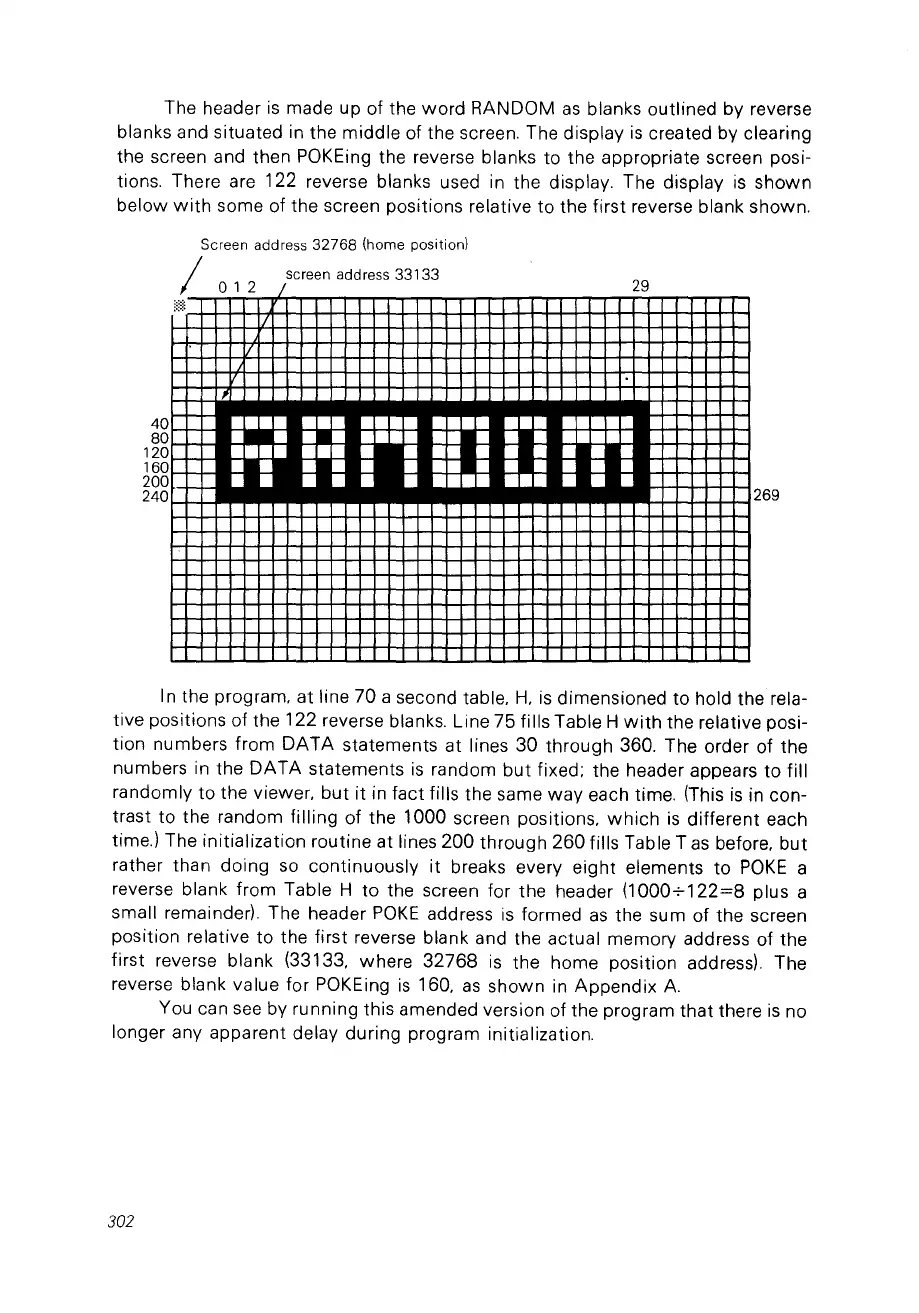
blanks and situated in the middle of the screen. The display
is
created by clearing
the screen and then POKEing the reverse blanks to the appropriate screen posi-
tions. There are 122 reverse blanks used in the display. The display
is
shown
below
with
some of the screen positions relative
to
the first reverse blank shown.
269
29
Screen address
32768
(home position)
/ screen address 33133
01
2
/
i:1:;:
Il
40
80
120
160
200
240
ln the program. at line
70
a second table,
H.
is
dimensioned
to
hold the rela-
tive positions of the 122 reverse blanks. Line 75 fills Table H
with
the relative posi-
tion numbers from
DATA
statements at lines 30 through 360. The order of the
numbers in the
DATA
statements
is
random
but
fixed; the header appears
to
fill
randomly
to
the viewer,
but
it in fact fills the same
way
each time. (This
is
in con-
trast
to
the random filling of the 1000 screen positions.
which
is
different each
time.) The initialization routine at lines 200 through 260 fills Table
Tas
before.
but
rather than doing so continuously it breaks every eight elements
to
POKE
a
reverse blank from Table H
to
the screen for the header
(1000+122=8
plus a
small remainderl. The header
POKE
address
is
formed
as
the sum of the screen
position relative
to
the first reverse blank and the actual memory address of the
first reverse blank (33133. where
32768
is
the home position address). The
reverse blank value for POKEing
is
160.
as
shown in Appendix
A.
You can
see
by running this amended version of the program
that
there
is
no
longer any apparent delay during program initialization.
302


 To Next Page