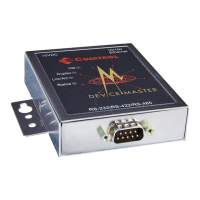
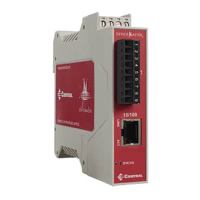
The DeviceMaster LT is a versatile device designed for connecting serial devices to various network environments. It supports multiple operating systems and offers a range of configuration and management features, including robust security options.
Function Description:
The DeviceMaster LT functions as a serial device server, allowing serial ports to be configured for different network environments. It supports COM ports (or secure COM ports) when the NS-Link driver for Windows is installed, tty ports when the NS-Link driver for Linux is installed, and Socket ports when SocketServer or the NS-Link web page is configured accordingly. It can connect serial devices to an application that supports TCP/IP socket communications, establish socket connections between two DeviceMaster LTs through an Ethernet network (serial tunneling mode), and facilitate faster data transmission for applications using UDP's broadcast capabilities (UDP mode).
Important Technical Specifications:
- Power Supply: The DeviceMaster LT 16-port uses an external power supply. Comtrol's power supply specifications are 5-30VDC output voltage, 275 mA @ 24VDC output current, and 90-260 VAC input line voltage at 43-63 Hz. For external power supplies, a minimum of 200 mA @ 24VDC and 4.5 W power is required.
- Serial Port Pinouts (RJ45):
- RS-232: RTS (Pin 1), DSR (Pin 2), DCD (Pin 3), RxD (Pin 4), TxD (Pin 5), GND (Pin 6), DTR (Pin 7), CTS (Pin 8).
- RS-422 (4-Wire): RxD- (Pin 2), RxD+ (Pin 4), TxD+ (Pin 5), GND (Pin 6), TxD- (Pin 7).
- RS-485 (2-Wire): TxD/RxD+ (Pin 5), GND (Pin 6), TxD/RxD- (Pin 7).
- TCP and UDP Socket Ports:
- 22 SSH / 23 Telnet: Used for administrative and diagnostic purposes (enabled by default, Port 23 can be disabled).
- 80 HTTP / 443 SSL or HTTPS: Used by the web server for administration and configuration (enabled by default, cannot be disabled).
- 102 RFC1006: Used for RFC1006 (ISO over TCP) serial port access (enabled by default, can be disabled by setting port number to -1).
- 161 SNMP: Used by the SNMP agent if enabled (default).
- 4606: Required for NS-Link or PortVision DX firmware updates (cannot be disabled).
- 4607: Used for diagnostic purposes (cannot be disabled).
- TCP 8000 - 8xxx: Incremented per serial port (e.g., 8000-8015 for a 16-port device).
- UDP 7000 - 7xxx: Incremented per serial port (e.g., 7000-7015 for a 16-port device).
- Security Modes:
- Secure Data Mode: Requires SSL encryption for TCP connections to SocketServer (Ports 8000, 8001, etc.) and NS-Link TCP connections (Port 4606). Disables UDP access, RFC1006 access, and MAC-mode access to serial ports. Requires SSH instead of telnet for diagnostic log (TCP Port 4607).
- Secure Config Mode: Encrypts/authenticates configuration and administration operations (web server, IP settings, load SW). Disables MAC mode admin commands (except ID request), TCP/IP admin commands (except ID request), telnet console access (Port 23), unencrypted http:// access (Port 80), e-mail notification, and SNMP features.
- SSL Performance: Encryption/decryption is CPU-intensive. Throughputs vary by cipher suite and baud rate. For example, at 9600 baud, RC4-MD5 supports 32 ports, while DES3-SHA supports 15 ports. SSL connection setup times are approximately 0.66 seconds for RSA, 3.84 seconds for DHE, and 3.28 seconds for DHA.
- Bootloader: The operating system that runs during power-on, loading SocketServer.
- Memory: Volatile (DRAM and SRAM) for program execution and buffers; non-volatile (flash and EEPROM) for program storage and user-configurable values.
Usage Features:
- Initial Configuration: Uses PortVision DX for easy IP address configuration and firmware updates. Users can program static IP addresses or use DHCP.
- Driver Installation: Supports NS-Link drivers for Windows (Windows XP to Windows 8.1, Windows Server 2003 to 2012) and Linux operating systems.
- Socket Port Configuration: Configurable via PortVision DX property pages or a web browser interface (SocketServer/NS-Link).
- Security Configuration: Enable/disable Secure Data Mode and Secure Config Mode via the web interface. Manage security keys and certificates (RSA Key Pair, RSA Server Certificate, DH Key Pair, Client Authentication Certificate).
- Serial Device Connectivity: Supports RJ45 Null-Modem Cables (RS-232, RS-422) and RJ45 Straight-Through Cables (RS-232/485).
- Documentation Access: PortVision DX provides a "Documentation" option to download and access DeviceMaster LT manuals.
Maintenance Features:
- Rebooting: The DeviceMaster LT can be rebooted via PortVision DX, the web page (Server Status), Telnet (using
reset command), or a physical Reset/Restore switch (depressed for less than 2 seconds).
- Firmware Updates: SocketServer firmware can be updated using PortVision DX (local network or across WANs via TFTP server) or RedBoot (Telnet method for Linux).
- Configuration File Management: Save and load SocketServer configuration files (.dc) and driver configuration files (device-level and port-level) using PortVision DX or the Comtrol Drivers Management Console. This allows for easy deployment of common settings to multiple devices or restoration of settings after driver reinstallation.
- Bootloader Management: Check Bootloader version and upload new versions using PortVision DX or RedBoot.
- Serial Port Settings Restoration: Restore serial port settings to default values via the NS-Link device driver for Windows or the web page.
- Factory Defaults Restoration: Clear flash memory (erasing program binaries) and EEPROM (resetting user-configurable values) to return the device to factory defaults. This can be done via serial connection using RedBoot commands (
fis init -f) or through the web server.
- Troubleshooting Tools: PortVision DX includes Port Monitor (PMon2) for checking communication, modem control, status signals, and raw byte counts, and Test Terminal (WCom2) for sending/receiving test data and performing loopback tests.
- LED Indicators: TX/RX LEDs (yellow/green) indicate data transmission and reception status. Network LEDs (green/yellow) indicate link establishment and activity. The Status LED indicates power and boot cycle completion.
- Password Configuration: Set passwords for web and Telnet server access to prevent unauthorized configuration changes.
- Secure Data Monitoring: Enable "Monitor Secure Data via Telnet" to view TX/RX data on a serial port when Secure Data Mode is active (using
monitor [-ac] portnumber command).

 Need help?

 To Next Page
 General