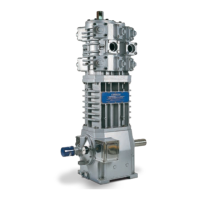
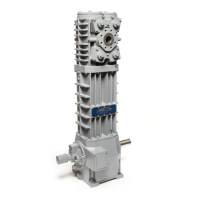
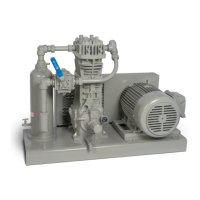
Appendix B—Specifications for Vertical Single-Acting Models 91–691
B. Specifications
Features and Benefits
Self-lubricating piston rings: Non-lubricated operation to minimize oil in gas
NPT or Class 300 RF connections: Versatility for your application
Multiple mounting configurations: Versatility for your application
High efficiency valves: Quiet, reliable operation
Reversible oil pump: Allows operation in either direction
Simplified top down design: Routine maintenance is minimally invasive
Operating Specifications
Model 91 291 491 691
Bore of cylinder inches (mm) 3.0 (76.2) 3.0 (76.2) 4.0 (101.6) 4.5 (114.3)
Stroke inches (mm) 2.5 (63.5) 2.5 (63.5) 3.0 (76.2) 4.0 (101.6)
Piston displacement cfm (m
3
/hr)
minimum @ 400 RPM 4.1 ( 7.0) 8.2 (13.9) 17.5 ( 2 9.7 ) 29.5 (50.0)
maximum @ 825 RPM 8.4 (14.3) 16.9 (28.7) 36.0 (61.2) 60.7 (103.2)
Maximum working pressure psig (bar g)
1
335 (23.1)
Maximum brake horsepower (kW) 7. 5 (5.6) 15 (11. 2) 15 (11. 2) 45 (33.6)
Maximum rod load lb (kg) 3,600 (1,632.9) 3,600 (1,632.9) 4,000 (1,814.4) 7,0 00 (3,175.1)
Maximum outlet temperature °F (°C) 350 (177 )
Maximum flow—propane gpm (m
3
/hr) 5 0 (11.4) 101 (22.9) 215 (48.8) 361 (82.0)
1
These numbers specify pressure-containing abilities of the compressor cylinder and head. For many applications, factors other than the pressure rating will
limit the maximum allowable discharge pressure to lower values. These factors include horsepower, temperature and rod load.
Equipment Type and Options Applications
Single-acting, vertical, reciprocating piston type vapor compressor
Single packed rod
NPT or Class 300 RF connections
Bulk transfer
Vapor recovery
Tank evacuation
Gas scavenging
32


 To Next Page