Page 13
INPUTS cont.
TAMPER - A 24Hr tamper circuit is available for monitoring system tampers. This Tamper circuit is programmable
as either normally closed loop or 2k2 EOL supervision (the default is normally closed loop). Any Tamper alarms on
this input are mapped to alarm outputs in the same manner as for detection zones.
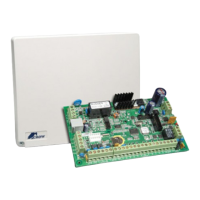
In addition to the Zone & Tamper inputs, you will find the following additional inputs on the control PCB;
AC - Connect the 17VAC yellow wires (no polarity) from the transformer to the terminals marked AC on the PCB.
The panel includes a mains transformer rated at 1.4 amps at 17 VAC.
EARTH - Connect the mains earth to the appropriate terminal on the mains terminal block in the control box
cabinet. Also connect a lead from this earth point to the terminal marked with the Earth symbol (next to AC
terminals) on the panel PCB.
BATTERY - Connect a sealed lead acid rechargeable 12VDC battery to the terminals labelled red and black on the
control panel being careful to observe the correct polarity. The minimum recommended battery capacity is 7 amp
hours. Battery charge current at these terminals is limited to 300mA maximum. The battery connection is protected
against short circuits by a thermal fuse. The panel performs a dynamic load test on the battery every 15 seconds
and if it fails the test at any time it will indicate a battery low condition.
LINE IN - These terminals are used to connect the panel to the incoming telephone line. The dialler uses this line
for reporting alarm events. An ADSL filter will be required before the Line In terminals if ADSL is present in the
building.
LINE OUT - These terminals are used to connect telephones and other communication equipment to the incoming
phone line via the panel dialler circuit. The telephone line is passed through the controller to ensure that the line is
available to the controller when it is required.
OUTPUTS
12 VOLT OUTPUTS - There are three 12VDC outputs on the panel PCB. These 12 volt outputs are regulated and
Thermal fuse protected against short circuits. The accessory outputs are marked 12V and 0V, while the keypad
buss 12V supply is labelled “POS” & “NEG”. The 12V outputs are supplied by thermal fuses. The recommended
maximum total load that should be drawn from all of the 12V outputs is 1A.
OUTPUTS 1 & 2 - These fully programmable, high current, open drain (high-going-low) type FET outputs capable
of switching up to 1.5A @ 12VDC. These 2 outputs are normally set as switched outputs, providing power for 12V
sirens or piezos. If required, these outputs can be programmed to be siren outputs designed to drive an 8 ohm 10
watt horn speaker on each output (see P37E option 1). If an inductive load is connected to these outputs a back
EMF diode should be fitted.
OUTPUT 3&4 - These are medium current, open drain (high-going-low) type FET outputs capable of switching up
to 1A. Like Outputs 1 & 2 they are fully programmable. If an inductive load is connected to these outputs a back
EMF diode should be fitted.
NOTE: - Connecting devices that draw current in excess of 1A to outputs 3 or 4 will damage the output.
OUTPUT 4 Relay - This is a relay output (rated 1A@30VDC) that works in parallel with the FET on output 4. It has
single pole changeover contacts. Like Outputs 1 & 2 it is fully programmable.
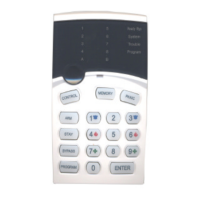
KEYPAD PORT - The terminals marked POS, NEG, CLOCK, & DATA make up the communications port which the
keypads and other intelligent field devices use to talk to the controller. The terminals are connected to
corresponding terminals on the remote devices. The "lin" terminal is only used by the keypads and utilises a fifth
wire to provide a communicator “listen-in” facility. This feature is particularly useful when servicing monitoring
faults. The keypad 12V supply (POS,NEG) is protected by a thermal fuse.
EXPANSION PORTS - There are two high speed expansion ports (labelled EXP1 & EXP2) plus one 9600 baud
serial port (labelled SERIAL). The serial port has no function at present and is provided for possible future use. The
two expansion ports allow optional devices such as the Cellular back-up module, CAN bus interface and other
peripherals to come later.
ETHERNET PORT - The on-board Ethernet port allows upload/download via the built-in web page, IP monitoring
and remote control via Smartphone and tablet apps.



 To Next Page