Seats and headrests
Seat functions
Folding down and raising the rear seat
backrest
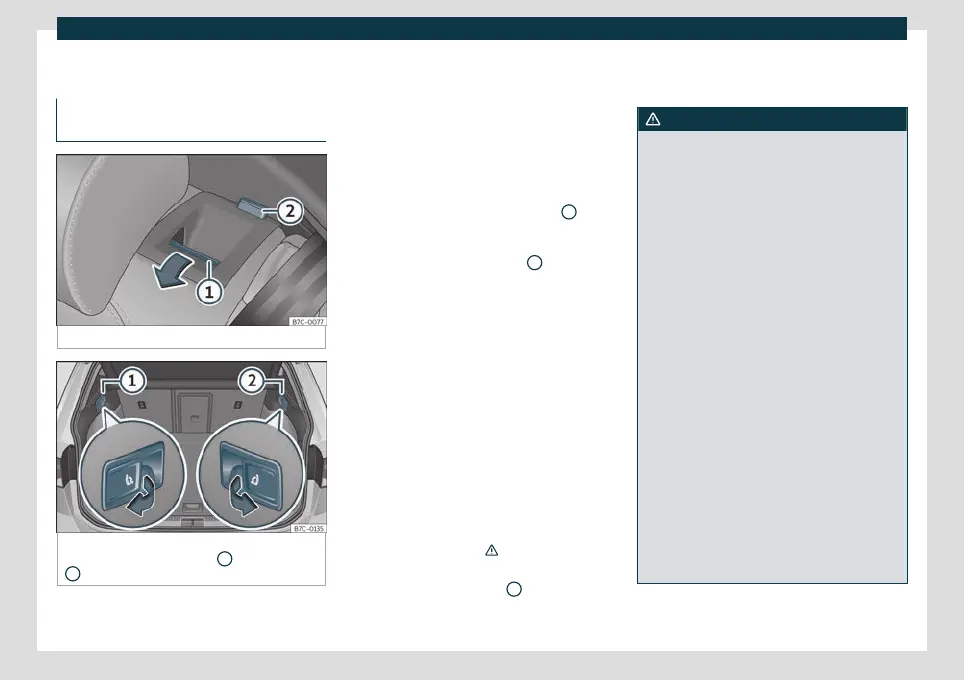
Fig. 101
Rear seat: folding the backrest.
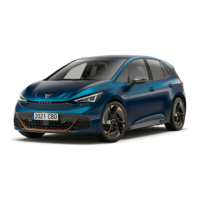
Fig. 102
In the luggage compartment: levers for
remote release of the left part
1
and right part
2
of the rear seat backrest.
The rear seat backrest is split and each part
can be lo
w
ered forward separately to extend
the luggage compartment.
Lowering the rear seat backrest with the
unlock button
●
Push the headrest down as far as it will go
›››
page 121.
●
Pull the unlock button
›››
Fig. 101
1
for-
w
ar
d and lift the backrest at the same time.
The rear seat backrest is not engaged when
the red marking of the button
2
is visible.
F
olding do
wn the backrest from the boot
with the unlocking levers
●
Push the headrest down as far as it will go
›››
page 121.
●
Open the rear lid
›››
page 98.
●
Pull the unlocking lever
›››
Fig. 102 of the
part of the backrest to fold down.
●
The corresponding part of the backrest will
be unlocked or will be folded forward.
●
If necessary, close the rear lid
›››
page 98.
Folding up the rear seat backrest
●
Lift the backrest and press it firmly into the
lock until it engages
›››
.
●
It should not be possible to see the red
mark of the unlock butt
on
2
.
●
Make sure that the seat belt is not trapped.
●
The backr
est must be pr
operly engaged.
●
If necessary, adjust the headrest.
WARNING
Serious injuries can be caused if the rear
seat backrest is lowered or lifted without
due care and attention.
●
When folding down the rear seat, always
make sure there are no people or animals in
the backrest area.
●
Never lower or lift the rear seat backrest
while driving.
●
Do no trap or damage the seat belt when
raising the rear seat backrest.
●
When lowering or lifting the rear seat
backrest, keep your hands, fingers, feet and
other body parts out of its path.
●
For the rear seat belts to offer the neces-
sary protection all the parts of the rear
backrest must be properly engaged. This is
particularly important in the case of the
centre rear seat. If someone is seated in a
seat whose backrest is not properly engag-
ed they will be thrown forwards, along with
the backrest, during an accident or a sud-
den driving or braking manoeuvre.
●
When the rear seat backrest is lowered or
is not properly engaged nobody else can
travel in the corresponding seats (not even
a child).
»
123



 To Next Page