Driving
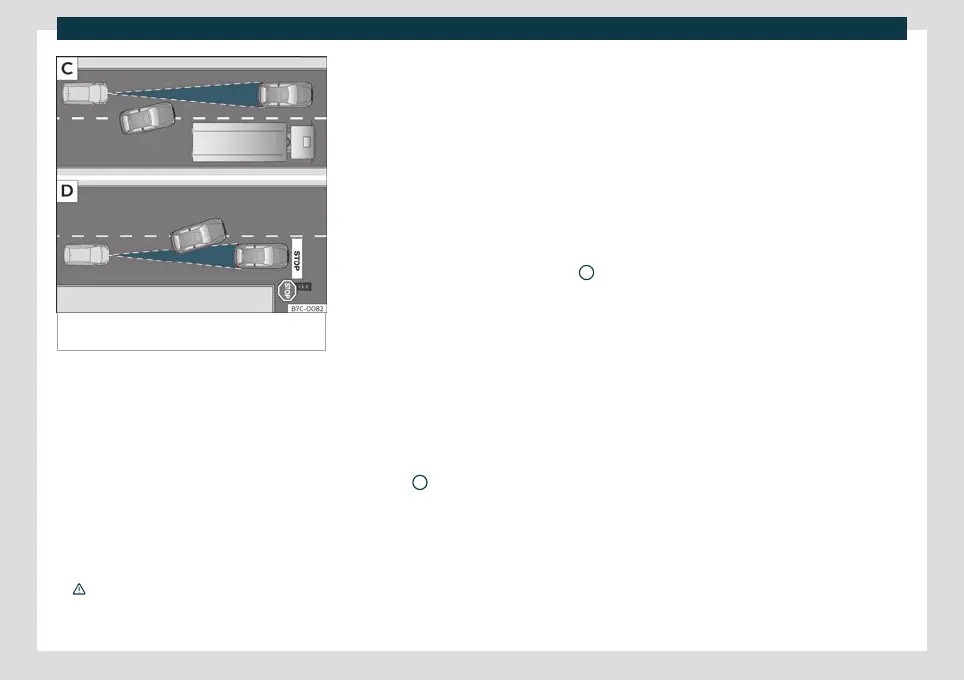
Fig. 221
Vehicle changing lanes.
One vehi-
cle turning and another stationary.
The ACC has certain limitations inherent to
the s
y
stem. Certain reactions, under certain
circumstances, may be unexpected or come
late from the driver's point of view. So pay at-
tention in order to intervene if necessary.
The following situations require maximum
attention:
Starting driving after a stopping phase
(only with automatic transmission)
After a stopping phase, the ACC may begin
driving when the vehicle in front moves off
›››
.
Overtaking
When the t
urn signal lights up bef
ore the ve-
hicle starts to overtake, the ACC accelerates
the vehicle automatically and thus reduces
the distance from the vehicle in front.
When the vehicle moves to the overtaking
lane, if the ACC does not detect another ve-
hicle in front, it accelerates until it reaches
the programmed speed.
System acceleration can be interrupted at
any time by pressing the brake or moving the
third lever to position
›››
Fig. 217
3
.
Driving thr
ough a bend
When ent
ering or leaving some curves, the
radar sensor may cease to sense the vehicle
driving in front of it, or react to a vehicle in
the adjacent lane
›››
Fig. 220. The vehicle
may brake unnecessarily or stop reacting to
the vehicle in front. In this case, the driver
has to intervene by accelerating or interrupt-
ing braking by applying the brake or pushing
the third lever to position
›››
Fig. 217
3
.
Driving in t
unnels
When driving thr
ough tunnels the radar sen-
sor may be limited. Switch off the ACC in
tunnels.
Narrow or misaligned vehicles
The radar sensor can only detect narrow ve-
hicles or vehicles that circulate out of align-
ment when they enter its range
›››
Fig. 220. In these cases, you should
brake as necessary.
Vehicles with special loads and accessories
Special loads and accessories of other vehi-
cles that jut out over the sides, backwards or
over the top may be out of the ACC's range.
CUPRA recommends disconnecting it.
Other vehicles changing lanes
Vehicles changing lanes a short distance
away from your own can only be detected
when they are within range of the sensors. As
a consequence, the ACC will take longer to
react
›››
Fig. 221. Brake yourself as neces-
sary.
Stationary vehicles
The ACC does not detect stationary objects
while driving, such as traffic tails or damaged
vehicles.
If a vehicle detected by the ACC turns or
moves over and there is a stationary vehicle
in front of it, the ACC will not react to it
›››
Fig. 221 . Brake yourself as necessary.
262


 To Next Page