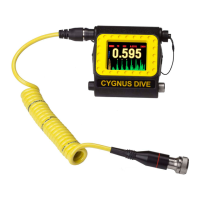
The Cygnus DIVE is an ultrasonic thickness gauge specifically designed for professional divers to conduct metal thickness surveys in both shallow and deep water environments. It is built to withstand extreme underwater conditions, providing quick, clear, and accurate metal thickness measurements.
Function Description
The primary function of the Cygnus DIVE is to measure metal thickness using ultrasonic technology. It offers three measurement modes:
- Multiple Echo Mode (ME): This is the most reliable and quickest method, designed to measure through coatings up to 3 mm (0.11”) thick as standard. With the Deep Coat feature enabled, it can measure through coatings up to 20 mm (0.78”) thick, depending on the coating material. It works by looking for three matched echoes to verify measurement validity, ignoring surface coatings. This mode is best suited for single element probes.
- Single Echo Mode (SE): Most useful on heavily corroded metals where Multiple Echo may fail, as it only requires the first return echo. However, it does not ignore surface coatings, which can lead to incorrect metal thickness measurements if not accounted for. This mode is primarily used with twin element probes.
- Echo-Echo Mode (EE): This mode also uses twin element probes and measures between the first two echoes, intended to ignore thin surface coatings (less than 0.5mm/0.02”). It requires caution as it does not verify measurements like Multiple Echo mode, but the A-Scan display helps verify readings.
The gauge can be worn on the diver's forearm, allowing one hand to remain free during surveys. It features a bright color display that shows thickness measurements in large numbers, supported by an A-scan display for visual verification. Measurement data can be sent to the surface via an RS-485 serial data link for data logging and survey report generation using Cygnus’ CygLink software.
Important Technical Specifications
General Attributes:
- Size: 105 mm x 110 mm x 35 mm (W x H x D) [4.1 in x 4.3 in x 1.4 in]
- Weight In Air: Complete Gauge 905 g (2 lb.), Gauge Body 557 g (1.22 lb.), Battery 79 g (0.17 lb.), Probe & Cable 269 g (0.6 lb.)
- Power Supply: Rechargeable Lithium-Ion Battery
- Probe Sockets: Fischer 105 Series
- Operating Temperature Range: -10°C to +50°C (14°F to 122°F)
- Storage Temperature Range: -10°C to +60°C (14°F to 140°F)
- Battery Operation Time: Approximately 10 hours of continuous measurement with a fully charged battery pack.
- Battery Voltage Range: Min 3.2 V dc, Max 4.5 V dc
- Battery Type: Sealed Lithium-Ion rechargeable single cell, 8.1 Watt-hours, internally protected against short circuit and overcharge.
- Low Battery Indication: Battery level indication on display with low battery warning message.
- Environmental Rating: IP68 Rated to 300 m (984 ft) immersion in sea water. Complies with MIL STD 810G for High Temp (+55°C), Low Temp (-20°C), Humidity (95%), Vibration, and Shock (20g, Transit Drop 1.22m).
- Materials: Sound Velocity from 2000 m/s to 9000 m/s [0.0780 in/µs to 0.3543 in/µs].
- Compliance: RoHS, CE, UKCA.
Measurement Range (in steel):
- Multiple Echo Mode:
- S2C probe: 3 to 250 mm [0.120 in. to 10.00 in.]
- S3C probe: 2 to 150 mm [0.080 in. to 6.000 in.]
- S5C/A probes: 1 to 50 mm [0.040 in. to 2.000 in.]
- Single Echo Mode:
- T5B probe: 2.0 to 100 mm [0.080 in. to 4.000 in.]
- T2C probe: 3.0 to 150 mm [0.120 in. to 6.000 in.]
- Echo-Echo Mode:
- T5B probe: 4.0 to 50 mm [0.160 in. to 2.000 in.]
- T2C probe: 6.0 to 50 mm [0.240 in. to 2.000 in.]
Accuracy: ±0.1 mm (±0.004”) or 0.1% of thickness measurement, whichever is greater.
Resolution:
- 0.1 mm (0.005”) for Low Resolution Mode or measurement >99.95 mm.
- 0.05 mm (0.002”) for High Resolution Mode and measurement <100.0 mm.
- 0.01 mm (0.001”) for Single Echo Mode only and measurement <100.0 mm.
- 0.01 mm (0.0005”) for Single Echo Mode only and measurement <100.0 mm.
Display:
- Type: Colour TFT Display
- Size: QVGA 320 x 240 Pixels 2.8”
- Information: Thickness Value and A-Scan Display.
Transmitter:
- Shape of Pulse: Square
- Pulse Energy (Voltage peak-to-peak): 70 V p-p
- Pulse Energy (Rise Time): 3 ns (max)
- Pulse Energy (Pulse Duration): S2C: 220 ns, S3C: 100 ns, S5A/S5C: 67ns, T2C: 220 ns, T5B: 100 ns.
Receiver:
- Gain Control: Automatic Gain Control up to pre-set Maximum Gain value, 120 dB dynamic range.
- Frequency Range: 1.0 MHz to 10.0 MHz (-6dB).
Data Output and Storage:
- Data Output: RS485 2-wire duplex serial data output, 56000/115200 Baud.
- Internal Storage: 32 Mbit Internal Flash Data Storage.
- Data Connector: Fischer 105 Series.
Usage Features
- Ergonomic Design: Can be worn on the diver's forearm, secured with an elasticated strap and quick-release buckle, allowing single-handed operation.
- Probe Connection: Two identical probe sockets allow connection on either the right or left arm. The unused socket is protected by a blanking plug. A security lanyard can be attached to the D-ring on the gauge.
- Probe Types: Supports both Single Element Probes (for Multiple Echo mode, through coatings) and Twin Element Probes (for Single Echo and Echo-Echo modes, better for heavy corrosion/pitting). Probes are identified by a colored band and face design.
- Automatic Probe Type Detection: The gauge can automatically detect S2C, T5B, and T2C probe types when set to AUTO, adjusting parameters accordingly. Other probe types (S3C, S5C, S5A) require manual setting.
- Calibration:
- Velocity of Sound (VELOCITY): Allows manual setting of sound velocity for different materials. A material list with typical velocities is provided, but calibration to a known thickness of the material under test is recommended for maximum accuracy.
- Calibrate to a Known Thickness (CALIBRATE): Calculates the velocity of sound for a sample of known thickness.
- Two Point Calibration (CALIBRATE 2 POINT): Available in Single Echo mode, this method calibrates against two reference thicknesses (min and max) of the same material, compensating for V-path error. A ladder step wedge is typically used for this.
- Probe Zeroing (Twin Crystal): Twin crystal probes require regular zeroing, especially with temperature changes, to compensate for wear and ensure accuracy.
- A-Scan Display: Shows ultrasonic echo pulses, aiding in visual verification of measurements, especially in Single Echo and Echo-Echo modes. It helps identify pits, flaws, and heavy corrosion. The A-Scan range can be set manually or automatically.
- Surface Preparation: Requires removal of hard marine growth (barnacles) for accurate readings. Loose rust or delamination may also need removal. Multiple Echo mode does not require removal of paint or thin surface protection.
- Signal Strength Indication: Vertical bars on the display indicate the strength of the received ultrasound signal, helping the operator find suitable measurement points.
- Stability Indication (SE & EE modes): The thickness measurement number changes from Red to Yellow when a stable reading has been maintained for 2 consecutive seconds, indicating reliability.
- Data Logging:
- AutoLog Feature: Enables hands-free data logging. The diver holds the probe stable for a minimum set time, and the measurement is automatically logged. The diver then releases the probe for a minimum set release time before the next measurement.
- Grouping Measurements: Measurements are logged sequentially with an ID number and can be grouped using a GroupID, which increments with each new logging session or manually by the diver.
- Memory: Stores up to 5000 thickness measurements, including A-scan graphs.
- Data Logger Status: Displays the number of measurements taken, remaining capacity, and current GroupID.
- Power Save Timer: Automatically turns off the thickness measurement and A-Scan graph, slows down the scan rate, and eventually enters standby mode after periods of inactivity to conserve battery life. Settings include Short (1 min), Medium (2 min), and Long (5 min).
- Calibration Lock Feature: Allows survey managers to lock Velocity, Units, and Resolution settings to prevent unauthorized changes during a survey.
- HelmetView Remote Display (Optional): A remote display unit that mounts on Kirby Morgan® dive helmets, showing thickness values or echo bars in limited visibility.
- Topside Repeater Remote Display Kit (Optional): A surface unit with an LCD display that mimics the DIVE gauge's readings via an RS485 umbilical cable. An optional Video Overlay feature can display measurements onto a composite PAL or NTSC video signal for monitoring and recording.
- CygLink Surface Display and Control Kit (Optional): A Windows® application for PC's that allows remote viewing, control, and data logging of the DIVE gauge. Functions include surface display of measurements and A-scan, remote setting of gauge parameters (velocity, units, Deep Coat), data logging into survey reports, and transferring logged data from the gauge.
Maintenance Features
- Cleaning: After each dive, the assembled gauge should be washed in fresh water and allowed to dry. Solvents or abrasive cleaners should not be used.
- Battery Care:
- Always remove the battery after use and when storing the gauge.
- Smear silicone grease on the battery contact face for lubrication and sealing.
- Only recharge with the supplied Cygnus battery charger.
- Occasionally perform a 14-16 hour recharge cycle to recondition batteries.
- Do not attempt to disassemble the battery; it is a sealed unit.
- Do not store or carry batteries in water to prevent anode terminal erosion.
- Do not change the battery pack underwater.
- Probe Membrane Replacement (Single Element Probes): Polyurethane membranes protect the probe face and should be changed when showing signs of wear. The kit includes a membrane key for easy replacement.
- Twin Element Probe Wear Indication: The gauge detects when the hard face of twin element probes has worn down by 2mm (0.08in) or more, displaying a "PROBE WORN" message, indicating the need for a new probe.
- Repairs: No user-serviceable parts inside the gauge. All repairs must be carried out by Cygnus Instruments or an authorized service dealer.
- Returning for Servicing: The complete kit (gauge, probes, leads) should be returned for service. Faulty or damaged Lithium batteries must be disposed of locally and not shipped back.
- Troubleshooting: CygLink provides troubleshooting for connection problems, including USB driver issues and wiring problems.

 Need help?
 General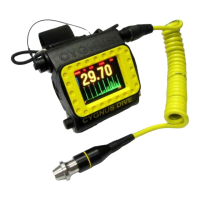

 To Next Page