Chapter 4 Configuring the Joint Parameters
48
4.3.1 Setting the Speed Reduction Rate in Manual Operation
The speed reduction rate in manual operation can be limited to 10% or below of that
in automatic operation.
This section provides the reduction rate calculation procedure using the maximum
composite tool-end speed and the target speed in manual operation.
NOTE: For details, refer to the ISO 10218-1:2006, Safety Requirements.
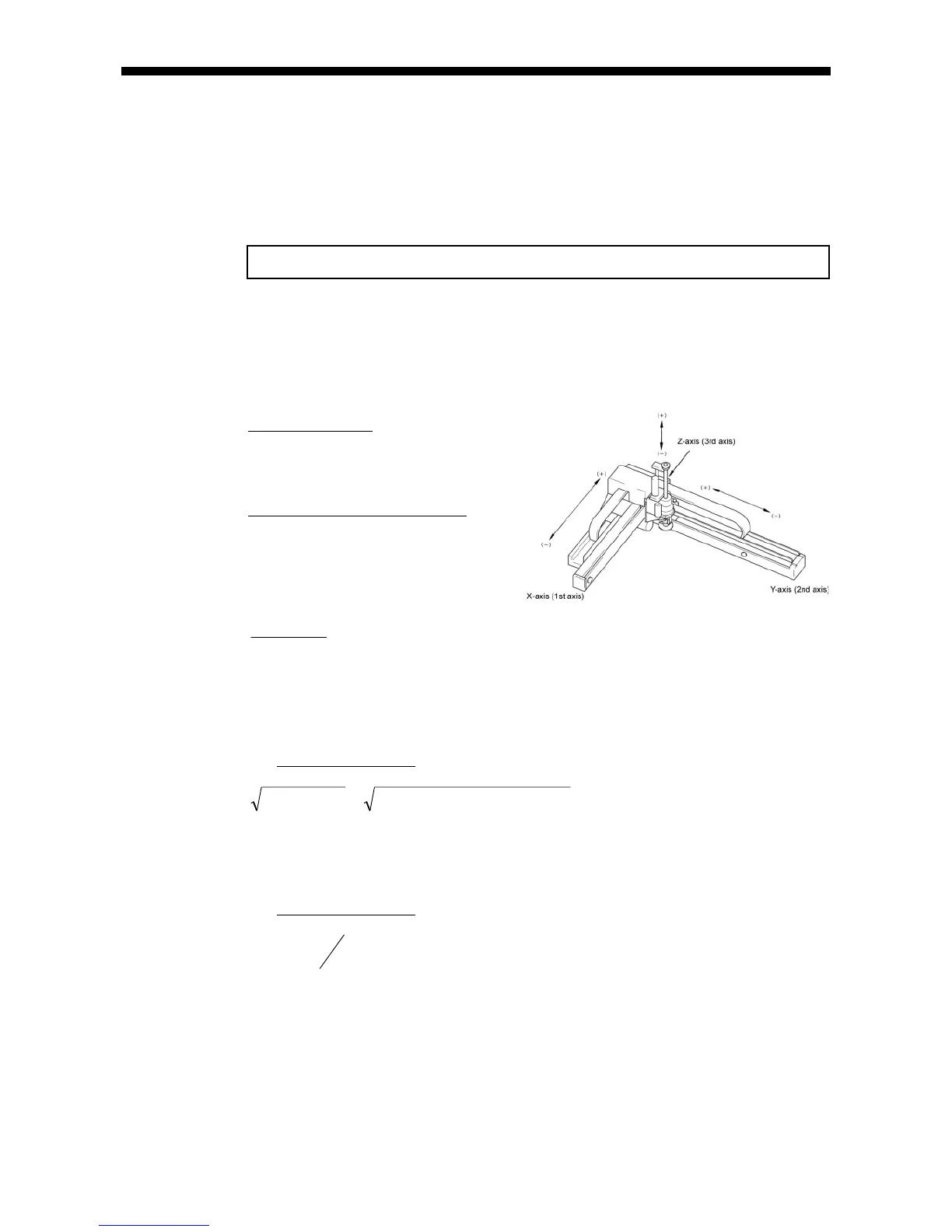
The example below uses a 3-joint mechanism configured with Cartesian coordinates
and limits the tool-end speed in manual operation to 250 mm/s or below.
(1) Check the specifications of the 3-joint mechanism and calculate the maximum
speed of each joint.
3-joint mechanism
X-joint: Max. speed 2000 mm/s
Y-joint: Max. speed 2000 mm/s
Z-joint: Max. speed 1000 mm/s
Calculating the maximum speed
Assuming:
Lead/rev.: 40 mm
Maximum motor rotation: 3000 rpm,
Then:
]/[2000
]/[40
60
][3000
smm
revmm
rpm
(2) Calculate the maximum composite tool-end speed.
Calculation example
]/[3000)1000()2000()2000(
222222
smmzyx
(3) Calculate the speed reduction rate in manual operation to limit the tool-end
speed to 250 mm/s or below.
Calculation example
8100
]/[3000
]/[250
smm
smm
(%) (Truncate the decimal places.)
(4) Enter the calculation result into the "Speed reducing rate in manual operation"
field in the ArmSet window shown on the previous page.


 To Next Page