EN-36 Originalbetriebsanleitung Allgemein
23.5 Cable brakes: adjusting the brake cable
tension
Warnings
Serious falls and accidents caused by reduced braking
power.
▪ Brake cables are wear parts. Check these for wear
and tear regularly, and replace the brake cables if
necessary.
The brake cable connects the brake lever to the brakes. It
is made of steel or aluminium, and is located in a brake
sleeve. If you have completely applied the hand brake
but do not have full braking force, all you need to do is to
tighten the brake cable, assuming there is little wear on the
brake pads. This reduces the distance between the brake
shoes and rim (rim brakes) or between the brake lining and
brake disc (disc brakes) and compensates for slight wear
on the brake pads. However, if the brake pads are severely
worn, these must be replaced 23.6 Replacing the brake
pads Page EN-36.
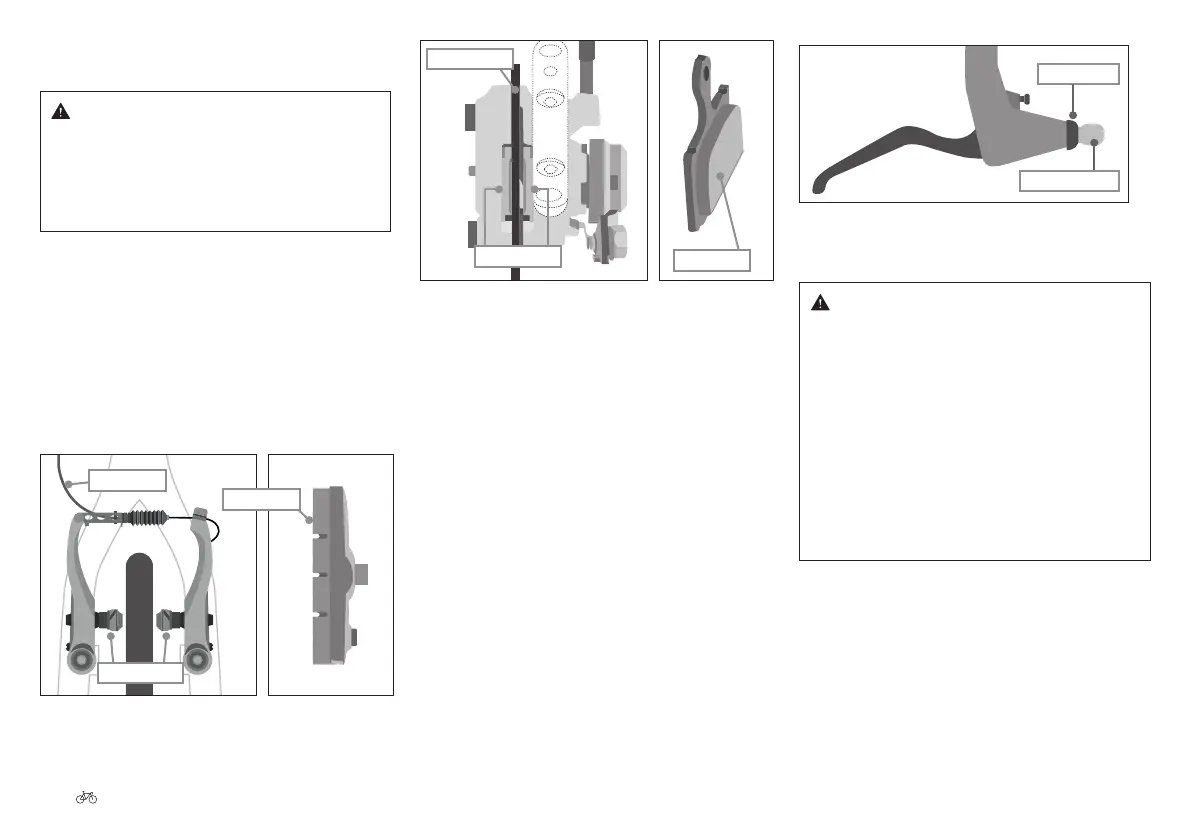
Fig. 51 Rim brakes Fig. 52 Brake shoe
Brake shoes
Brake cable
Brake lining
Fig. 53 Disc brakes Fig. 54 Brake lining
Brake pads
Brake disc
Brake lining
Most brake levers have screws to adjust the length and
tension of the brake cables. To adjust the tension, proceed
as follows:
1. Unscrew the lock nut a few turns counterclockwise.
2. Rim brake: To increase the tension, you must now
unscrew the adjustment screw counterclockwise step
by step until the distance between the brake shoes
and rim is 1-2 mm on each side. Make sure that the
brake shoes contact the two sides of the rim or brake
disc at the same time. To reduce the tension, turn the
adjustment screw clockwise.
2. Disc brake: To increase the tension, you must now
unscrew the adjustment screw counterclockwise step
by step until the desired pressure point is reached on
the brakes
23.4.3 Changing the pressure point Page EN-35.
To reduce the tension, turn the adjustment screw
clockwise.
3. Finally, retighten the lock nut clockwise.
If there is still no braking eect, the brake pads probably
need to be replaced
23.6 Replacing the brake pads Page EN-36.
Fig. 55 Brake cable tension adjustment screw
Adjustment screw
Lock nut
23.6 Replacing the brake pads
Warnings
Serious falls due to lack of bicycle control.
▪ The appropriate brake pads must be used in order to
obtain the right friction pairing.
Carbon: Particularly on carbon rims, only pads that
are expressly intended for this purpose may be used.
▪ Brake pads may not come into contact with oil
or grease. Otherwise, this will impair braking
performance.
Have the brake pads replaced if they have come into
contact with oil or grease.
▪ Do not ride your bicycle if the brake pads are worn
out. Have these replaced in a specialist workshop.
Brake pads are friction agents on brake shoes (rim brakes)
or carrier plates (disc brakes), and are therefore wear
parts. If they are worn out, they must be replaced, as the
braking force decreases as a result of wear. On rim brakes,
you can notice wear as the brake lever must be drawn
further and further towards the handlebars when braking
in order to achieve a braking eect. Brake pad wear on disc
brakes produces a metallic scratching sound, which only
appears when the brake lining is already completely worn



 To Next Page